

You are not losing control of quality because your team is not working hard enough. You are losing control because the structure underneath the work is broken. Bug leakage rises, release dates slip, and leadership starts pointing at QA, even though the testing team is executing exactly the process they were handed. Understanding why a QA process fails is not about assigning blame. It is about locating the structural gaps that produce bad outcomes regardless of individual effort.
TL;DR
- Most QA failures trace back to structural problems: where QA sits in the pipeline, how coverage is defined, and who owns functional testing standards.
- Measuring coverage by test count instead of risk exposure creates a false sense of safety while critical paths go untested.
- Manual regression run inside every sprint is the single fastest way to consume QA capacity without producing strategic value.
- When bug leakage, late defect discovery, and repeated post-launch fires cluster together, a process audit will find more than another tool will.
- Fixing one structural failure at a time is sustainable; rebuilding everything at once is not.
The Symptoms Are Obvious. The Cause Usually Is Not.
The conversation about QA failure almost always focuses on the wrong things. Teams add test cases. They buy another tool. They extend the testing window before the next release. None of those fixes touch what is actually breaking the process.
The symptoms are familiar: bugs discovered in production, regression cycles that stretch across the full sprint, QA flagged as the bottleneck in retrospectives, and a slow erosion of confidence in the release. Those outcomes share a common origin. They come from process architecture that was never designed to scale, governance that was never formalized, and a structural position for QA that guarantees it will always be reacting instead of preventing.
The fix starts with identifying which structural failure is costing you the most.
Four Structural Failures That Break QA Before a Single Test Runs
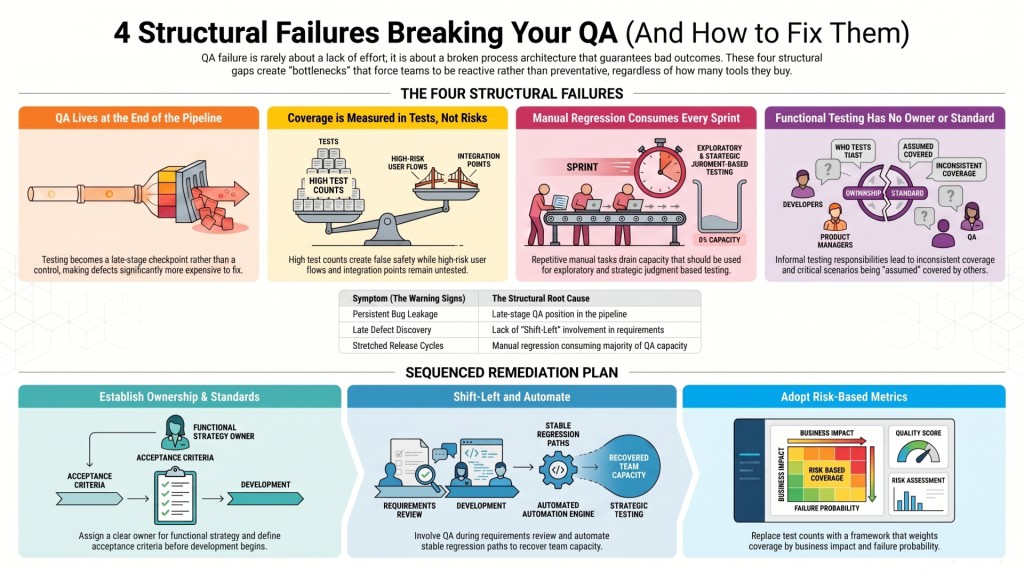
QA Lives at the End of the Pipeline, Not Inside It
When QA receives completed features as a handoff at the end of the sprint, testing becomes a checkpoint rather than a control. By the time a defect is found, it has already traveled through design, development, and code review. Research from the Consortium for Information and Software Quality consistently puts the cost of fixing a production bug at 100 times more than catching it at the requirements stage. That is not a rounding error. That is a structural tax on every release cycle that runs QA last.
Shift-left testing addresses this by embedding QA activity earlier in the development cycle: during requirements review, during design validation, and alongside development rather than after it. The structural change is not about doing more testing. It is about doing testing at the point where it actually changes outcomes.
Coverage Is Measured in Tests Written, Not Risks Addressed
A test suite with 2,000 cases sounds comprehensive until you examine what those cases actually cover. If coverage metrics are built around test count, teams naturally write tests that are easy to write. Happy-path scenarios get thorough coverage while edge cases, integration points, and high-risk user flows go shallow or untested.
Risk-based coverage flips the measurement. It starts with the question: what failure would cost us the most? High-severity, high-probability failure paths get the deepest coverage. Lower-risk areas get proportional attention. The result is a smaller suite that catches more of what matters, with less wasted effort on scenarios that rarely produce meaningful defects.
Manual Regression Is Consuming Every Sprint
Manual regression is not inherently broken. It is broken when it is the primary mechanism for verifying that existing functionality still works after every change. At that scale, regression consumes the capacity that should be going toward exploratory testing, new feature validation, and the judgment-based testing that automation cannot replicate.
Consider a team running two-week sprints with four QA engineers. If three of those four engineers spend the majority of each sprint on manual regression, the team functionally has one person doing strategic testing. That ratio explains a significant portion of bug leakage. Not because the regression was done badly, but because everything else was underfunded.
Test automation applied to a stable, well-understood regression suite frees that capacity. It is not a replacement for manual testing. It is a reassignment of manual effort toward the work where human judgment adds the most value.
Functional Testing Has No Owner and No Standard
Functional testing is the most frequently under-governed area in QA. It gets distributed informally: developers test their own features, QA runs a pass before release, and product managers do ad-hoc validation when time allows. No single person owns the functional test strategy, no standard defines what done looks like, and coverage varies entirely based on who had time that week.
When functional testing has no owner, it has no consistency. The same feature may receive thorough coverage in one sprint and minimal coverage in the next, depending on workload. Critical integration points between features fall through the gap between what development considers tested and what QA considers tested. This is where a significant share of production bugs originate. Not from complex edge cases, but from functional scenarios that everyone assumed someone else covered.
Functional testing as a formal discipline requires a defined scope, an accountable owner, documented acceptance criteria tied to test cases, and a review process that verifies coverage before a release is approved.
What a Broken QA Process Costs Beyond the Bug Count
The direct cost of a production bug is visible: support tickets, hotfix development, engineer time pulled from the roadmap. The indirect costs accumulate more quietly and do more long-term damage.
Development velocity degrades when engineers are pulled into production firefighting. Each unplanned incident interrupts focused work and adds cognitive overhead that does not show up in velocity metrics but shows up in output quality. Sprint planning becomes unreliable when teams cannot trust that previous releases are stable, because untested assumptions carry forward into every new cycle.
There is also a talent retention dimension. Senior engineers do not want to work in environments where every release is a controlled emergency. QA engineers who know their work is not taken seriously, or who spend every sprint on manual regression that should be automated, do not stay. The process failure becomes a hiring and retention liability that compounds over time.
The Dportenis engagement shows what unstructured QA costs in practice: a legacy system replacement with no formal testing methodology, bug tracking over WhatsApp and spreadsheets, and active payment processing risk. Outpost QA identified 450 bugs before launch and prevented payment system failures that would have disrupted retail operations from day one.
Three Signs the Fix Requires a Process Audit, Not Another Tool
Teams often respond to QA failures by evaluating new tools: a better test management platform, a different automation framework, a new reporting dashboard. Tools matter, but they do not fix structural problems. They make structural problems more visible while leaving them intact.
A process audit is the right intervention when three conditions exist:
- Persistent bug leakage: Critical or high-severity defects are reaching production consistently across multiple release cycles, not as isolated incidents.
- Late defect discovery: The majority of significant defects are found after development is complete, which means the testing strategy is not catching failures early enough to change their cost.
- Repeated post-launch fires: The same categories of failure appear in production repeatedly, which indicates the regression strategy has coverage gaps that survive every release.
When those three conditions cluster together, the problem is the architecture of the process, not the execution within it. An audit identifies which structural failure is driving the outcomes and produces a prioritized remediation plan that addresses root causes rather than symptoms.
How to Stop the Bleeding Without Rebuilding Everything at Once
A full QA process overhaul is not always possible, and it is rarely the fastest path to improvement. The more practical approach is sequenced remediation: identify the structural failure with the highest current impact, fix that first, and stabilize before moving to the next layer.
For most teams in this situation, the sequence looks like this:
- Establish functional testing ownership. Assign a clear owner for functional test strategy. Define acceptance criteria standards and tie them to test case requirements before development begins.
- Automate the most stable regression paths. Identify the core regression scenarios that run every sprint without modification. Automate those first to recover QA capacity, then expand automation coverage incrementally.
- Move QA involvement earlier. Introduce QA review at the requirements stage for new features, even informally. Catching ambiguous requirements before development starts costs almost nothing and prevents a category of defect that is otherwise guaranteed.
- Establish a coverage standard based on risk. Replace test count as the primary coverage metric with a risk-based framework that weights coverage by business impact and failure probability.
None of these steps requires a new tool. They require deliberate process decisions and someone with the authority to enforce them consistently across sprints.
If your team is past the point where internal remediation is realistic, an external QA process audit gives leadership a clear picture of where the process is broken, what it is costing, and what to fix in what order. Outpost QA’s Enterprise Governance and QA Process Audits service is built for this situation: teams that have QA in place but know it is not working, and need a structured path to fix it without disrupting the releases they have in flight.
If bug leakage, stretched release cycles, and repeated production incidents describe your current situation, speak with a QA Architect at Outpost QA about a process audit. You will get a clear picture of the structural gaps and a prioritized plan for addressing them.
Frequently Asked Questions
What is the most common reason a QA process fails?
The most common root cause is structural position: QA operates as a final checkpoint at the end of development rather than as an integrated part of the sprint cycle. This guarantees that defects are found late, when they are expensive to fix and timeline pressure is highest. Coverage gaps, undefined ownership of functional testing, and manual regression consuming too much QA capacity are the next most frequent contributors.
How do you know if the problem is the process or the team?
If the same categories of defect appear in production across multiple releases and multiple team compositions, the problem is the process. Team-level execution failures tend to be inconsistent and often self-correct. Structural failures produce consistent, repeatable outcomes regardless of who is doing the work.
Does test automation fix a broken QA process?
Automation fixes one specific problem: it removes stable, repetitive regression work from manual QA capacity. It does not fix coverage gaps, late QA involvement, unclear ownership of functional testing, or poor risk prioritization. Applying automation to a broken process produces faster execution of the wrong strategy.
What does a QA process audit actually produce?
A structured audit produces a documented assessment of the current state: where coverage is shallow, where ownership is undefined, where the testing strategy diverges from actual risk, and where tooling or process governance is creating bottlenecks. The output is a prioritized remediation roadmap that sequences fixes by impact and implementation effort.
How long does it take to see improvement after fixing a QA process?
The first measurable improvement typically appears within two to three sprint cycles after the highest-impact structural fix is implemented. Establishing functional testing ownership and automating core regression paths are the fastest levers; teams that address those two areas first consistently see defect leakage rates drop before any other change takes full effect.