
HBR Is Talking to HR Leaders. This Argument Belongs in Engineering.
Harvard Business Review published a piece in July 2026 arguing that performance management needs new metrics in the AI era, because traditional productivity scores and goal completion rates cannot measure work that is co-produced with an AI system. HBR framed this as an HR and management problem. It is not. It is an engineering problem, and it is already costing companies production bugs that should have been caught in QA.
TL;DR
- Traditional QA metrics like ticket throughput and sprint velocity create false confidence when AI-assisted testing tools are in the pipeline
- AI tools can generate test cases at scale while silently leaving coverage gaps that ship undetected to production
- Five concrete metrics replace the old scoreboard: defect escape rate, AI-to-manual coverage ratio, override rate, false negative rate, and MTTD vs. MTTR
- Accountability does not distribute itself across a pipeline; a dedicated QA function with its own measurement model is the structural fix
- Per the 2024 World Quality Report by Capgemini, 44% of organizations cite lack of QA metrics visibility as a primary obstacle to release confidence
The HBR article identifies a specific failure mode: when employees use AI tools, their managers keep measuring output volume while the actual value added shifts to judgment quality, specifically the ability to catch what the AI got wrong. That exact failure mode is running live inside engineering orgs right now.
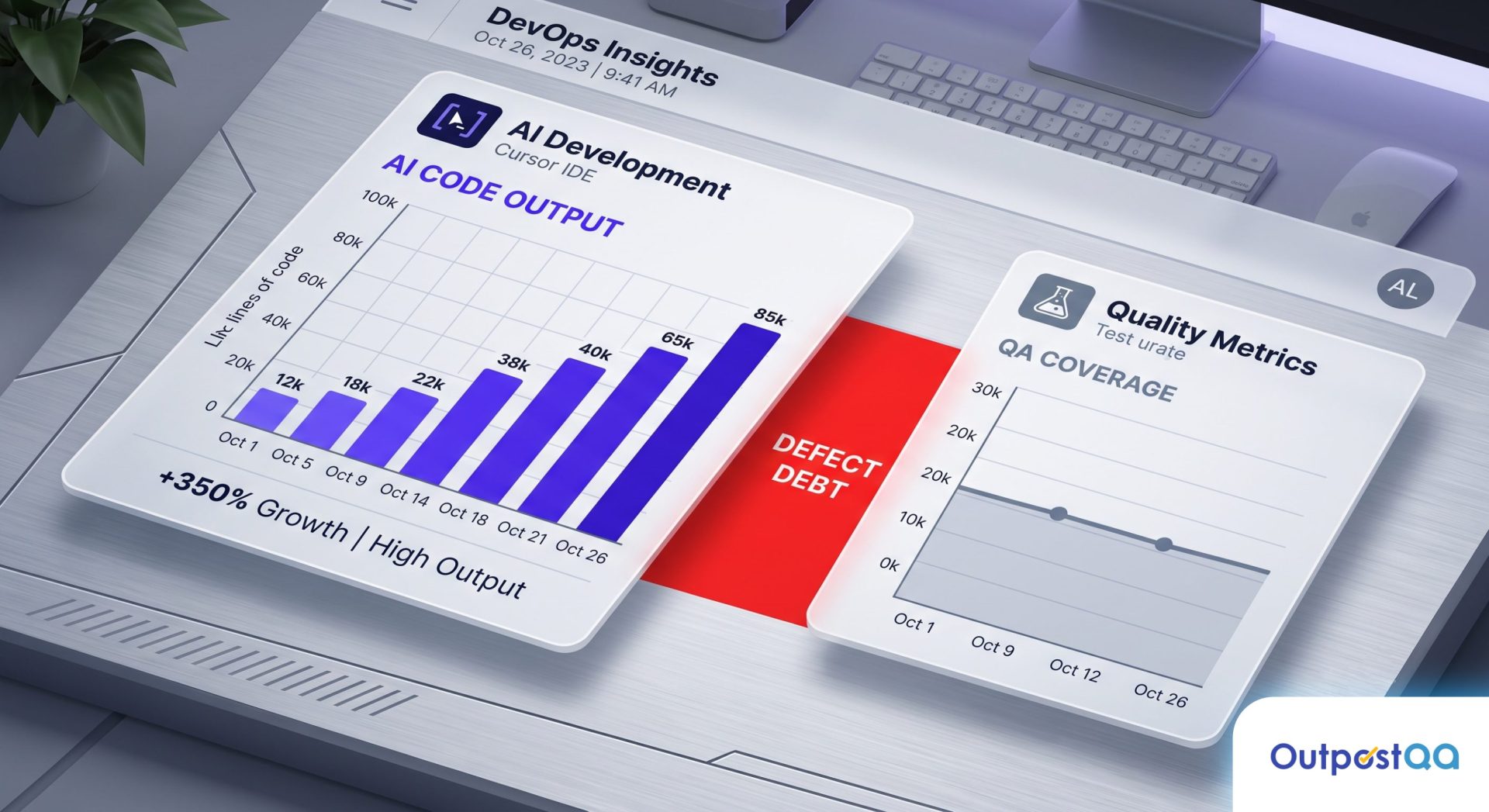
AI-assisted testing tools generate test cases, suggest coverage paths, and flag anomalies. They look productive. Sprint dashboards show green. Ticket throughput climbs. And somewhere in the pipeline, a coverage gap that the AI confidently skipped ships to production as a defect your customer finds first.
What Happens When Ticket Throughput Becomes the Wrong Scoreboard
When QA teams are measured on how many tickets they close per sprint, they close tickets. They do not necessarily validate that the tickets represent meaningful coverage of the actual risk surface, particularly when an AI tool has already pre-generated the test cases for them.
This is the same mismeasurement problem HBR describes, translated into engineering terms. The scoreboard rewards activity, not judgment. In an AI-augmented pipeline, judgment is the only thing that catches what automation confidently missed. The DORA State of DevOps Report finds that elite engineering teams are distinguished not by test volume but by their change failure rate, a signal of how often code that passed QA still broke in production. Most teams measuring ticket throughput are not tracking that number at all.
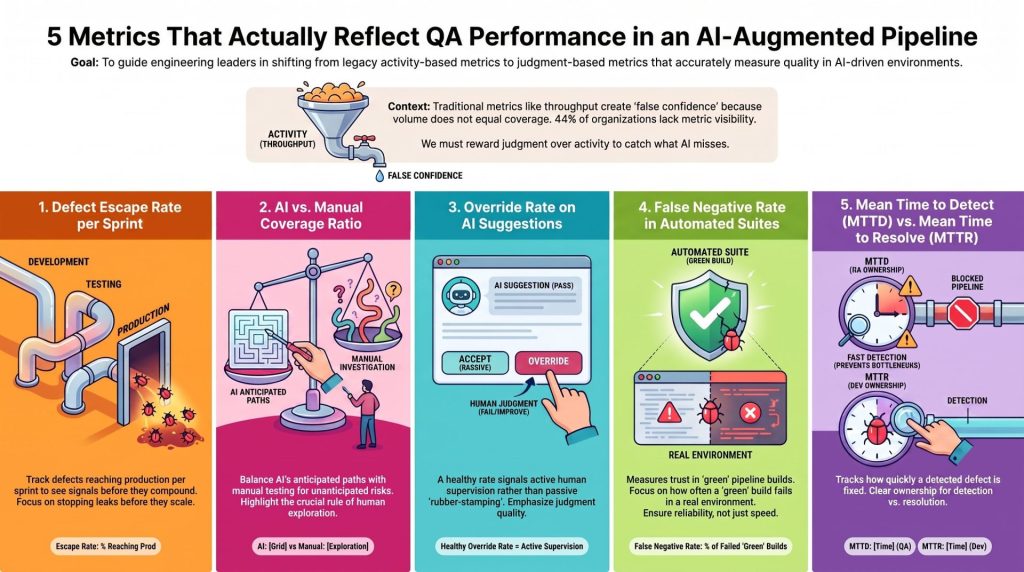
Five Metrics That Actually Reflect QA Performance in an AI-Augmented Pipeline
Defect Escape Rate per Sprint
How many defects reached production that QA had the opportunity to catch? This is the most direct measure of whether your QA process is working. Track it per sprint, not per quarter, so you can see the signal before it compounds.
AI-Assisted vs. Manual Exploratory Coverage Ratio
AI tools cover the paths they were trained to anticipate. Manual exploratory testing covers the paths no one anticipated yet. If your ratio skews heavily toward AI-assisted coverage, you have a blindspot problem, not a coverage problem.
Override Rate on AI-Generated Test Suggestions
When a QA engineer reviews an AI-generated test case and modifies or rejects it, that is a signal of judgment quality. A team with a healthy override rate is actively supervising its tooling. A team with a near-zero override rate is not reviewing, it is rubber-stamping.
False Negative Rate in Automated Suites
How often does the automated suite pass a build that subsequently fails in a real environment? This metric directly measures how much trust you can place in a green pipeline result. Without it, you are flying on instrument readings you have never calibrated.
Mean Time to Detect vs. Mean Time to Resolve
MTTD measures how quickly a defect is found after it is introduced. MTTR measures how quickly it is fixed. Both matter, but MTTD is the QA metric. If detection is slow, everything downstream is slower. Most teams track MTTR because it is visible in Jira. MTTD requires deliberate instrumentation.
Accountability Does Not Distribute Itself Across a Pipeline
The HBR article warns that “human in the loop” language can diffuse accountability rather than anchor it. The same risk applies to QA in an AI-augmented pipeline. When everyone is nominally responsible for quality, no one is measurably accountable for it.
A dedicated QA function with its own measurement model is the structural answer. Not developers doing QA as a side task, not an AI tool running unreviewed. A team whose sole accountability is catching what everything else missed, measured on metrics that actually reflect whether they did. Outpost QA’s QA Process Audits & Enterprise Governance practice is built for engineering leaders who suspect their current measurement model is giving them false confidence.
If your QA metrics have not changed since you introduced AI-assisted testing tools, they are almost certainly measuring the wrong things. Talk to a QA Architect at Outpost QA to pressure-test your current measurement model before the next release cycle does it for you.
Frequently Asked Questions
Why are traditional QA metrics like ticket throughput inadequate in an AI-augmented pipeline?
Ticket throughput measures activity, not judgment. When AI tools generate test cases automatically, closing tickets at high volume no longer signals that meaningful coverage decisions were made. The risk surface shifts to what the AI did not anticipate, and throughput metrics cannot see that gap.
What is a healthy override rate for AI-generated test suggestions?
There is no universal benchmark, but a near-zero override rate is a warning sign. It suggests QA engineers are accepting AI output without review rather than actively supervising it. Teams should track this rate over time and treat sudden drops as a process flag worth investigating.
How do MTTD and MTTR differ in practical terms for a QA team?
Mean Time to Detect (MTTD) measures how long after a defect is introduced it takes for QA to find it. Mean Time to Resolve (MTTR) measures how long after detection it takes to fix the defect. QA owns MTTD. Development owns MTTR. Conflating the two obscures where the bottleneck actually lives.
Can these five metrics be tracked without specialized tooling?
Most can be tracked with data already in your existing pipeline. Defect escape rate and MTTD require correlating defect timestamps with sprint close dates, which most issue trackers support. The AI-to-manual coverage ratio and override rate require your team to log AI interactions consistently, which is a process discipline question, not a tooling question.
Does this apply to teams that use AI-assisted testing tools but still have dedicated QA engineers?
Yes, and especially to those teams. Dedicated QA engineers using AI tooling without updated measurement frameworks are the precise scenario where false confidence builds fastest. The tooling looks productive. The engineers are working. The metrics look green. The coverage gaps are invisible until they are not.