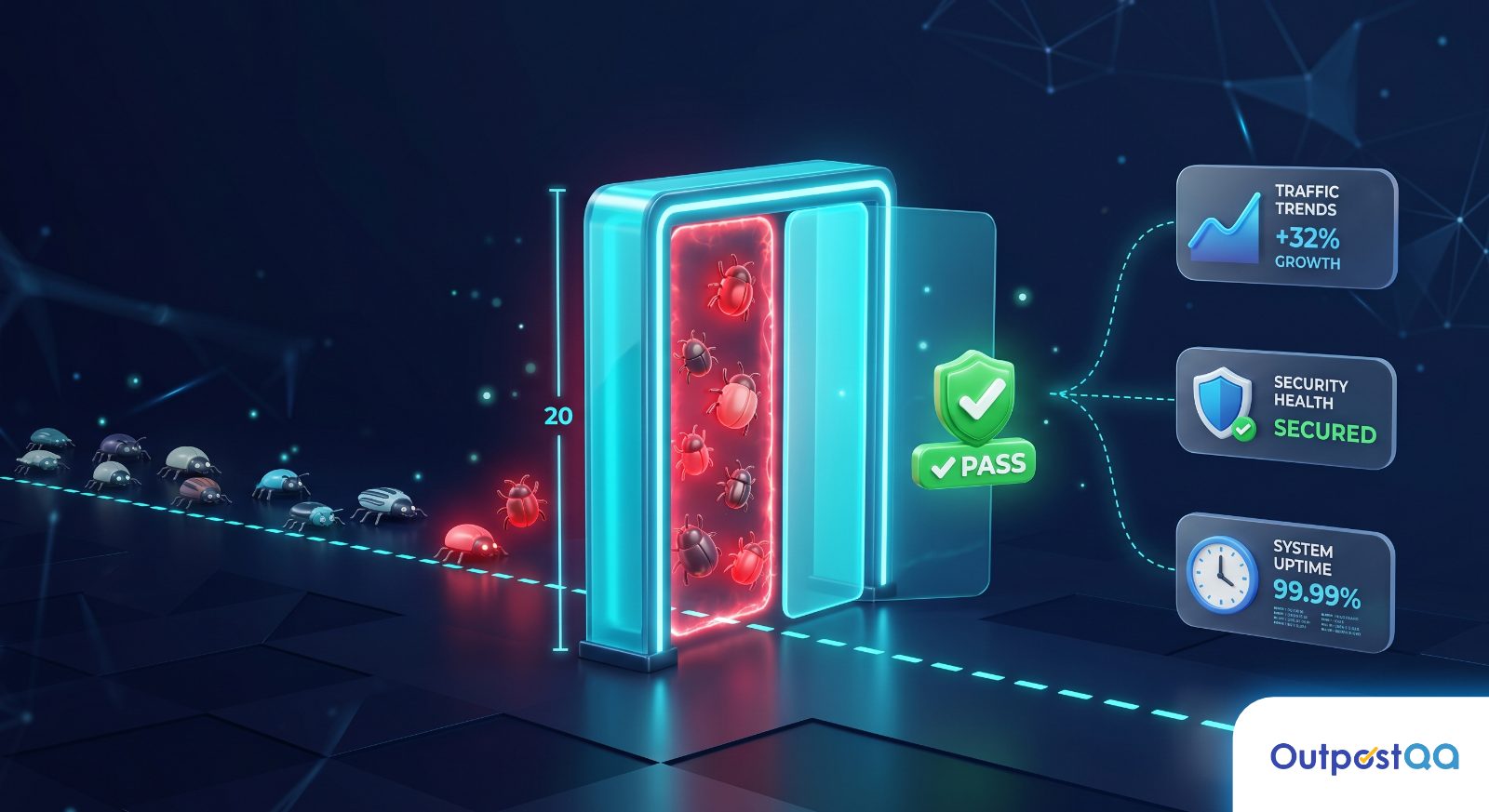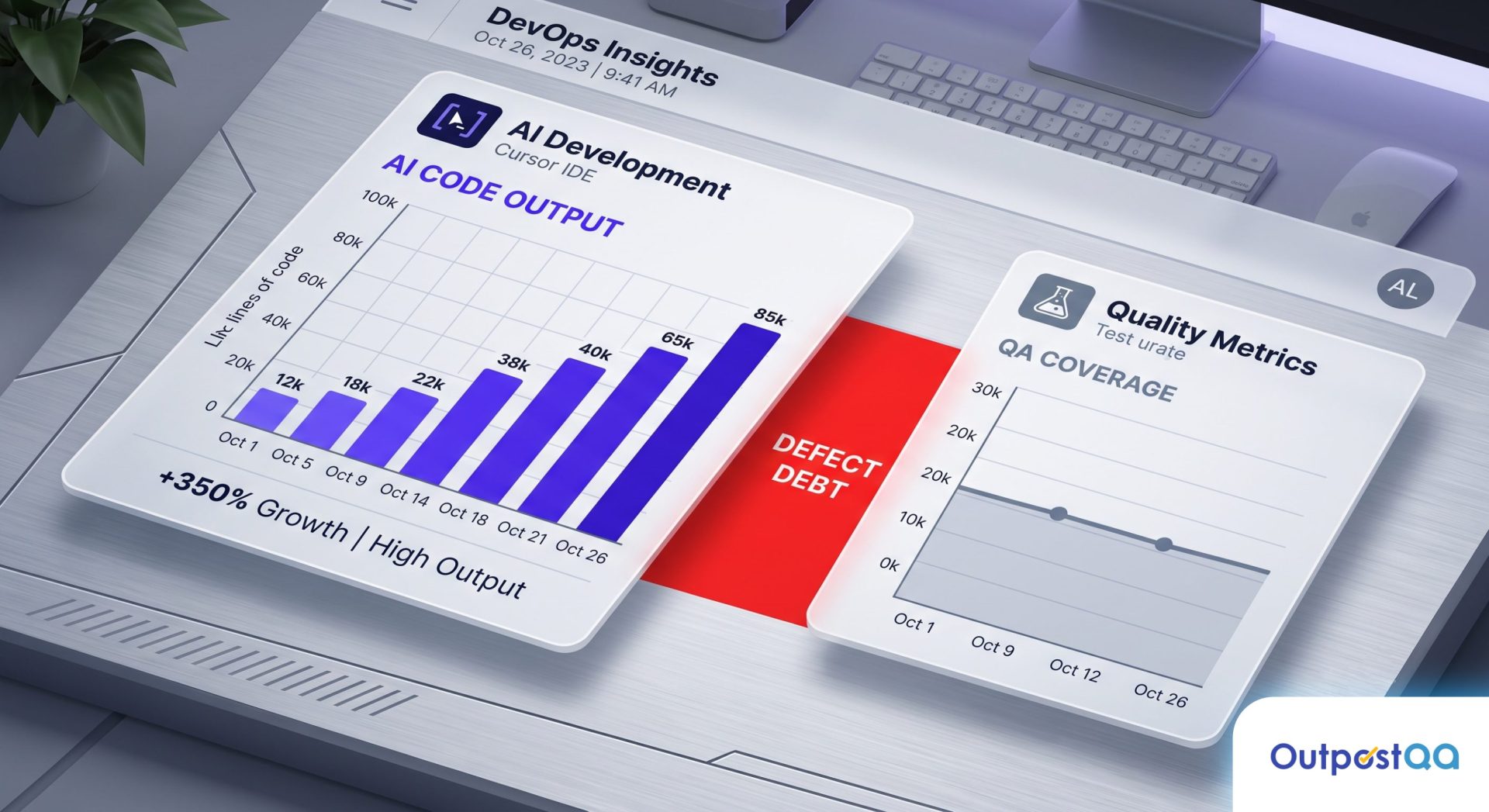
AI coding assistants are shipping more code per engineer than most QA organizations were built to absorb. If your team is using GitHub Copilot, Cursor, or similar tools and your QA coverage has not changed since last year, you already have a gap. The question is whether it surfaces in staging or in production.
TL;DR
- AI coding tools increase code output per engineer without automatically increasing QA coverage, creating a compounding defect risk.
- Developer-led QA becomes unsustainable when code volume accelerates; the bias problem is worse, not better, with AI-assisted code.
- Coverage gaps appear first in edge cases, security logic, and regression paths that AI code generators do not test.
- The staffing mistake most engineering leaders make is treating QA headcount as a lagging response to quality incidents rather than a proportional investment in throughput.
- A dedicated nearshore QA pod absorbs the coverage burden AI tools create without pulling developers off feature work or adding full-time headcount overhead.
AI Tools Raise the Ceiling on Code Output. QA Coverage Does Not Scale Automatically.
This is not a debate about whether AI will replace testers. That belongs in career advice columns. For an engineering leader responsible for what ships to production, the problem is structural: your developers can now generate code significantly faster than before, and your QA capacity is still sized for the throughput you had twelve months ago.
Per the 2024 Stack Overflow Developer Survey, more than 76% of developers were using or planned to use AI coding tools. That adoption did not come with a corresponding increase in test coverage. Code volume scales on demand; QA organizations do not.
The gap that creates is not theoretical. Every sprint where AI-accelerated development outruns QA coverage is a sprint where defect risk accumulates silently. That debt does not disappear. It compounds until a production incident forces you to recognize it.
What Happens When Developer-Led QA Meets AI-Accelerated Throughput
Developers Testing Their Own AI-Assisted Code: A Compounding Risk
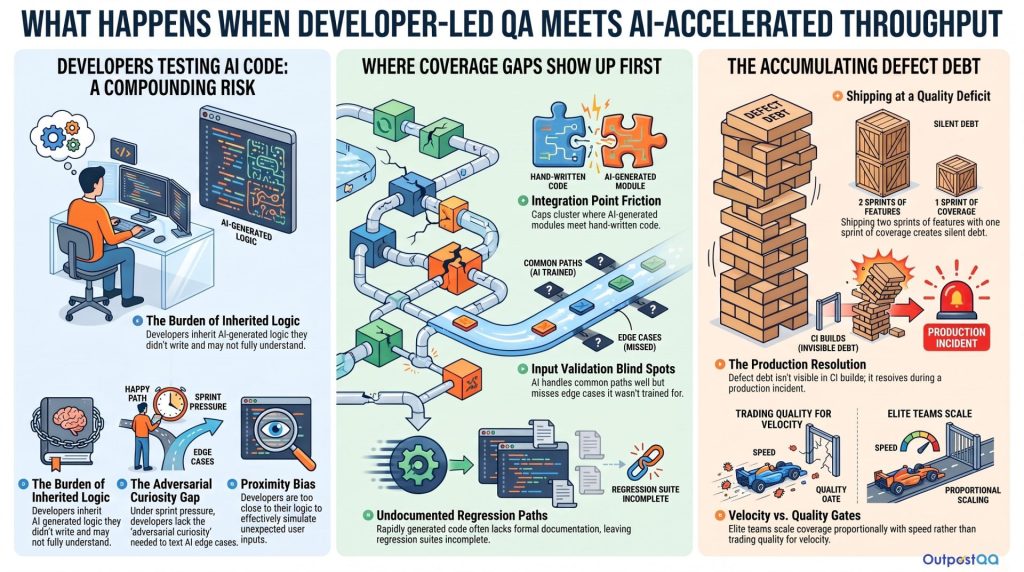
Having developers test their own code was already a problem before AI tools entered the picture. Developers are too close to their own logic to test it adversarially. They know what the code is supposed to do, so they test exactly that, and miss what it does at edge cases or under unexpected inputs.
AI-assisted code introduces a second layer of the same problem. When a developer accepts a Copilot suggestion, they inherit logic they did not write and may not fully understand. Testing that code requires genuine adversarial curiosity, not a quick sanity check before a pull request is merged. Most developers, under sprint pressure, are not doing that.
Where Coverage Gaps Show Up First in AI-Era Pipelines
Coverage gaps in AI-accelerated pipelines tend to cluster in three areas: integration points between AI-generated modules and hand-written code, input validation for edge cases the AI model did not anticipate, and regression paths that were never formally documented because the code was generated quickly and never had a test written against it.
None of these are visible in a passing CI build. They appear after deployment, usually when a real user hits a combination of inputs that no developer thought to simulate.
The Defect Debt That Accumulates Before Anyone Notices
Defect debt in an AI-era pipeline accumulates faster than in a traditional sprint cycle. The throughput advantage that makes AI tools attractive — more features per sprint — is the same mechanism that compounds untested risk. A team shipping two sprints’ worth of features with one sprint’s worth of QA coverage is not ahead. It is running a deficit that will resolve itself at the worst possible time.
According to the DORA State of DevOps Report, elite-performing engineering teams deploy more frequently and recover from incidents faster, but they achieve that through investment in testing and observability, not by trading quality gates for velocity. Speed and coverage are concurrent investments in high-performing organizations, not a trade-off.
Three Places AI-Generated Code Breaks Conventional QA Assumptions
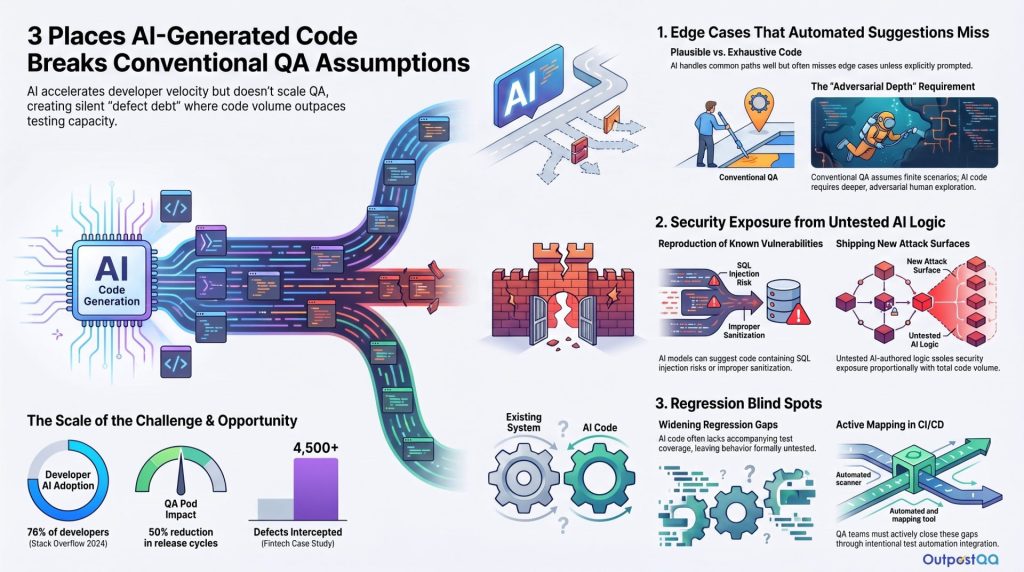
Edge Cases That Automated Suggestions Miss
AI code generators produce plausible code, not exhaustive code. The suggestion a developer accepts handles the common path well. It handles the edge case only if that edge case was represented in the training data and the developer explicitly prompted for it, which most do not.
Conventional QA treats edge cases as a finite set of scenarios a human tester can reason through. AI-generated code expands the edge case surface without expanding visibility into it. A QA engineer reviewing the output of an AI-assisted sprint needs to approach it with more adversarial depth, not less.
Security Exposure from Untested AI-Written Logic
AI-generated code carries a specific Security and DevSecOps risk that most engineering teams have not fully accounted for. Code suggestions drawn from large training corpora can reproduce patterns that contain known vulnerabilities. SQL injection risks, improper input sanitization, insecure defaults, and supply chain exposure from suggested dependencies are all documented concerns with AI-generated code.
If your QA process does not include security validation of AI-authored logic, you are shipping attack surface you have not reviewed. That risk scales directly with code volume. More AI-generated code means more untested security exposure.
Regression Blind Spots in Partially AI-Authored Codebases
Regression testing depends on understanding what changed and what might break as a result. In a codebase where portions were generated by AI without accompanying test coverage, regression suites have gaps by definition. You cannot regress against behavior you never formally tested.
As AI-assisted development becomes a larger share of total code output, those blind spots widen. A QA team not actively mapping and closing them with test automation and CI/CD integration is maintaining a regression suite that covers less of the actual codebase with every sprint.
The Staffing Decision Engineering Leaders Are Getting Wrong Right Now
The most common mistake when AI tools accelerate a team’s output is treating QA as a lagging response function. Quality incidents happen, then QA investment increases. The logic feels reasonable until you map it against AI-era throughput: if incidents are your signal, and AI tools have tripled your code velocity, you will be reacting to a much larger incident before the signal is strong enough to act on.
QA capacity should be proportional to code output, not to incident history. If your developers are shipping materially more code per sprint than they were eighteen months ago, your QA coverage should have scaled proportionally in the same window. For most engineering organizations, it has not.
Hiring full-time QA engineers is one option. It is slow (typical time-to-hire for senior QA talent runs three to four months), expensive when you factor in full employment overhead, and creates an HR liability that fluctuates with the business. Pulling developers off feature work to cover QA gaps is the other common response. The cost there is immediate: developer velocity drops, morale follows, and the QA coverage you get is compromised by the same proximity bias described above.
A Dedicated QA Pod Absorbs the Coverage Burden AI Tools Create
A nearshore QA pod structured around your sprint cycle solves the capacity problem without the overhead of either alternative. The pod integrates directly into your development workflow, scales with code volume rather than incident frequency, and covers the exact areas where AI-generated code creates the most risk: edge case exploration, security validation, regression coverage, and CI/CD pipeline integration.
Outpost QA’s pods are built for this model. They operate in the same timezone as US-based engineering teams, communicate without friction, and come without the recruiting cycle, employment liability, or onboarding drag of full-time hires. When a Fortune 500 fintech client needed QA coverage across 20-plus concurrent projects shipping on a weekly release cadence, a dedicated Outpost QA pod reduced release cycles by 50% and intercepted more than 4,500 defects before they reached production.
The coverage gap AI tools create is real and it is growing. The fastest way to close it is a dedicated team that exists specifically to absorb that burden — not developers pulled sideways, and not a hiring process that takes a quarter to complete.
If you want to understand where your current QA coverage actually stands relative to your team’s AI-accelerated output, speak with a QA Architect at Outpost QA to map your code volume against your actual coverage and find the gap before production does.
Frequently Asked Questions
Does using AI coding tools mean we need more QA engineers or just better automation?
Usually both, in sequence. Automation handles regression coverage at speed, but it requires human QA engineers to design the suite, maintain it as the codebase evolves, and perform the adversarial exploratory testing that automation does not cover. AI-generated code increases the surface area that both functions need to address.
How quickly can a QA coverage gap become a production problem?
It depends on release frequency. Teams shipping weekly with AI-accelerated development and no proportional QA investment can accumulate meaningful defect debt within two to three sprint cycles. The gap is not always visible in CI metrics until a user-facing incident reveals it.
Is nearshore QA a realistic option for teams already using AI development tools?
Yes, and the timezone alignment is a specific advantage. A nearshore QA pod in the same working hours as the development team can review AI-generated pull requests, run exploratory sessions, and flag coverage gaps in the same sprint cycle where the code was written, rather than after a lag.
What types of testing matter most for AI-generated code specifically?
Edge case and boundary testing, security validation for common vulnerability patterns in AI-suggested code, and regression coverage for integration points between AI-generated and hand-written modules are the highest-priority areas. These are also the areas most likely to be under-covered in developer-led QA arrangements.
Can we use AI tools to test AI-generated code and close the loop that way?
Partially. AI-assisted test generation can accelerate test authoring, but it reproduces the same blind spots as the code it evaluates if it draws from similar training patterns. Human QA judgment remains necessary for adversarial testing, security review, and regression path mapping in codebases with significant AI-authored content.