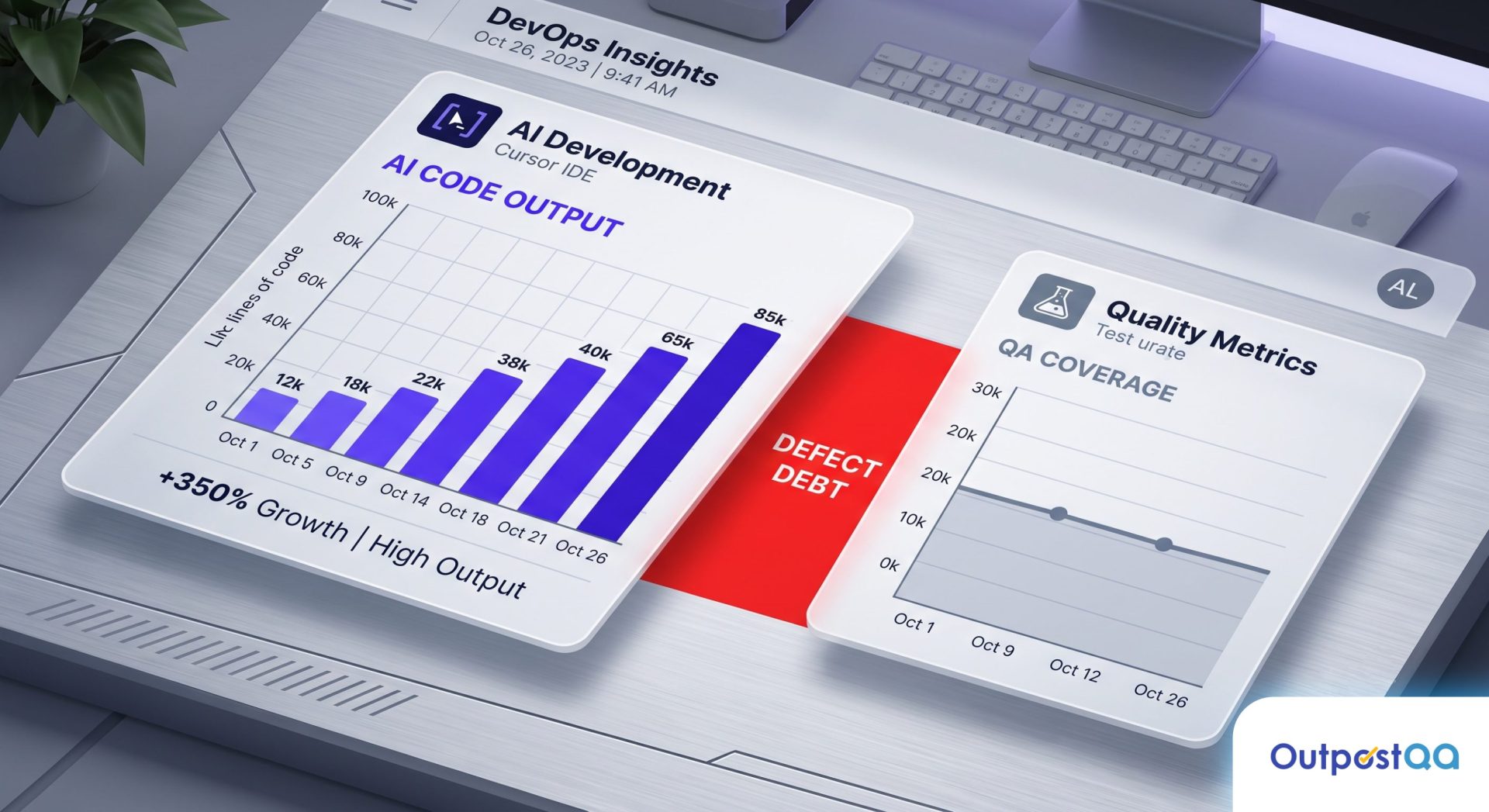

Most engineering leaders who get burned by a QA outsourcing partner did not choose the wrong vendor on paper. They chose the wrong evaluation criteria entirely. The tool stack looked right, the hourly rate was competitive, and three months later the engagement was in collapse because no one verified timezone overlap, team continuity, or how the vendor would actually plug into the CI/CD pipeline. Here is a guide on how to evaluate a QA Outsourcing partner the right way.
TL;DR
- Most QA vendor evaluations fail because they focus on certifications and hourly rates rather than operational fit criteria.
- The five criteria that predict success are: timezone overlap, team continuity, pipeline integration depth, communication fidelity, and buyer-side readiness.
- A structured pilot with defined pass/fail criteria is more predictive than any sales conversation or proposal review.
- Dedicated pod models outperform shared resource pools because product context accumulates over time rather than resetting on every ticket.
- Certifications and tool stacks are entry requirements, not differentiators. Do not let them drive the shortlist.
Most QA Vendor Evaluations Start With the Wrong Questions
The default RFP for QA outsourcing asks some version of the same five things: What tools do you use? What are your hourly rates? What certifications does your team hold? Can you show us sample test plans? Do you have experience in our industry?
These are not bad questions. They are just the wrong starting questions, because they measure inputs rather than outcomes. A vendor can answer all five perfectly and still deliver an engagement that stalls within 90 days.
The failure modes that actually end outsourcing engagements are almost never about tool choice. Per the 2024 World Quality Report by Capgemini, communication and collaboration challenges remain among the top barriers to QA effectiveness in outsourced models, outranking technical skill gaps as a root cause of poor outcomes. The problem is operational and structural, not technical.
Here is what that looks like in practice. A team selects a vendor with a strong automation portfolio. The vendor is headquartered in Eastern Europe and works a shifted schedule to cover US hours. Standups happen at 7 AM local time for the QA team, which means responses to build failures after 2 PM Eastern go unanswered until the following morning. Sprint reviews become asynchronous summaries. The QA team cycles through three different engineers over six months because the account falls below the vendor’s priority threshold. By month four, the engineering team is doing triage themselves again.
None of those problems appeared in the proposal. All of them were predictable with better evaluation criteria.
The Five Criteria That Actually Predict Whether an Engagement Succeeds
Timezone Overlap: Verify It, Do Not Accept It at Face Value
Every offshore QA vendor claims US business hours coverage. Ask specifically what that means. “Coverage” can mean a team working a night shift in Bangalore, a project manager who relays messages during overlap hours, or a genuine shared workday with no communication lag.
The test is simple: during the sales process, request a live technical standup at 2 PM Eastern on a Tuesday. Ask how they would handle a critical regression failure discovered at 3:30 PM on a Thursday before a Friday release. If the answer involves “we will escalate to our US coordinator” or anything that introduces a relay layer, that is your answer.
Nearshore teams working from Mexico and Latin America operate in Central or Pacific time, which means genuine same-day collaboration, real-time Slack responsiveness, and sprint ceremonies that fit inside a normal US workday without forcing anyone onto an uncomfortable schedule. That is not a minor convenience. It compounds across every sprint cycle for the life of the engagement.
Team Continuity and Attrition: The Metric No Vendor Advertises
No vendor will list their annual staff attrition rate in a proposal. You have to ask directly: “What is the typical tenure of engineers on a client engagement? How often does team composition change on a six-month contract?”
High-turnover vendor organizations create a specific and damaging failure pattern: every time an engineer cycles off an account, the product context they accumulated walks out with them. The replacement engineer starts from a documentation baseline, not from lived experience with the codebase, the edge cases, or the team’s testing conventions. Coverage degrades, defect rates spike briefly, and the client team ends up re-onboarding a new QA engineer every few months without realizing that is what is happening.
The engagement model that prevents this is a dedicated QA pod: a structured team assigned to a single client’s product, not shared across a vendor’s account roster. When the same engineers run regression on every sprint, they build product intuition that no test plan can fully document. That institutional knowledge is one of the highest-value assets an outsourced QA engagement can generate, and shared resource pools destroy it by design.
Pipeline Integration Depth: QA Inside the Sprint, Not After It
Ask any vendor how they integrate with your CI/CD pipeline. The answer separates operationally mature partners from staffing vendors with a testing specialty.
A surface-level answer describes testing deliverables: “we run regression before each release and provide a test report.” A meaningful answer describes integration architecture: “we configure automated test suites to trigger on pull requests in GitHub Actions, we own the test maintenance backlog as a first-class item in the sprint, and our engineers are in your Jira instance updating test cases as acceptance criteria change.”
The DORA State of DevOps Report consistently identifies test automation integration as one of the strongest predictors of elite software delivery performance. Teams where QA is embedded inside the sprint rather than queued after it deploy more frequently and recover from failures faster. An outsourced QA partner who cannot describe where they sit inside the pipeline will become a bottleneck at release time, exactly as the vendor they are replacing did.
Nearshore Communication Fidelity: No Translation Layer, No Overhead
This criterion is distinct from timezone overlap. A vendor can share your timezone and still introduce communication friction through language barriers, cultural translation overhead, or a project management layer that acts as an intermediary between your engineers and the QA team.
Communication fidelity means your developers can open a Slack thread with a QA engineer, describe a bug in colloquial technical English, and get a precise, contextually accurate response without any intermediary. It means bug reports are written in the same register your team uses internally. It means a QA engineer can sit in a sprint retrospective and contribute observations about testing friction without needing a translator or a project manager to interpret.
This is not a soft criterion. Communication overhead compounds across every daily standup, every defect triage, every sprint planning session. When that overhead is near zero, collaboration quality improves in ways that directly affect coverage depth and defect resolution speed.
Buyer-Side Readiness: Your Organization Has to Be Prepared Too
Most evaluation frameworks only assess the vendor. This one cuts both ways.
Before you contact any vendor, answer these questions honestly: Do you have documented acceptance criteria at the story level? Is your staging environment stable enough for an external team to test against without constant firefighting? Do you have a designated internal owner who will manage the QA relationship day-to-day? Is your CI/CD pipeline in a state where automated tests can be added without a two-week infrastructure project first?
If the answer to two or more of those is no, you are not ready to onboard an outsourced QA partner. You are ready to begin a QA process audit. The distinction matters because onboarding a QA team into an undocumented, unstable environment does not accelerate quality; it creates noise and mutual frustration until the environment problems are resolved. Addressing buyer-side readiness before the vendor evaluation saves months of a broken engagement.
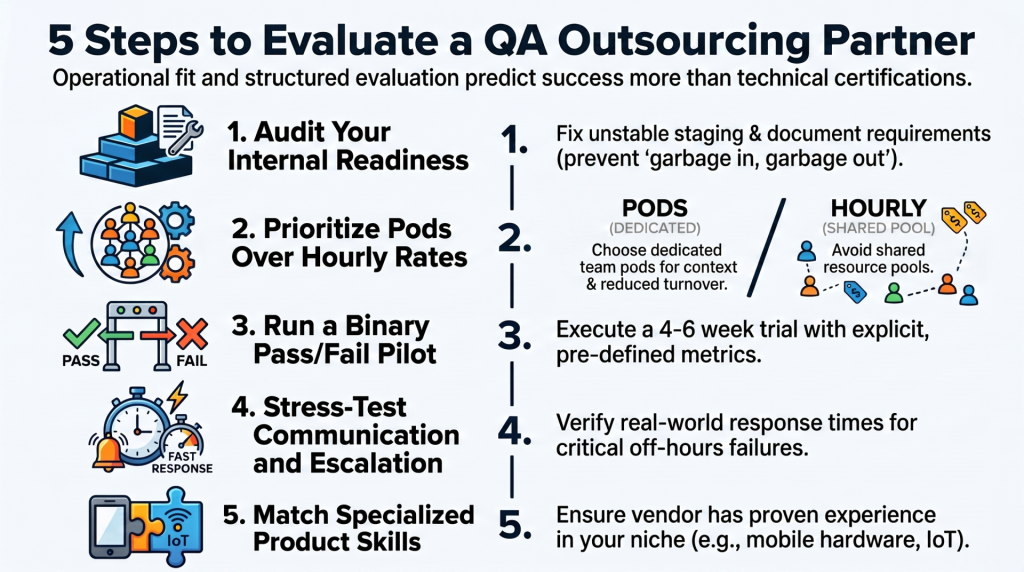
Step 1: Audit Your Own Readiness Before Contacting Any Vendor
Gather your last three sprint retrospectives and look for any recurring theme related to testing friction: unclear requirements, environment instability, late QA involvement, or insufficient test documentation. These are not vendor problems. They are organizational problems that a vendor engagement will surface immediately.
Run through this checklist before issuing any RFPs:
- Environment Stability: Does your staging environment reflect production closely enough for a QA team to find real defects rather than environment-specific false positives?
- Acceptance Criteria Quality: Are stories written with enough specificity that an external engineer could derive test cases without a lengthy discovery conversation?
- Internal QA Ownership: Is there a named person on your team who will own the vendor relationship, review coverage reports, and escalate blockers?
- Pipeline Accessibility: Can an external team be granted scoped access to your CI/CD tooling, test management system, and defect tracker without a six-week security review?
- Documentation Baseline: Does a test inventory exist, even informally? Or will the vendor be starting from a blank slate with no prior test artifacts?
If your honest answers reveal multiple gaps, address them first. The cost of fixing these internally before onboarding a partner is a fraction of the cost of a failed engagement that collapses because the vendor had no stable surface to work against.
Step 2: Build a Shortlist Around Engagement Model, Not Hourly Rate
Hourly rate comparisons are a trap. A vendor charging $35 per hour with a shared resource pool and 30% annual attrition is more expensive over a twelve-month engagement than a vendor charging $55 per hour with a dedicated pod and low turnover. The re-onboarding cost of cycling through three engineers, the coverage degradation during transitions, and the lost institutional knowledge represent real engineering team overhead that never appears in the hourly rate comparison.
Build your shortlist by asking two questions before anything else:
- Is this vendor’s engagement model dedicated pod or shared resource pool?
- Does their geographic model produce genuine timezone alignment with our team?
These two questions will eliminate most vendors from consideration before you ever review a proposal. What remains is a shortlist worth evaluating on technical depth, domain fit, and engagement process.
Step 3: Run a Structured Pilot With Defined Pass/Fail Criteria
A pilot is not a “trial period” where you observe the vendor and form a general impression. A pilot is a bounded engagement with specific deliverables, defined success metrics, and a binary outcome: the engagement proceeds or it does not.
Structure the pilot as follows:
- Define a scope bounded to one feature area or one sprint cycle, not the entire product.
- Write explicit pass/fail criteria before the pilot begins: defect detection rate, bug report quality, pipeline integration completeness, standup participation quality, and response time to escalation requests.
- Brief the vendor on the criteria. A partner worth keeping will not object to being evaluated against explicit standards.
- Assign an internal owner to track performance against criteria daily, not weekly.
- At pilot completion, evaluate the criteria and make a binary decision. Do not extend indefinitely because the relationship feels promising.
The pilot also surfaces information the sales process cannot. You will see how the vendor handles ambiguity in acceptance criteria. You will see whether their bug reports contain enough context for your developers to reproduce and fix defects without back-and-forth. You will learn whether they can hold their own in a sprint ceremony or whether they default to passive observation.
Step 4: Stress-Test Communication and Escalation Before Signing Anything
Before the contract is signed, run two scenarios past the vendor.
The first: “Our nightly build fails at 11 PM Eastern and the release is scheduled for 9 AM Eastern the following morning. Walk me through exactly what happens from your side.”
The second: “A critical defect is discovered in production on a Friday afternoon. Your team is not scheduled to work the weekend. What is the escalation path and what can we expect in terms of response?”
The quality of these answers tells you whether the vendor has thought through operational edge cases or whether they have only prepared for normal-state conditions. A vendor who has not considered after-hours escalation paths has not thought carefully about what it means to be a true engineering partner rather than a business-hours testing service.
Also verify: Who is the named point of escalation above the engagement lead? What is their average response time for escalation events? Has the vendor handled a production severity-one incident for a client before, and what did that look like?
Step 5: Confirm Specialized Coverage Matches Your Actual Product
Generic QA outsourcing vendors can cover web application regression and basic functional testing competently. If your product extends beyond that, the evaluation needs to match.
If your product includes a mobile application, the vendor needs demonstrated iOS and Android coverage, cross-device test matrix experience, and familiarity with the specific failure patterns of native app testing. If your product includes hardware or firmware, that requires a different skill profile entirely. Hardware, IoT, and firmware testing involves physical device validation, hardware-software synchronization testing, and failure modes that do not exist in pure software environments. A vendor who tests web applications cannot transfer those skills to an IoT device without a significant ramp.
If you have accessibility requirements tied to WCAG compliance or government contract obligations, verify that the vendor has engineers trained specifically in accessibility testing methodology, not just engineers who have run automated accessibility scanners.
Ask for concrete evidence of specialized coverage: prior work examples, specific tools used, engineers who can describe the failure patterns common to your product type. Verbal claims of broad capability without supporting specifics are a flag.
Certifications and Tool Stacks Are Table Stakes, Not Differentiators
ISTQB certification, familiarity with Selenium, Playwright, or Cypress, and experience with Jira are the floor, not the ceiling. Every qualified QA vendor will have these. Evaluating vendors primarily on tool stacks is like hiring a senior engineer because they know Python. The tool is not the thing. The judgment, the product context, and the operational model are the thing.
A vendor who can articulate their test automation strategy clearly, describe how they handle flaky tests in a CI environment, and explain their approach to balancing automated coverage with exploratory testing is demonstrating real competency. A vendor who lists seventeen tools in a capability matrix is demonstrating a sales deck.
Treat certifications as a threshold check, not a ranking criterion. Once a vendor clears the threshold, take them off your evaluation rubric and put the weight on the five operational criteria above.
When Outpost QA works with engineering teams on enterprise governance and QA process audits, one of the most consistent findings is that failed outsourcing engagements had technically qualified vendors. The failure was structural: wrong engagement model, wrong timezone coverage, no CI/CD integration, or a buyer organization that was not ready to onboard a partner. Qualifying a vendor on certifications and tool stacks will not protect you from any of those failure modes.
If you are currently evaluating QA outsourcing options or questioning whether your existing vendor is actually set up to succeed, bring your specific situation to the team at Outpost QA. Talk to a QA architect about your evaluation criteria and find out whether what you are measuring will actually predict the outcome you need.
Frequently Asked Questions
How long should a QA outsourcing pilot last before deciding to proceed?
Four to six weeks is the right range for most teams. Shorter than four weeks does not give the vendor enough time to accumulate product context or complete a meaningful regression cycle. Longer than six weeks without a binary decision often means the evaluation criteria were not defined clearly enough at the outset.
What is the difference between a dedicated QA pod and a shared resource model?
A dedicated pod assigns a fixed team of engineers exclusively to your product for the duration of the engagement. A shared resource model draws engineers from a pool that serves multiple clients simultaneously. Dedicated pods accumulate product context over time; shared pools reset that context frequently as team composition changes.
Should I evaluate QA outsourcing vendors differently for mobile or hardware products?
Yes. Mobile and hardware products require specialized testing skill sets that general QA vendors often cannot demonstrate with real evidence. For mobile products, ask for cross-device test matrix examples. For hardware and firmware products, ask specifically about physical device validation experience and whether the vendor has engineers who understand embedded systems failure modes.
Is nearshore QA always preferable to offshore QA?
For US-based teams that work standard business hours, nearshore models produce meaningfully better collaboration outcomes because they eliminate the communication lag and relay layers that characterize offshore engagements. Whether that tradeoff justifies the cost difference depends on how collaboration-intensive your sprint process is and how often real-time escalation is needed.
What internal role should own the outsourced QA vendor relationship?
A named QA lead or engineering manager who participates in sprint ceremonies, reviews coverage reports weekly, and has authority to escalate issues to the vendor’s engagement lead is the minimum. Without a designated internal owner, vendor accountability drifts and performance issues compound before anyone catches them.