You have been handed a test framework. It has no README, the last commit is four months old, and the engineer who built it is now on a P0 customer escalation. The sprint starts Monday. This is not a hypothetical: it is the most common version of the build vs buy internal QA tooling cost problem, and it almost never comes up in the meeting where the original build decision gets made.
TL;DR
- Internal QA tooling builds feel fast and low-cost because the initial sprint uses engineers already on payroll, making the true cost invisible until much later.
- The real expense is not the build; it is the ownership: maintenance, documentation, and keeping the framework current as the codebase evolves.
- The “rotation off” failure mode is the most common and least discussed: the builder gets reassigned, and the framework quietly stops catching defects.
- Per the DORA State of DevOps research, elite-performing engineering teams consistently rely on shared, maintained tooling platforms rather than bespoke internal builds.
- Building internally can make sense, but only under specific conditions; most teams do not meet them.
The Build Feels Fast. The Ownership Is What Kills You.
The build vs buy internal QA tooling cost calculation almost always gets the numerator right and ignores the denominator. The initial sprint estimate is concrete: two engineers, four weeks, existing salary overhead. The resulting tool works. Tests pass. The demo looks clean.
What the estimate never includes is every hour spent on that framework after the sprint closes. Maintenance, dependency upgrades, flakiness triage, documentation that never gets written, and the compounding cost of a framework that silently falls out of sync with the codebase it is supposed to cover. The DORA State of DevOps research found that elite engineering teams converge on shared, well-maintained tooling platforms rather than bespoke internal builds, precisely because the ownership burden of custom tooling competes directly with deployment frequency and developer velocity.
The build is not the problem. The build is the beginning of the problem.
Three Phases of Internal QA Tooling Failure
Most internal QA tooling does not fail suddenly. It fails across a predictable arc that engineering leads rarely see coming because each phase looks, at the time, like a normal part of shipping software.
Phase 1: The Build (It Feels Like Progress)
A senior engineer, often your best one, volunteers or gets assigned to build the framework. They have strong opinions about the right approach, they move fast, and four to six weeks later there is a working test harness integrated into CI. Coverage numbers go up. The team feels good about the investment.
A few things get quietly deferred: documentation, onboarding notes, a decision log explaining why certain tradeoffs were made. These feel like polish, not substance, so they get scheduled for “after the next release.”
Phase 2: The Drift (The Framework Falls Behind the Codebase)
The builder gets pulled to something more urgent. This is not a failure of planning; it is how engineering organizations work. Customer-facing features compete for the same senior capacity as internal infrastructure, and customer-facing features win almost every time.
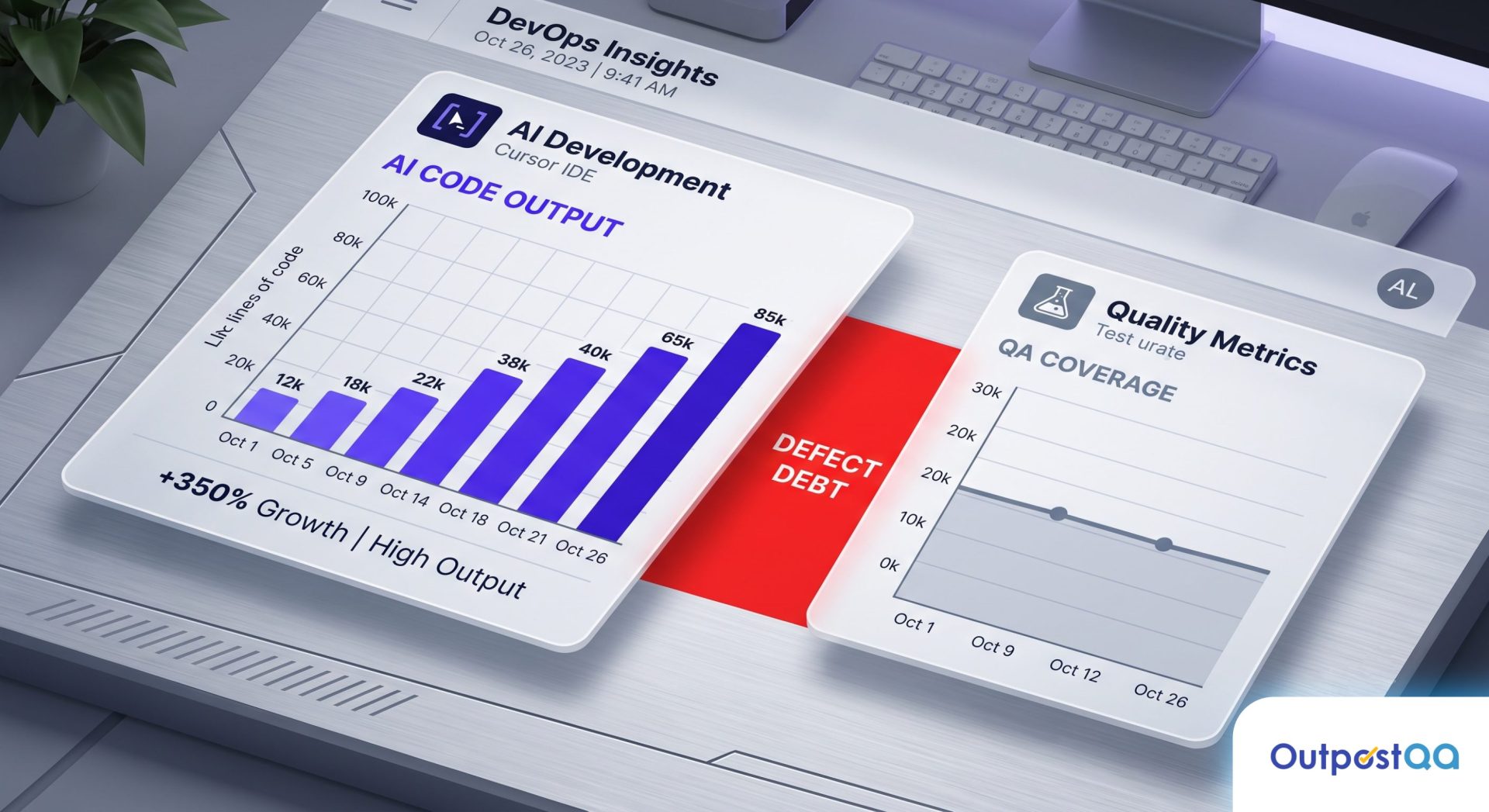
The framework still runs. Tests still pass. But new features ship without corresponding test coverage, because writing tests for the new API surface requires understanding the framework’s internals, and nobody has time to reverse-engineer four months of undocumented decisions. The framework drifts. The gap between what the codebase does and what the tests cover grows one sprint at a time.
The 2024 World Quality Report by Capgemini found that test coverage maintenance ranks among the top challenges in sustaining automation programs, with teams reporting that existing test assets become outdated faster than they can be updated. The drift phase is not an edge case; it is the statistical norm.
Phase 3: The Reckoning (Two Quarters of Missed Defects)
A defect reaches production. Post-mortem analysis reveals the test that should have caught it existed at one point, was green, and was silently testing the wrong behavior after a refactor six weeks ago. Nobody noticed because the framework had no owner checking assertion validity, only a CI job confirming that tests did not throw exceptions.
This is the phase where the real build vs buy internal QA tooling cost becomes visible. Two quarters of defect-masking coverage, remediation work to audit and repair the suite, and the reputation cost of shipping bugs through a process the team believed was working. The original four-week sprint investment looks very different in this light.
What Does a Senior Engineer’s Time Actually Cost When Redirected to Maintenance?
This is the opportunity cost calculation that almost never appears in build vs buy discussions at the engineering level.
A senior engineer at a mid-size US software company, fully-loaded compensation including benefits and overhead, costs between $200,000 and $280,000 per year. At 2,080 working hours annually, that is roughly $96 to $135 per hour of their time.
Now consider what maintenance of a bespoke internal QA framework actually demands:
- Dependency management: Keeping test runner versions, assertion libraries, and CI integrations current across major releases.
- Flakiness triage: Investigating and fixing intermittent test failures, which on a poorly-maintained framework can consume 20 to 30 percent of a sprint’s QA capacity, per Stack Overflow Developer Survey findings on developer time lost to internal tooling friction.
- Coverage audits: Verifying that tests are asserting meaningful behavior rather than simply executing without error.
- Onboarding: Teaching each new team member the framework’s undocumented conventions.
If a senior engineer spends 15 to 20 percent of their working hours on internal tooling maintenance during the drift phase, that is 300 to 400 hours per year of capacity not being applied to the customer-facing roadmap. At fully-loaded rates, that is $29,000 to $54,000 annually, in a year when the tool is merely drifting, not failing outright. The reckoning phase costs more.
When Building Internally Makes Sense (and When It Does Not)
This is a genuine comparison, not a one-sided argument. Internal builds do make sense under specific conditions. The question is whether your team actually meets them.
Build internally if:
- You have a genuinely unique technical constraint: Hardware-in-the-loop test harnesses, proprietary communication protocols, or embedded firmware environments where no external tooling covers your surface area. If the testing problem is truly novel, buying a partial solution and building the gap is legitimate.
- You have a named, long-term owner: Not “the team will own it,” which means no one will own it. A specific engineer with a long-term assignment to internal tooling infrastructure, protected time on their roadmap, and explicit accountability.
- You have a documentation standard you will actually enforce: If your team does not have a track record of maintaining internal documentation under sprint pressure, assume the documentation will not happen.
Do not build internally if:
- The problem is solved by existing tooling: Playwright, pytest, and established CI platforms cover the vast majority of web, API, and integration testing scenarios. Wrapping them in a custom abstraction layer adds ownership cost without adding testing capability.
- The engineer proposing the build is your most senior: Pulling your best engineer off customer-facing work to build internal infrastructure is usually the wrong trade at the wrong time.
- You cannot answer “who maintains this in 18 months?” If the answer is “we’ll figure it out,” the drift phase is already scheduled.
The honest version of the build vs buy internal QA tooling cost conversation includes the 18-month maintenance projection, not just the initial sprint estimate. Most teams run the sprint estimate and call it the full cost.
If you are heading into a planning cycle with an internal tooling build on the roadmap, or if you have already shipped one and are not sure whether it is still doing what you think it is doing, a framework audit before your next engineer rotation is worth the time. Reach out to Outpost QA and we will take a look at what you have, tell you what is working, and tell you honestly what is not.
Frequently Asked Questions
How long does a bespoke internal QA tool typically stay actively maintained before it drifts?
Based on patterns observed across engineering teams, meaningful drift typically begins within three to six months of the original builder being reassigned, faster if the codebase is evolving quickly. Active maintenance rarely continues past twelve months without a named owner and protected time.
Is the “rotation off” problem specific to small teams?
No. Larger teams often have more pronounced rotation because senior engineers are in higher demand across more competing priorities. The problem is not team size; it is whether internal tooling has an explicit owner who is accountable for it on a continuing basis.
What is the difference between a custom framework and a configured open-source tool?
A custom framework is written from scratch by your team and has no external community maintaining it. A configured open-source tool, such as a Playwright setup with your team’s specific fixtures and helpers, inherits the maintenance of the core library from an external community while only requiring you to maintain the configuration layer. The ownership cost is significantly lower with the latter.
Can AI-assisted code generation reduce the cost of building internal QA tooling?
AI tooling lowers the cost of the initial build, which was rarely the expensive part. It does not reduce the cost of maintaining, documenting, auditing, and passing ownership of the resulting framework over its operational lifetime. The drift and reckoning phases are organizational problems, not code-generation problems.
At what point should a team audit an existing internal QA framework rather than replace it?
Audit first if the framework is under two years old, reasonably documented, and the coverage gaps are identifiable and bounded. Replace if the original author is gone, there is no documentation, and the team cannot confidently describe what the framework actually covers. A framework audit is usually a one-to-two week exercise; a replacement is a quarter-long project.