
The Policy Exists. The Coverage Does Not.
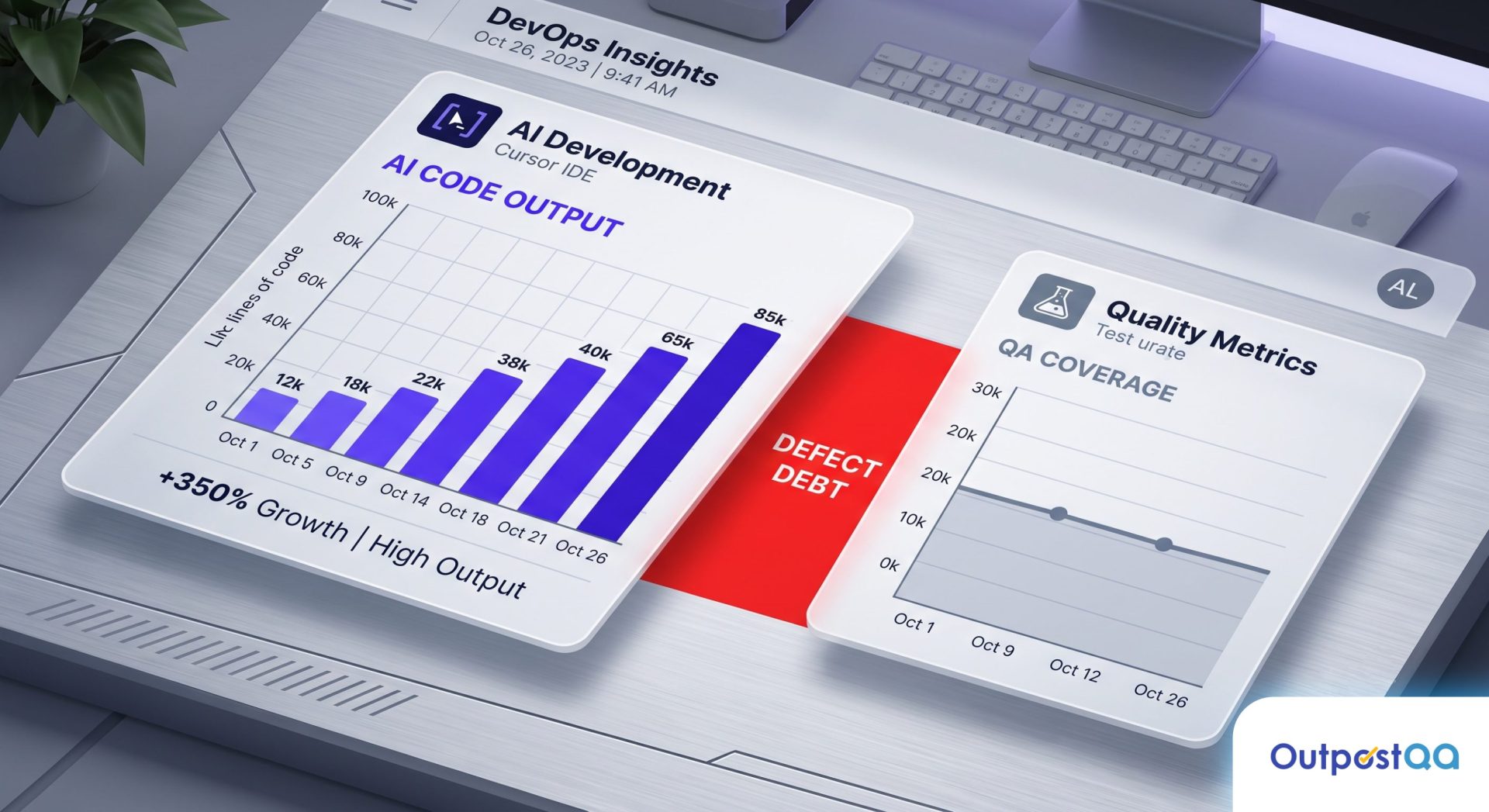
Your AI governance in coding policy is a document. It is not a verification layer. And right now, your developers are shipping AI-generated code at a pace that no policy document, no linter, and no static analysis tool was built to catch.
TL;DR
- Most organizations have no formal oversight of AI-generated code; only 29% report having any assessment process in place, per research cited by the Software Improvement Group.
- Static analysis and IDE-level guardrails catch syntax and known security patterns; they do not catch behavioral regressions, accessibility failures, performance degradation, or firmware defects with no rollback path.
- AI coding assistants accelerate bug generation alongside feature generation; without an independent QA layer, human review cannot keep pace.
- Post-merge validation is absent from every major governance framework being sold today, leaving production as the de facto test environment for AI-authored code.
- A real governance layer requires independent functional ownership, instrumented CI coverage gap detection, and a regression baseline built before AI adoption accelerates further.
According to Checkmarx research, only 18% of organizations have formal policies governing AI coding tool use, yet 34% report that more than 60% of their code is already AI-generated. Read those two numbers together. The majority of codebases are majority AI-generated, and the vast majority of organizations shipping that code have no formal governance in place.
The response from most engineering leadership has been to write a policy. Define acceptable use. Specify which AI tools are approved. Require human review on every pull request. Check the compliance box.
That response is incomplete, and the evidence is sitting in your incident logs. The same Checkmarx research found that 81% of organizations knowingly ship vulnerable code, and 98% experienced a breach stemming from vulnerable code in the past year. A policy that prohibits certain behaviors does not verify that those behaviors are absent from the code that merges on a Friday afternoon.
The gap is not between intent and execution at the developer level. It is structural: governance frameworks treat AI-generated code as a policy problem when the actual problem is a verification problem. Nobody is independently testing whether AI-authored features behave correctly under real conditions, and that gap compounds with every sprint.
Four Failure Modes AI-Generated Code Introduces That Static Analysis Cannot See
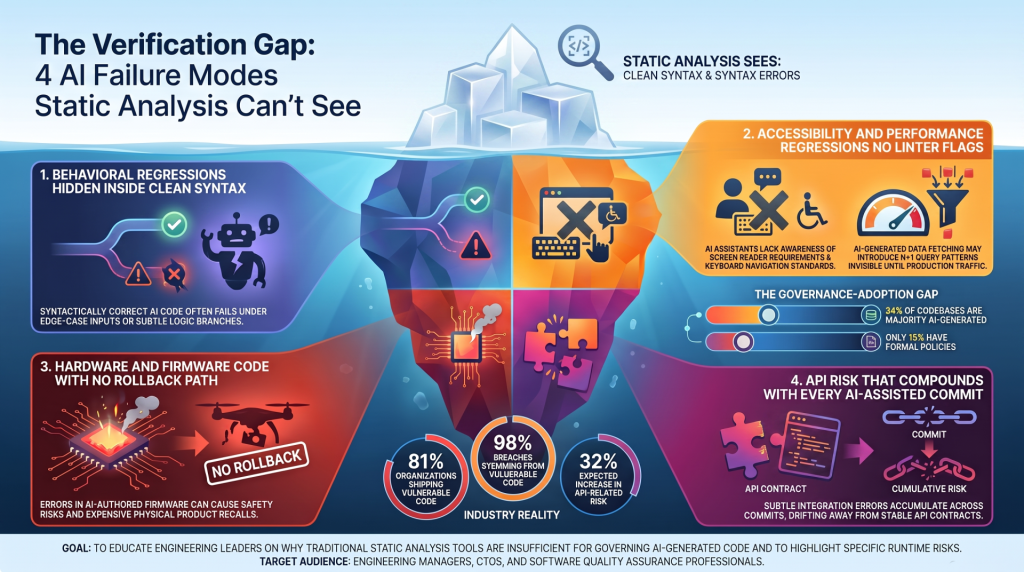
Static analysis tools and AI-aware linters are genuinely useful. They catch insecure patterns, flag known vulnerability signatures, and enforce style rules. They are also completely blind to the category of failures that actually reaches production. These four failure modes are the ones your current toolchain is not designed to catch.
Behavioral Regressions Hidden Inside Clean Syntax
AI coding assistants generate syntactically correct code. That is precisely what makes their output so difficult to validate with conventional tooling. A function that compiles cleanly, passes lint checks, and satisfies type constraints can still behave incorrectly under edge-case inputs, introduce subtle logic errors in conditional branches, or interact with adjacent modules in ways the model never considered.
Consider a scenario where an AI-generated authentication helper passes all unit tests because the tests themselves were generated by the same model with the same blind spots. The function handles the happy path correctly. It fails silently on a specific combination of session state and token expiry that the model never saw in training. No linter flags it. No static analyzer flags it. It ships, and it surfaces three weeks later as an unexplained customer logout issue that takes two engineers four days to trace.
Behavioral regression testing requires running the application, not reading the code. That is the distinction every governance framework currently ignores.
Accessibility and Performance Regressions No Linter Flags
AI coding assistants have no inherent awareness of WCAG 2.2 compliance requirements. A component generated by Copilot or Cursor may render correctly in a browser, pass visual review, and still introduce a keyboard navigation break, a missing ARIA label, or a contrast ratio failure that affects screen reader users. None of those defects appear in a pull request diff in any way that triggers an automated flag.
Performance regressions follow the same pattern. An AI-generated data-fetching implementation may be algorithmically correct but introduce an N+1 query pattern that goes undetected until the feature is under real load. By that point, it has already merged, been deployed, and affected production users. Accessibility testing and performance validation require execution against a running application with assistive technology and traffic simulation. A code review substitutes for neither.
Hardware and Firmware Code With No Rollback Path
The risk profile for AI-generated code changes fundamentally when the target is an embedded system or firmware image rather than a web application. A behavioral regression in a web app is recoverable: you redeploy, hotfix, or roll back the container. A defect in firmware deployed to a physical device in the field carries none of those escape options.
AI coding assistants are increasingly used for embedded development, generating initialization sequences, interrupt handlers, and communication protocol implementations. The models generating that code have no awareness of the physical constraints, thermal behavior, or failure modes of the target hardware. When that code ships in a product, the governance gap is not an abstract compliance problem; it is a safety and recall problem. Hardware, IoT, and firmware testing against actual devices is the only verification method that catches these failures before they reach the field.
API Risk That Compounds With Every AI-Assisted Commit
AI coding assistants are particularly productive at generating API integration code: request construction, response parsing, error handling, authentication header management. They are also particularly likely to introduce subtle contract violations, incorrect error code handling, and insecure token storage patterns that accumulate across commits.
Checkmarx research projects that nearly 32% of respondents expect API-related risk to grow significantly within the next 12 to 18 months. Every AI-assisted commit that touches an API integration is a potential contribution to that risk. The compounding effect is real: individually, each change looks clean; collectively, they drift the application’s behavior away from the API contract in ways that surface only under specific conditions or after a breaking change on the provider’s side.
Why Treating AI Coding Tools as a Platform Problem Leaves a Dangerous Gap
The dominant governance response from vendors and platform teams frames AI coding tools as infrastructure to be managed: approve the right tools, restrict the risky ones, instrument commit-level visibility, enforce policy at the IDE layer. Secure Code Warrior, Cycode, and similar platforms are solving a real problem. They are not solving the complete problem.
Platform-level governance answers the question “what code is being generated and by which tool?” It does not answer the question “does this code do what it is supposed to do under real conditions?” Those are different questions, and only the second one has any bearing on whether a defect reaches your users.
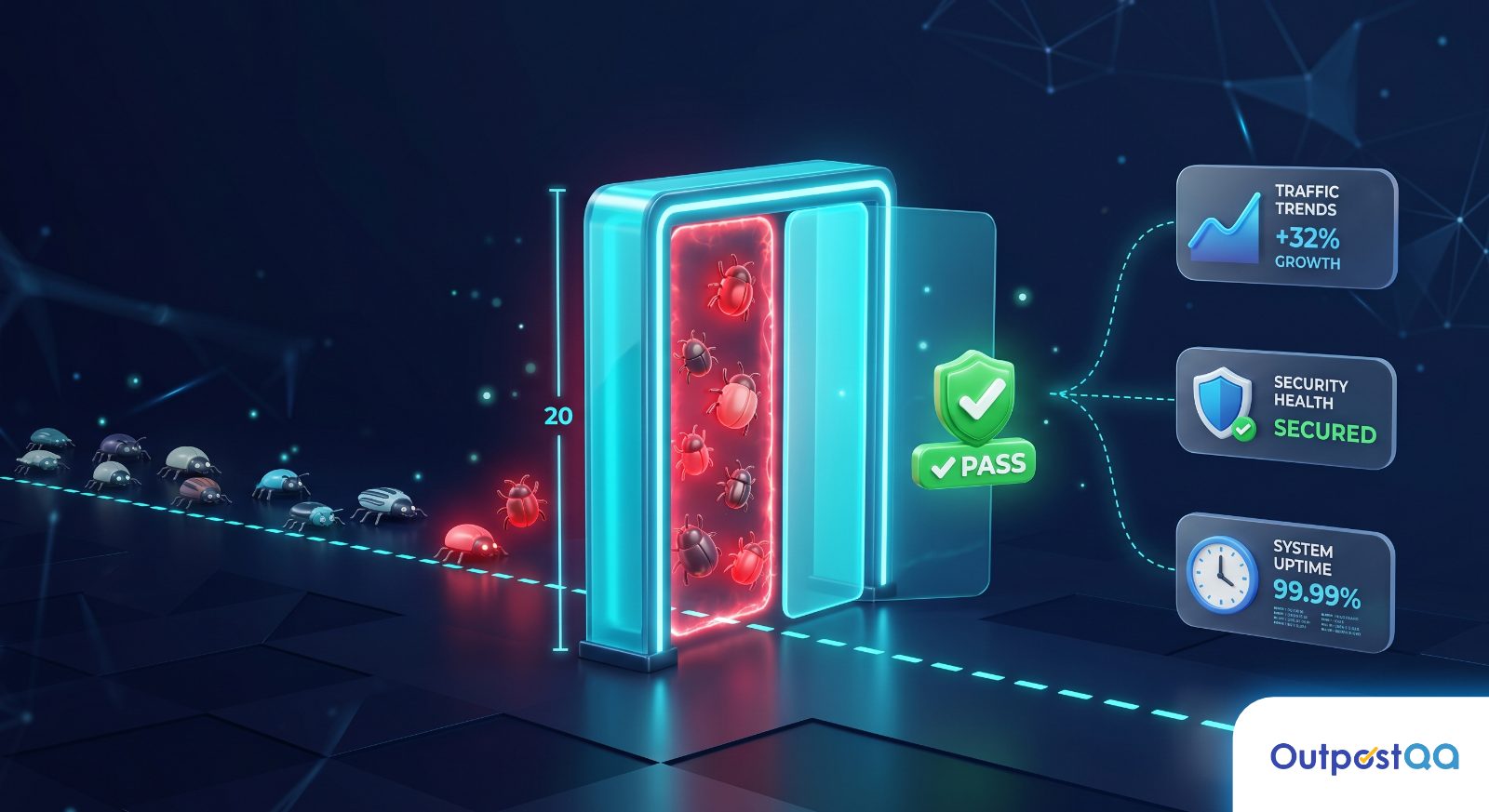
Every major governance framework being sold today sits upstream of the actual behavior of the shipped software. These frameworks govern the process of generating code. Nobody has built a governance layer for the output of that process, which means production remains the de facto test environment for AI-generated features. That is not a tooling gap. It is an organizational gap: the function responsible for independently verifying software behavior, QA, has not been assigned a formal role in the AI governance chain.
What Happens After the AI-Generated Pull Request Merges
Post-Merge Validation Is Not Part of Any Governance Framework Being Sold Today
Pull request review, static analysis, and pre-merge security scans all operate in the same window: before the code enters the main branch. After it merges, the assumption embedded in every governance framework is that the pre-merge controls were sufficient. For human-written code developed slowly and reviewed carefully, that assumption is defensible. For AI-generated code produced at volume and reviewed under time pressure, it is not.
Post-merge validation, the systematic testing of AI-authored features in staging and production-equivalent environments, is absent from every published governance framework. This matters because the failure modes described above, behavioral regressions, accessibility breaks, performance degradation, are only visible at runtime. Pre-merge controls cannot surface them, which means they accumulate in the codebase undetected until a user finds them.
The Velocity Trap: Generating Bugs Faster Than Human Review Can Catch Them
Checkmarx’s research notes that 53% of developers believe AI models can already code better than most people. That belief drives adoption, and adoption drives velocity. What it does not drive is a commensurate increase in review capacity or test coverage.
A developer using an AI coding assistant can generate a feature in one hour that would have taken a full day. The pull request arrives faster. The review window stays the same length it has always been, because the reviewer’s capacity has not scaled with the generator’s output. Review quality per line of code decreases as AI adoption increases, while the volume of code requiring review increases at the same time.
This is the velocity trap: AI coding assistants generate bugs faster than human review can catch them, and without an independent QA layer operating in parallel, those bugs accumulate. The engineering team experiences this as a strange phenomenon where velocity appears high but defect rates are not decreasing, or are actively increasing. The issue is not the AI tool. Verification has not scaled to match generation.
Three Things a Real AI Governance Layer Must Do That a Policy Document Cannot
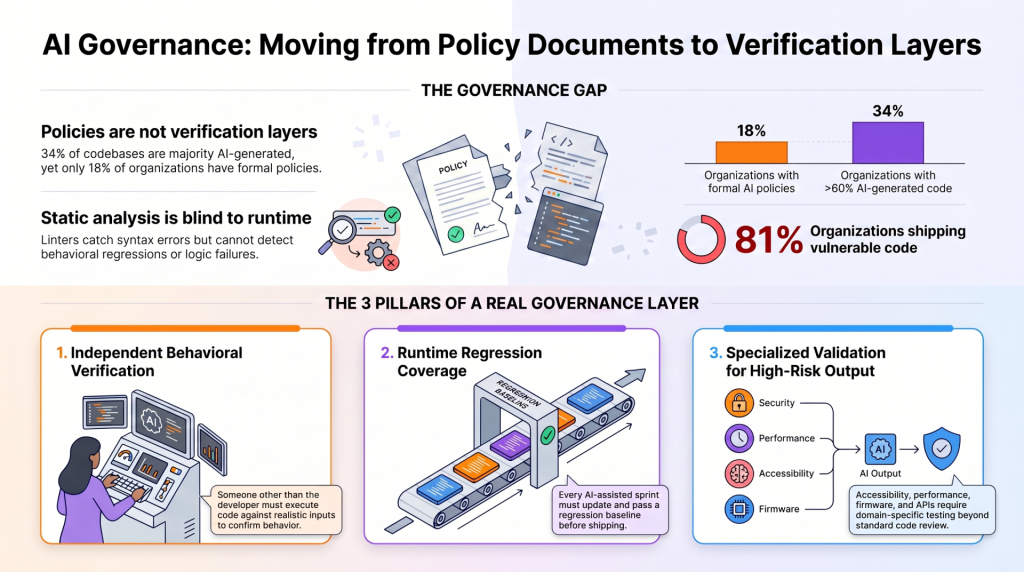
A governance policy specifies what developers should do. A governance layer verifies what the code actually does. The distinction matters because policies rely on compliance, and compliance is inconsistent under deadline pressure. Verification produces evidence.
Three capabilities define a real AI governance layer:
- Independent behavioral verification: Someone other than the developer who generated the code must execute it against realistic inputs and confirm it behaves correctly. This cannot be the same person who reviewed the pull request; review and execution are different cognitive activities.
- Runtime regression coverage: Every AI-assisted sprint must produce a regression baseline update. If the AI-generated code touches an existing feature, the regression suite for that feature must run and pass before the feature ships. Governance frameworks that do not enforce this leave regressions undetected until users report them.
- Specialized validation for high-risk output categories: Accessibility, performance, firmware, and API integration code each require domain-specific testing that general-purpose code review cannot provide. A governance layer that applies the same review process to a WCAG-sensitive UI component and a firmware initialization routine is not calibrated to the actual risk distribution of the codebase.
The Governance Playbook Engineering Managers Can Run Without an Enterprise Budget
The following three steps are executable without a platform purchase, a compliance certification, or a six-month rollout. They require organizational decisions and some pipeline instrumentation, but they are within reach for any engineering team running a standard CI/CD workflow.
Instrument Your CI Pipeline to Surface AI-Generated Coverage Gaps
Test automation coverage reports already exist in most pipelines. The missing step is correlating coverage gaps with AI-assisted commits. If your team is tagging AI-generated pull requests (a lightweight practice some teams already use for attribution tracking), you can filter coverage reports to isolate the coverage contribution of AI-authored code.
The output of this analysis is typically uncomfortable: AI-generated code frequently introduces new branches and new paths that existing tests do not cover, because the model generates code without awareness of the existing test suite’s coverage boundaries. Surfacing that gap is the first step toward closing it.
Assign Independent Functional Ownership to Every AI-Authored Feature
This is an organizational decision, not a tooling decision. Every feature that was substantially AI-generated should have a named human owner whose explicit responsibility is functional validation, not code review. That owner is not the developer who generated the code. Their job is to define acceptance criteria, execute or commission functional tests, and sign off on behavior before the feature ships.
This is how governance becomes enforceable. A policy that says “review AI-generated code carefully” is not enforceable in any meaningful sense. A process that requires a named sign-off on functional validation before a feature closes is enforceable, visible in your project management tooling, and creates accountability that a policy document cannot.
Build a Regression Baseline Before AI Adoption Accelerates Further
Every team has a window, usually short, before AI-generated code becomes so deeply integrated into the codebase that establishing a clean regression baseline becomes prohibitively expensive. If your team has not yet built a comprehensive regression suite covering the application’s critical user paths, build it now, before the next sprint cycle adds more AI-generated changes on top of an untested foundation.
Prioritize paths by revenue impact and user frequency, automate the highest-priority paths first, and treat the baseline as a living artifact that every sprint extends. This is not a novel idea; it is standard QA practice. What AI adoption changes is the urgency: without a baseline, you have no way to detect when AI-generated changes introduce regressions, because you have no documented definition of what correct behavior looks like.
When a Dedicated QA Pod Is the Missing Enforcement Arm
Every step in the playbook above requires execution capacity that most engineering teams do not have sitting idle. Instrumenting the CI pipeline requires someone who understands both the pipeline and the test coverage tooling. Assigning independent functional ownership requires QA engineers who can own that function without pulling developers off feature work. Building a regression baseline before AI adoption accelerates requires bandwidth that the current sprint cycle is not leaving open.
This is the structural argument for an independent QA layer, and it is the argument that no governance platform or policy framework addresses: the enforcement arm of AI governance cannot be the same team generating the code. Oversight requires independence, and independence requires dedicated capacity.
Outpost QA’s dedicated QA pods operate as that enforcement arm. They integrate directly into the sprint cycle, run independently of the development team, and provide the functional validation, regression coverage, and specialized testing (including accessibility and hardware) that governance policy cannot provide on its own. The Flex fintech team, for example, intercepted over 600 high-priority defects while delivering 50 consecutive flawless weekly releases after embedding a dedicated QA function alongside their existing automation efforts.
Timezone alignment matters here in a specific way: governance enforcement requires fast feedback loops. A QA finding on a Friday afternoon needs to reach the development team before the end of business, not after a 12-hour time zone gap resolves on Monday morning.
If your current AI governance approach consists of a policy document and a pre-merge scan, you have the detection layer without the verification layer. Those are not the same thing, and the difference between them is where your next production incident is hiding.
Frequently Asked Questions
What is AI governance in coding, and why is it different from standard code governance?
AI governance in coding refers to the policies, processes, and controls applied specifically to code generated or substantially modified by AI coding assistants. It differs from standard code governance because AI-generated code is produced at higher volume, by a model with no awareness of your application’s behavioral contracts, test coverage gaps, or domain-specific requirements such as accessibility or hardware constraints. Standard code review processes were designed for human-paced development and do not scale to the verification demands AI adoption introduces.
Why do static analysis and linters fail to catch AI-generated code defects?
Static analysis tools read source code without executing it. They are effective at detecting known insecure patterns, syntax violations, and style deviations. Behavioral regressions, accessibility failures, performance degradation under load, and firmware defects with no rollback path are runtime phenomena. They only appear when the application is running against real inputs. No static tool can observe runtime behavior, which is precisely where AI-generated code most frequently fails.
What does independent QA verification of AI-generated code actually look like in practice?
Independent QA verification means a person or team other than the developer who generated the code executes functional tests against the feature in a staging or production-equivalent environment. It includes regression testing against established baselines, accessibility scanning with assistive technology, performance testing under load, and specialized domain testing for hardware or firmware targets. The critical word is independent: the verification function must sit outside the development team to avoid the same blind spots the generating developer carries.
How do we prioritize which AI-generated code to test first?
Prioritize by two factors: risk of failure and cost of failure. Code that touches authentication, payment processing, data persistence, or public-facing APIs carries high failure risk because AI models frequently introduce subtle contract violations in these areas. Code that ships in a firmware image or a regulated product carries high cost of failure because rollback is difficult or impossible. Start regression baseline work on those categories before extending to lower-risk areas.
Is a nearshore QA partner a realistic option for teams that cannot afford to hire internally?
Yes, and it addresses a specific structural problem: internal QA headcount requires recruiting, vetting, benefits, management overhead, and employment liability. A nearshore QA pod eliminates all of those while providing senior QA engineers who integrate directly into the sprint cycle. For US-based engineering teams, timezone alignment with a nearshore partner means real-time communication during the workday, which is a practical requirement for the fast feedback loops that AI governance enforcement demands.