What AI Governance in CI/CD Actually Means at the Pipeline Level
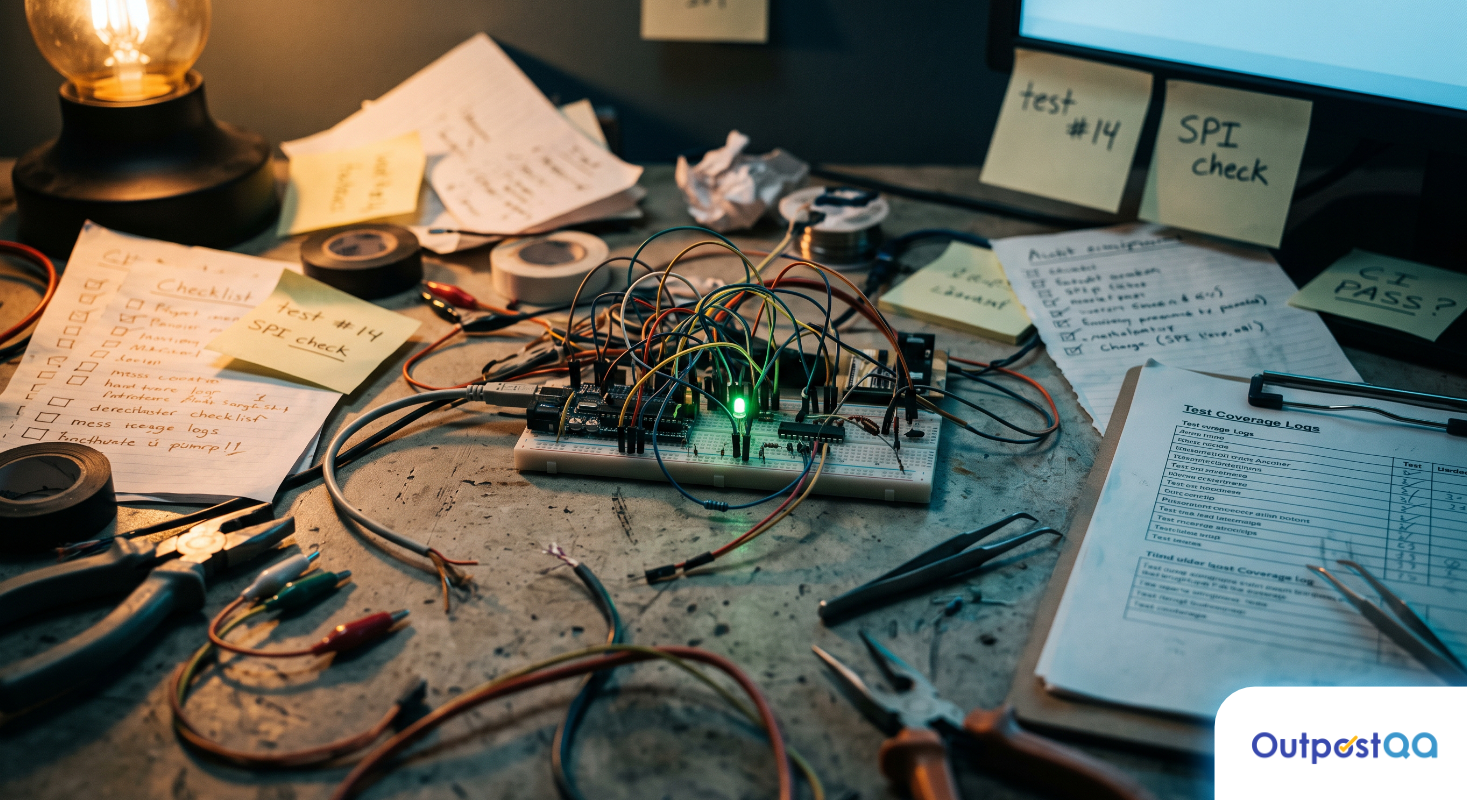
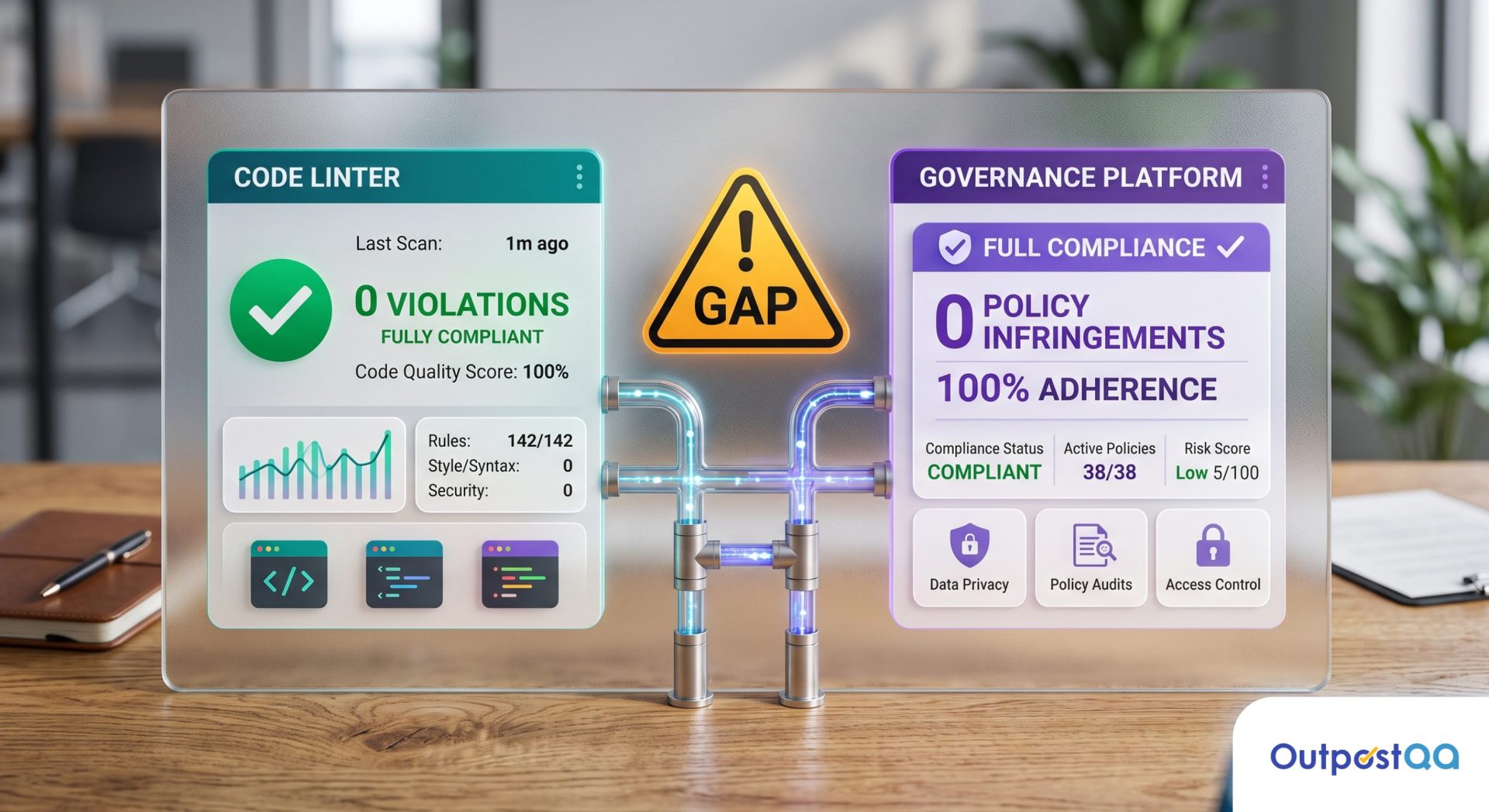
Your CI/CD pipeline has governance tooling configured. AI-powered policy engines flag violations. Security scanners run on every pull request. And yet, when an auditor asks who approved the last production deployment, the answer is a spreadsheet, a Slack thread, and three people who each assumed someone else owned the checkpoint. AI governance in CI/CD pipelines does not fail because the tools are wrong. It fails because accountability is distributed across teams that each own a slice of the pipeline but no one owns the full loop.
TL;DR
- AI governance tools set and flag policy rules inside CI/CD pipelines; they do not assign or enforce human accountability for those rules.
- AI-generated test artifacts (test cases, coverage reports, scripts) are themselves a compliance risk if no dedicated QA function validates them before they enter the pipeline.
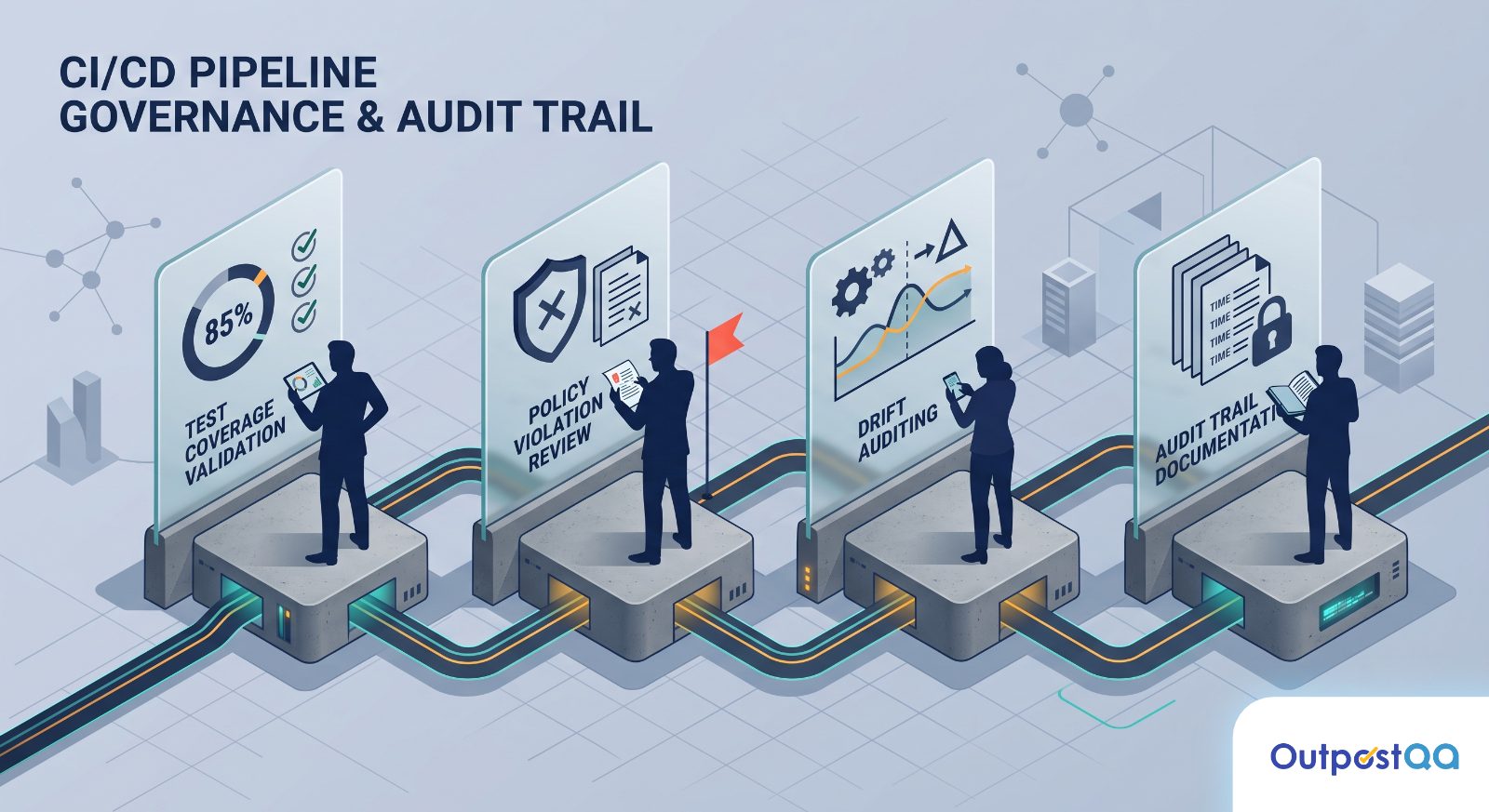
- Four specific checkpoints require human QA ownership: coverage validation, policy-flagged violation review, drift auditing, and audit trail maintenance.
- Distributed teams compound governance gaps because approval handoffs fall into timezone and communication dead zones.
- A QA process audit is the fastest way to determine whether your current pipeline governance structure has clear ownership or is quietly fragile.
AI governance in CI/CD pipelines refers to the set of controls, review gates, and accountability structures that ensure AI-assisted development and AI-integrated pipelines produce outputs that are testable, traceable, and compliant with the standards your organization is held to. That definition matters because most teams conflate governance with tooling. They are not the same thing.
A governance tool can enforce a policy automatically. It cannot tell you whether that policy was the right one to enforce, whether the AI-generated artifact it is validating was trustworthy to begin with, or whether the audit trail it produces will satisfy a regulator rather than just fill a dashboard. According to the DORA State of DevOps Report, elite engineering teams deploy significantly more frequently than low-performing teams while maintaining lower change failure rates. The difference is not automation alone; it is structured ownership of the quality and compliance gates automation passes through.
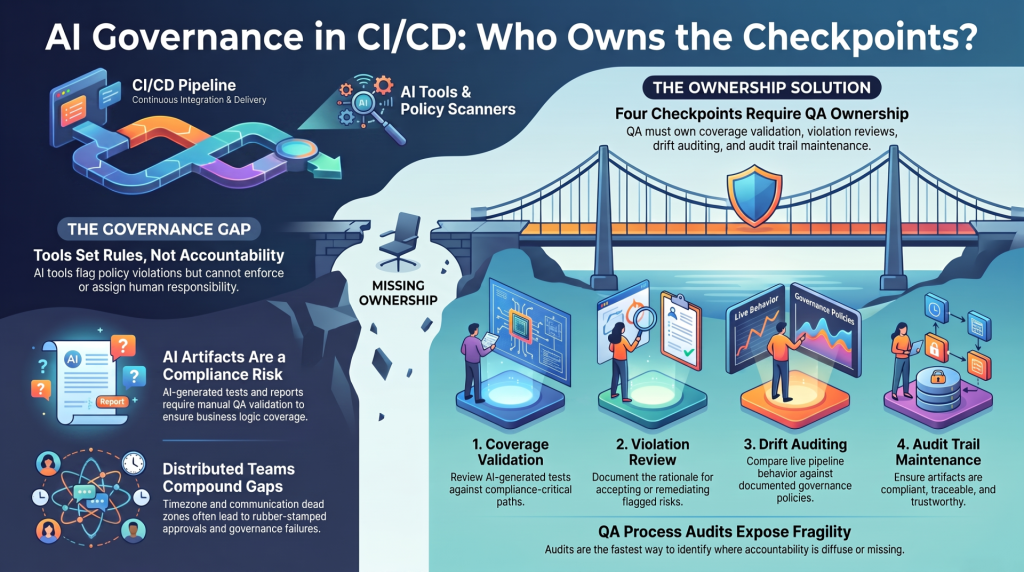
The Gap Between Governance Policy and Governance Execution
AI Tools Set the Rules. They Do Not Enforce Accountability.
Policy engines like Open Policy Agent can block a deployment when a rule is violated. What they cannot do is determine whether the rule itself reflects your current regulatory environment, whether a flagged violation was a false positive, or who is responsible for resolving it before the next release window closes. Those decisions require judgment, and judgment requires a human with defined ownership.
The accountability gap shows up most clearly in post-incident reviews. A violation was flagged. Someone marked it as accepted risk. The deployment went through. Six weeks later, a compliance audit surfaces the same issue, and no one can reconstruct who accepted the risk or on what basis. The tool logged the event. Nobody owned the decision.
When AI-Generated Test Artifacts Become a Compliance Risk
Most governance conversations focus on AI governing the pipeline. The less-discussed problem runs in the opposite direction: when AI tools generate test cases, test scripts, or coverage summaries, those outputs require validation before they can be trusted for compliance purposes.
An AI-generated test suite that achieves 80% line coverage tells you something about surface area. It does not tell you whether the tests cover the specific business logic paths your compliance framework requires. If your QA process accepts AI-generated artifacts without human review, you are presenting coverage data to auditors that no qualified engineer has actually signed off on.
What a Governance Failure Actually Looks Like in Production
Consider a fintech product that ships a payment processing update through a pipeline with automated governance checks. The policy engine validates the build. The coverage report, generated by an AI tool, shows acceptable numbers. The deployment is approved. Three days after release, a transaction edge case surfaces in production that the AI-generated suite did not cover because the coverage tool optimized for breadth, not for the specific regulatory paths that govern payment validation.
The bug is not the only problem. The compliance documentation for that release shows green checkmarks across all governance gates, and none of them reflect a qualified human reviewing whether the test strategy actually addressed the right risk surface. That is a governance failure, not a testing failure.
Four Checkpoints Where Human QA Ownership Closes the Loop
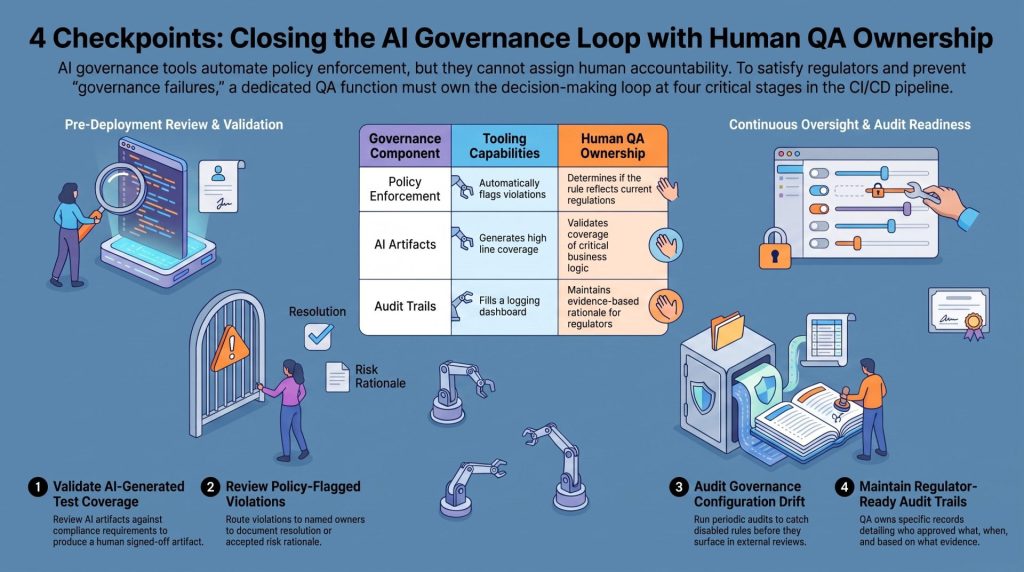
Checkpoint 1: Validating AI-Generated Test Coverage Before It Enters the Pipeline
Before any AI-generated test artifact is accepted as valid coverage for a regulated feature, a dedicated QA engineer should review it against the compliance requirements for that release. This is not a full manual rewrite of the suite. It is a structured review: does this coverage address the business-critical and compliance-critical paths for this specific change?
This checkpoint should produce a signed-off artifact, not just a passed gate. The distinction matters when an auditor asks for evidence that a qualified human reviewed the test strategy.
Checkpoint 2: Reviewing Policy-Flagged Violations Before Deployment Approval
Every violation flagged by a governance tool should route to a named owner, not a shared queue. The QA team is the right owner for violations related to test coverage, quality thresholds, and test artifact integrity. Security violations route to the security team. The point is that “the tool flagged it” cannot be the end of the process.
The review should document the decision: resolved, accepted risk with documented rationale, or blocked pending remediation. That documentation is what converts a governance tool into a governance process.
Checkpoint 3: Auditing Drift Between Governance Configuration and Live Pipeline Behavior
Pipeline configurations drift. A rule active in the governance policy three months ago may have been quietly disabled to unblock a deadline-pressured release. A QA team embedded in the pipeline can run periodic drift audits comparing the governance configuration against actual pipeline behavior, surfacing gaps before they become audit findings.
Per the 2024 GitLab Global DevSecOps Survey, a significant proportion of security and compliance teams report discovering pipeline configuration drift only after a security incident or external audit, rather than through proactive internal review. Catching drift early costs far less than reconstructing a compliance posture after the fact.
Checkpoint 4: Maintaining the Audit Trail Regulators Will Actually Ask For
An audit trail that satisfies an internal dashboard is not the same as one that satisfies a regulator. The difference is usually specificity: who approved what, on what date, based on what evidence, and with what documented rationale.
A dedicated QA function should own the compliance artifact record for each release cycle. That includes test execution reports, coverage sign-offs, violation review decisions, and deployment approval documentation. When these records live in a shared drive with inconsistent naming conventions and no clear owner, they are practically useless in an audit scenario.
Why Distributed Teams Make This Harder and One Way to Fix It
Governance handoffs fail in the gaps between teams. When DevOps, security, and QA operate in different timezones with no shared sprint cadence, a policy violation flagged at 4 PM Eastern either waits 12 hours for an offshore QA review or gets rubber-stamped to avoid blocking the release. Neither outcome reflects real governance.
The fix is not more tooling. It is a QA function that operates in the same timezone as the engineering and DevOps teams, embedded in the same sprint cycle, with defined ownership of the four checkpoints above. A nearshore QA pod structured this way eliminates the async delay that makes governance gates slow. Violations get reviewed in real time, decisions get documented immediately, and the audit trail stays current rather than being reconstructed after each release.
Outpost QA’s Enterprise Governance & QA Process Audits service is built for exactly this situation: engineering teams that have CI/CD automation and AI tooling in place but have not established clear QA ownership of the compliance loop. The audit maps your current pipeline against the four checkpoints above, identifies where accountability is diffuse, and produces a governance structure with named ownership at each gate.
If your pipeline has governance tooling but no clear answer to “who owns each checkpoint,” that is the assessment worth doing before your next compliance review. Contact the Outpost QA team to schedule a QA process audit for your CI/CD governance structure.
Frequently Asked Questions
What is the difference between AI governance tools and a governance process?
Governance tools automate policy enforcement at defined pipeline stages. A governance process defines who owns the decisions those tools surface, how violations are reviewed and documented, and how the resulting audit trail is maintained. Tools without process produce logs; process without tools produces bottlenecks. Both are required.
Who should own the AI governance checkpoints in a CI/CD pipeline?
Ownership should be distributed by domain: QA owns test coverage validation and artifact sign-off, security owns vulnerability and access control violations, and DevOps owns configuration and infrastructure compliance. The critical requirement is that each checkpoint has a named owner and a documented decision record, not a shared queue that no one monitors.
How do AI-generated test artifacts create compliance risk?
AI tools that generate test cases or coverage reports optimize for metrics like line coverage or branch coverage. They do not inherently account for the specific business logic or regulatory paths your compliance framework requires. Accepting AI-generated coverage data without human QA review means presenting compliance documentation that no qualified engineer has validated, which creates exposure in external audits.
What is configuration drift in a CI/CD governance context?
Configuration drift occurs when the active pipeline configuration diverges from the documented governance policy. This typically happens when rules are disabled to unblock a release and never re-enabled. Periodic drift audits comparing the governance configuration against live pipeline behavior are the standard control for catching this before it surfaces as an audit finding.
How does a QA process audit help with CI/CD governance?
A QA process audit evaluates whether your existing pipeline governance structure has clear ownership at each compliance checkpoint. It identifies where accountability is diffuse, where AI-generated artifacts are accepted without human validation, and where your audit trail has gaps that would create problems in a regulatory review.