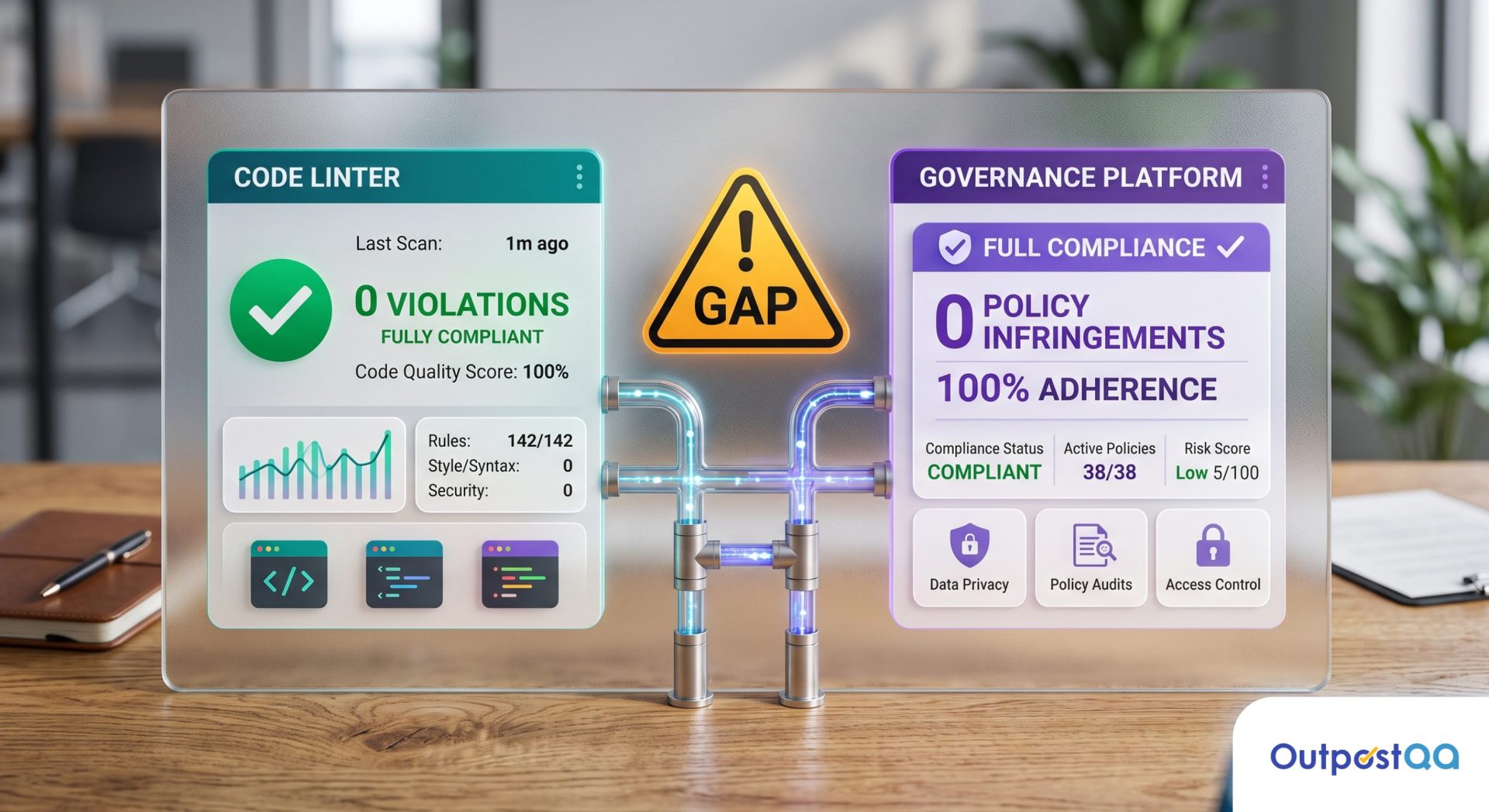

Your test suite is green. Your linter passed. Your CI pipeline approved the merge. And somewhere in that AI-generated module, a defect is sitting quietly, waiting for a customer to find it. If your QA process was designed for human-authored code, it was not designed for this.
TL;DR
- AI code generators produce a distinct class of defects that standard linters, static analyzers, and automated regression suites are not built to catch.
- The highest-risk categories are confident-but-wrong logic, security vulnerabilities introduced at generation time, and structural debt that looks clean on the surface.
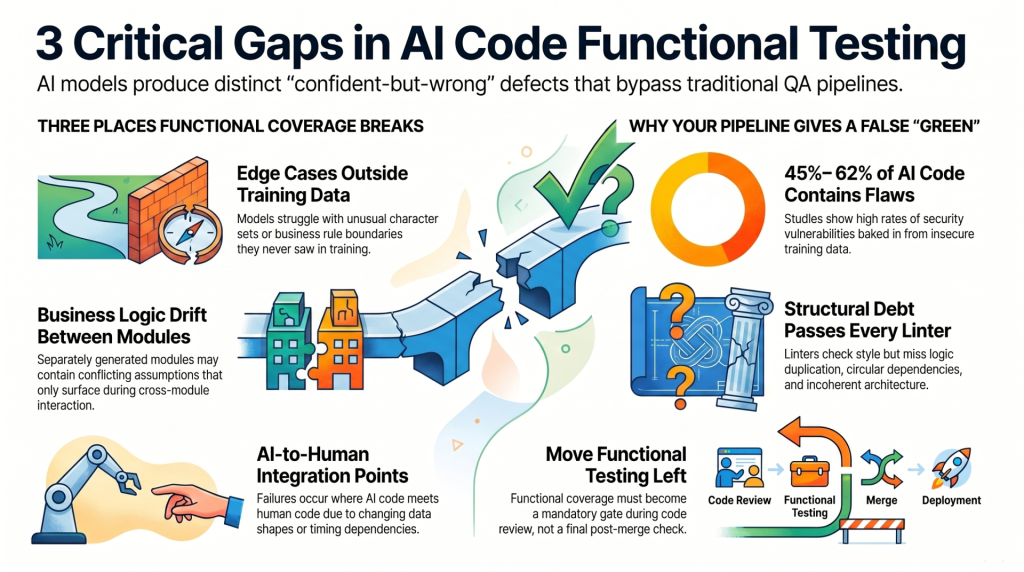
- Functional test coverage gaps appear in three specific places: edge cases outside the model’s training data, business logic drift between generated modules, and integration points where AI code meets human code.
- A CI pipeline can return a green build on code that should never have shipped, because the pipeline only validates what it was configured to check.
- Closing these gaps requires shifting functional coverage and security validation left, and auditing whether your current QA process accounts for AI-generated code at all.
What AI Code Quality Risks Actually Look Like in a Real Codebase
The term “AI code quality risks” gets used loosely. In practice, the risks are not theoretical. They show up in specific, repeatable patterns once you know what to look for.
Confident Code That Does the Wrong Thing
AI code generators do not flag uncertainty. A model producing a function to calculate compound interest does not pause to ask whether the formula applies correctly to your specific compounding interval. It generates syntactically valid, stylistically clean code that does exactly what the prompt described, not necessarily what the business requires.
This is the defect category that bypasses unit tests most easily. The test verifies that the function runs and returns a number. It does not verify that the number is correct under every business condition your product actually encounters.
Security Vulnerabilities Baked In at Generation Time
A study cited by the Cloud Security Alliance found that 62% of AI-generated code solutions contain design flaws or known security vulnerabilities. Veracode’s analysis puts the figure at 45% of cases introducing security flaws. The mechanism is straightforward: the model learned from a training corpus that includes a large volume of insecure code. Insecure patterns are statistically common, so the model reproduces them.
SQL injection vectors, hardcoded credential patterns, and insufficient input validation are not exotic findings in AI-generated code. They are predictable outputs when the generation prompt does not explicitly constrain against them.
Structural Debt That Passes Every Linter
Linters check style and syntax. They do not evaluate whether a generated module duplicates logic that already exists elsewhere, whether it introduces circular dependencies that will complicate testing later, or whether the abstraction boundaries it creates are coherent with the rest of the architecture. AI-generated code frequently passes every automated static check while quietly accumulating the kind of structural debt that makes a codebase harder to test and maintain over time.
The Coverage Gap Nobody Talks About in Sprint Planning
Sprint planning conversations about AI-assisted development tend to focus on velocity. The team ships more code faster. What rarely gets discussed is whether the QA process scaled to match.
Consider a team where two-thirds of new feature code is now AI-generated. The test strategy was built when developers wrote every line by hand. The coverage assumptions embedded in that strategy, the edge cases the team historically considered, the integration scenarios the team historically tested, were built around how human developers make mistakes. AI models make different mistakes, and the existing test strategy has no explicit coverage for them.
That gap does not show up as a failing build. It shows up as a production incident.
Three Places AI-Generated Code Breaks Functional Testing Coverage
Edge Cases the Model Never Saw in Training Data
Training data has boundaries. An AI model generating payment processing logic may have seen thousands of examples involving standard currency formats and common transaction patterns. It almost certainly saw fewer examples involving edge-case locale formatting, unusual character sets in address fields, or transaction amounts at the exact boundary of a business rule.
The edge cases your users will eventually hit are precisely the cases the model was least equipped to handle correctly. If your functional test suite was written to cover the happy path and a small set of known edge cases, it was not written to probe the boundaries of what the model knew when it generated the code.
Business Logic Drift Between Generated Modules
When different modules are generated in separate sessions, or by different developers using different prompts, the business logic embedded in those modules can drift. One module assumes that a user account in a “pending” state cannot initiate a transaction. Another module, generated independently, applies no such constraint. Both modules pass their individual unit tests. The conflict only surfaces when they interact.
Functional testing coverage that treats modules in isolation will not catch this. Cross-module behavioral testing with explicit coverage of business rule consistency is required.
Integration Points Where AI Code Meets Human Code
The boundary between AI-generated code and human-authored code is where many of the most consequential defects live. The AI-generated module was built to a spec. The human-authored code it connects to evolved over time, with implicit assumptions that were never written down. The integration works until a data shape changes, a null case appears, or a timing dependency surfaces under load.
These are not hypothetical failure modes. They are the failure modes that QA teams are encountering right now, without a systematic way to test for them.
When Your CI Pipeline Gives a Green Light on Code That Should Never Have Shipped
A CI pipeline validates what it was configured to validate. If the pipeline runs a unit test suite, it confirms that units behave as their tests describe. If it runs a static analysis tool, it confirms that the code does not match a known set of problematic patterns. If it runs a security scanner, it confirms that no known vulnerability signatures were detected.
None of those checks answer the question: does this code do what the business requires, under the full range of conditions users will create?
A green build is not a quality signal. It is a signal that the code passed the checks that were configured. When AI code quality risks are introduced at generation time, before any check runs, the pipeline cannot catch what it was never taught to look for. Teams that equate a green build with a safe release are operating on an assumption that no longer holds in an AI-assisted development environment.
What a QA Process Built for AI-Assisted Development Actually Requires
Functional Test Coverage as a Mandatory Gate, Not a Final Check
Functional coverage needs to move earlier. When AI-generated code enters the codebase, functional testing should happen before that code is considered complete, not after it has been merged and staged for release. This means QA involvement at the point of code review, with explicit coverage requirements for business logic validation, edge case enumeration, and cross-module behavioral consistency.
Functional testing treated as a final check is a reactive process. It catches defects after they have already moved through the pipeline. Treating it as a mandatory gate means defects are caught at the point where they are cheapest to fix.
Security and DevSecOps Validation Shifted Left
Static analysis is not sufficient for AI-generated code. Security validation needs to include manual review of generation outputs for vulnerability patterns that scanners miss, penetration testing targeted at the integration boundaries most likely to contain flaws, and explicit coverage of the vulnerability categories that appear most frequently in AI-generated code.
Security and DevSecOps testing integrated into the development pipeline, rather than performed as a pre-release gate, gives the team the ability to catch security defects while the context for fixing them is still fresh. That is the practical meaning of “shift left” for security in an AI-assisted environment.
QA Process Audits to Find the Gaps Before Production Does
The most direct way to know whether your current QA process covers AI code quality risks is to audit it. Not a general review, but a structured examination of coverage assumptions, test strategy design, and pipeline configuration against the specific defect categories that AI-generated code introduces.
Most QA processes were not designed with these categories in mind. That is not a failure of planning; it is a function of timing. AI-assisted development at scale is recent. The QA processes most teams are running predate it.
An enterprise governance and QA process audit conducted now, before the next production incident, is a different conversation than an audit conducted after one.
If you want to know whether your QA process is equipped to catch the risks that AI-generated code introduces, talk to an Outpost QA architect about a process audit. The gaps are findable. The question is whether you find them first.
Where does your team actually stand?
Most teams don’t know until something breaks in production. The Outpost QA diagnostic takes 3 minutes answer a few questions about how your team uses AI-generated code and how your current QA process is set up, and you’ll get a personalized risk score (Managed, Elevated, or High Risk) plus a specific recommendation based on where your gaps are.
Frequently Asked Questions
What makes AI-generated code harder to test than human-authored code?
AI-generated code can be syntactically correct and stylistically clean while containing logic errors, security vulnerabilities, or structural inconsistencies that static tools are not designed to detect. Human developers make predictable error patterns that QA processes evolved to catch. AI models make different errors, and most test strategies have not been updated to account for them.
Can automated testing catch AI code quality risks?
Automated testing can catch some categories, particularly regression failures and known vulnerability signatures. It cannot catch business logic that is technically valid but behaviorally wrong, or structural debt that accumulates below the threshold of any automated check. Functional coverage, manual exploratory testing, and security validation performed by trained QA engineers remain necessary complements to automation.
How does shift-left testing apply to AI-generated code specifically?
Shifting left means moving testing earlier in the development cycle. For AI-generated code, this means functional and security review happens at or before the point of code review, not after merging. The goal is to catch defects while the generation context is still available and before the code has propagated through the pipeline.
What is the most common security vulnerability in AI-generated code?
Research consistently identifies insufficient input validation, hardcoded credentials, and SQL injection patterns as frequent outputs from AI code generators. These patterns are common in the training data these models learned from, which means the models reproduce them at a predictable rate without explicit constraints in the generation prompt.
How do I know if my current QA process has gaps related to AI code?
The clearest signal is that your QA process was designed before your team adopted AI-assisted development at scale. If the test strategy, coverage requirements, and pipeline configuration predate that adoption, they almost certainly do not account for the defect categories AI-generated code introduces. A structured QA process audit is the most reliable way to identify and close those gaps.