
When Your Developers Are Also Your QA Team, Everyone Loses
Your developers are shipping mobile features. They are also writing the test cases, running the regression checks, and filing their own bug reports. Every sprint, that arrangement costs you more than it looks like on paper, because the production bugs landing in your App Store reviews are telling a different story than your internal coverage metrics.
TL;DR
- When developers own mobile QA, feature velocity and test quality both suffer simultaneously.
- A dedicated QA pod runs parallel to development, covering functional, regression, performance, security, and accessibility testing sprint by sprint.
- Device fragmentation is a resourcing problem: without dedicated QA, coverage gaps across iOS versions and Android OEMs are inevitable.
- Per the 2024 World Quality Report by Capgemini, quality issues on mobile remain a leading driver of user churn and negative app store ratings.
- Removing QA from the developer’s job description compresses release cycles and shifts bug discovery from production to staging.
QA at most mobile engineering organizations looks like a developer finishing a feature, switching contexts, and spending the next two hours tapping through their own screens looking for something they built and therefore cannot see objectively. It looks like regression coverage that shrinks every sprint because there is never enough time. It looks like a release that ships because the deadline arrived, not because anyone signed off on quality.
The cost is not just bugs in production. It is developer morale, sustained over months. Senior engineers did not take the job to run smoke tests on their own PRs. When QA is nobody’s dedicated responsibility, it becomes everybody’s least favorite part of the job, and it shows in the work.
Per the 2024 World Quality Report by Capgemini, teams without dedicated QA functions report significantly longer defect resolution cycles and higher rates of production escapes than teams with embedded QA coverage. The pattern holds consistently in mobile, where device fragmentation and OS version variance amplify every coverage gap.
What a Dedicated Mobile QA Pod Does Sprint by Sprint
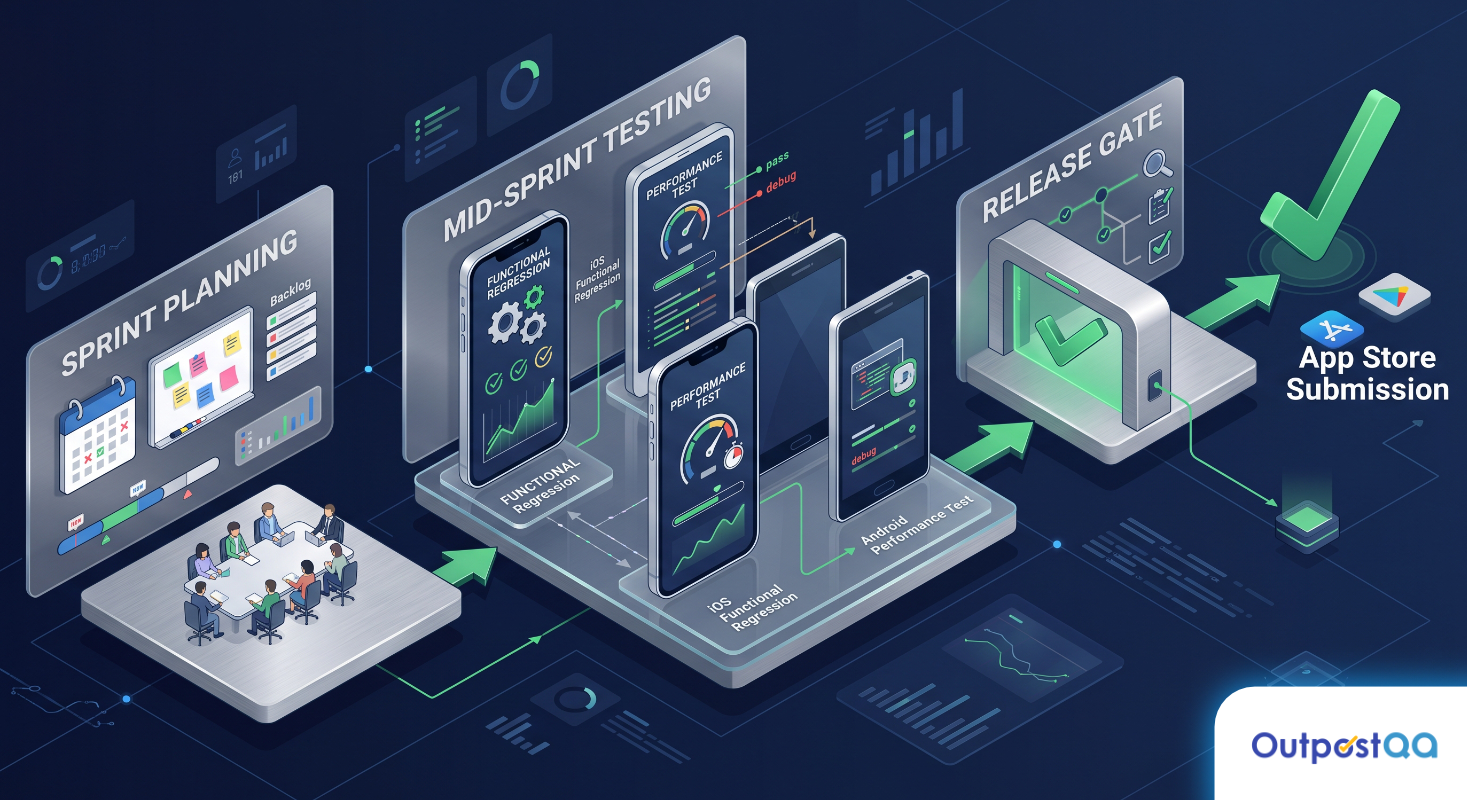
The practical answer to “what does QA look like in mobile apps” is not a list of test types. It is a cadence. A dedicated QA pod does not hand off at the end of the sprint; it runs parallel to development from day one of planning through the moment a build clears the release gate.
Sprint Planning: Scoping Test Coverage Before a Line of Code Is Written
In the planning session, a QA engineer reviews the upcoming stories alongside the product and engineering team. The goal is acceptance criteria specific enough to test against. If a story says “improve checkout flow,” QA flags that before development begins, not after. Test cases are drafted against defined behaviors, edge cases are documented, and the device matrix for that sprint’s features is scoped.
This is where shift-left testing pays its most visible dividend. Ambiguous requirements caught in planning cost thirty minutes. The same ambiguity caught after a developer has built against it costs a sprint.
Mid-Sprint: Running Functional, Regression, and Device Matrix Tests in Parallel
While development continues on new stories, QA is running functional tests on completed features and regression tests on existing flows. Bugs are filed the same day they are found, triaged in standup, and routed back to the developer who wrote the code while the context is still fresh. Turnaround time on a bug found on day three of a sprint is measured in hours. Turnaround time on a bug found the day before release is measured in days, sometimes sprints.
The device matrix runs in parallel, not at the end. If a layout breaks on a Samsung Galaxy running Android 13, that surfaces mid-sprint, not at the release gate.
Release Gate: The Checklist That Stands Between a Build and the App Store
No build advances to the App Store without clearing a defined release gate. The checklist is not improvised: it covers critical path functional flows, regression suite results, performance benchmarks under constrained network conditions, security validation for session handling and data permissions, and accessibility checks against the WCAG 2.2 mobile guidance. A build that fails any gate criterion does not ship. That sounds obvious, but it requires someone with the authority and the time to enforce it, and that person cannot be the developer who wrote the feature.
Four Test Types That Define Real Mobile QA Coverage
Functional Testing Across iOS and Android Variants
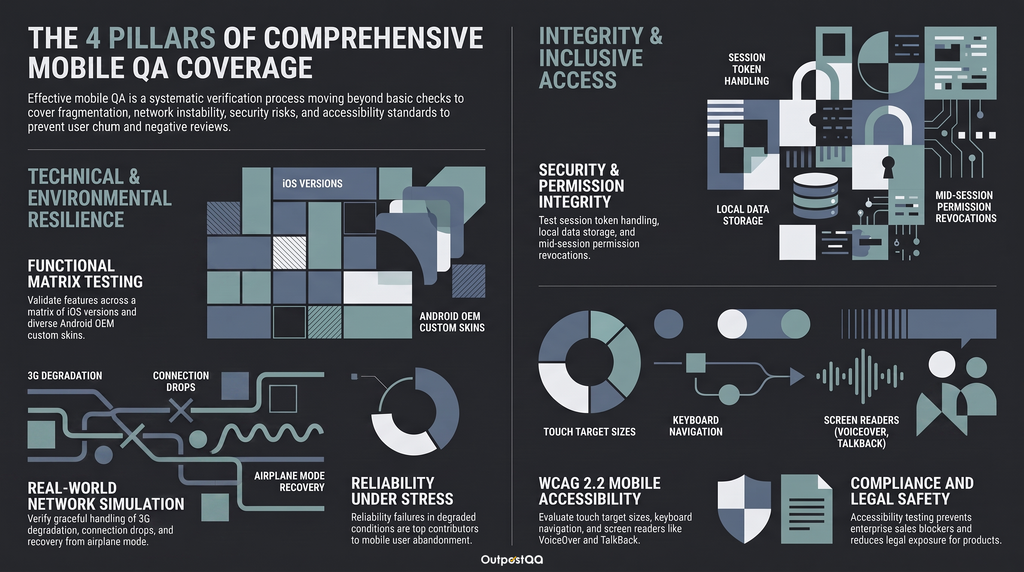
Functional testing on mobile is not a single pass on one device. It covers the declared acceptance criteria for each feature across a matrix of OS versions and device classes. An app that works correctly on iOS 17 may behave differently on iOS 16.4. A layout that renders cleanly on a Pixel 8 may break on a mid-range Android OEM with a custom skin. A dedicated QA team maintains that matrix and executes against it systematically, not opportunistically.
Performance Testing Under Real Network Conditions
Mobile users do not always operate on a stable Wi-Fi connection. Performance testing simulates 3G degradation, connection drops mid-session, background data throttling, and recovery from airplane mode. An app that times out silently instead of surfacing a helpful error state will generate one-star reviews from users who never understand why their order disappeared. According to research cited by the DORA State of DevOps Report, reliability failures under degraded conditions are among the top contributors to user abandonment on mobile platforms.
Security Testing for Session, Permission, and Data Handling
Mobile security testing covers session token handling, permission escalation risks, insecure local data storage, and the behavior of the app when a user revokes a permission mid-session. For fintech and healthtech products, this is a compliance requirement as much as a quality one. A QA team with a security testing practice validates these surfaces on every release, not only when a penetration tester is engaged for an annual audit.
Accessibility Testing Against WCAG 2.2 Mobile Guidance
Accessibility testing is the least common item on a mobile QA checklist and the one most likely to create enterprise sales blockers and legal exposure. WCAG 2.2 introduced new success criteria specifically relevant to mobile interactions, including target size requirements for touch controls and focus appearance for keyboard-equivalent navigation. Outpost QA’s accessibility testing covers screen reader compatibility, color contrast, and touch target sizing across iOS VoiceOver and Android TalkBack, which are the two assistive technology environments that matter most in the App Store ecosystem.
Device Fragmentation Is a Resourcing Problem, Not Just a Technical One
Engineering leaders often frame device fragmentation as a tooling problem. Get the right test automation framework, get the right device cloud, and coverage will follow. In practice, fragmentation is a capacity problem. Building a realistic device matrix, deciding which combinations represent your actual user base, maintaining the automation that runs against it, and triaging failures that are device-specific rather than code-specific all require dedicated hours that a developer doing their own QA does not have.
Consider a team shipping a React Native app targeting iOS and Android. Even scoping conservatively, the relevant test matrix covers the two most recent major iOS versions, four or five Android API levels, and at least six to eight physical device classes representing different manufacturers, screen densities, and RAM configurations. Running that matrix manually on a two-week sprint cycle is a full-time job. Maintaining the automation that runs it is a separate full-time job. Developers cannot do both while also shipping features, and expecting them to produces the predictable result: coverage shrinks to whatever the developer can reach on the device sitting next to their laptop.
Outpost QA’s mobile app testing service runs this matrix as a standard part of the engagement, not as an add-on. The pod manages the device coverage strategy, maintains the automation layer, and surfaces device-specific defects before they reach the store.
Eight Sleep ran into this directly when a simultaneous mobile app redesign and hardware launch created a fragmentation problem their offshore QA vendor could not keep pace with. After Outpost QA embedded into their sprint cycle, defect rates dropped 45% and the launch cleared without a critical production escape.
What Changes When QA Is No Longer the Developer’s Job
The immediate change is time. Developers get their focus back. Sprint capacity previously consumed by context-switching into test mode returns to feature development. PRs move faster because the developer is not also waiting to validate their own work before merging.
The second change is bug discovery timing. Defects found mid-sprint by a QA engineer cost a fraction of what defects found post-release cost to fix. Research consistently places the cost multiplier for post-release fixes at ten times or more compared to defects caught during active development. The exact figure varies by study, but the direction is not in dispute.
The third change is accountability. When QA owns release quality, the release gate has teeth. A build does not ship because the calendar says it should; it ships because a dedicated team has signed off on it. That shift in accountability changes how engineering teams think about quality, not just how they test for it.
If your mobile engineering team is carrying QA as an unofficial second job, the velocity cost is already showing up in your sprint metrics. Talk with a QA Architect at Outpost QA about what an embedded mobile QA pod looks like inside your sprint cycle.
Frequently Asked Questions
How quickly can a dedicated mobile QA pod integrate into an existing sprint cycle?
Most teams reach full integration within one to two sprints. The first sprint typically covers onboarding, test environment setup, and initial device matrix scoping. By the second sprint, the QA pod is running parallel to development on active stories.
What is the difference between a QA pod and a QA contractor?
A QA pod is a structured team assigned to your product with a defined scope, delivery cadence, and clear accountability for release quality. A contractor is an individual filling hours. The operational difference shows up in sprint planning, triage bandwidth, and the ability to cover multiple test types simultaneously.
Does a dedicated mobile QA team replace test automation, or run alongside it?
Both. A dedicated QA team builds and maintains the automation layer that covers regression and runs in CI/CD, while also running exploratory and functional testing on new features where automation has not yet been written. The two are complementary, not alternatives.
How does a nearshore QA pod handle device matrix coverage?
The QA team maintains a defined device matrix based on your actual user analytics and App Store distribution data. That matrix is reviewed and updated each quarter as OS versions shift and new device classes enter the market.
When should an engineering leader bring in dedicated mobile QA rather than hire internally?
When the time-to-hire for a senior mobile QA engineer exceeds the time the team can afford to operate without dedicated coverage. Hiring internally takes three to six months on average; an embedded QA pod can be operational in two to four weeks.