
A firmware defect that ships is not a bug report waiting in your backlog. It is a recall notice, an FDA inquiry, or a factory floor stoppage waiting to happen. CTOs shipping connected hardware products often carry this risk without a clear framework for evaluating whether their firmware testing is rigorous enough to catch failure modes before product reaches the field. A specialized firmware testing company exists to close that gap, but the discipline is poorly understood even by the engineering leaders who need it most.
TL;DR
- Firmware defects discovered post-shipment cost orders of magnitude more to remediate than application-layer bugs caught in development.
- A firmware testing company validates bootloader behavior, OTA update integrity, hardware-in-the-loop scenarios, and environmental edge cases that generic QA vendors do not cover.
- Regulated industries (medical, avionics, industrial control) impose specific firmware validation standards that require specialized knowledge to satisfy.
- The firmware testing services market is fragmented because the discipline sits between hardware engineering and software QA, and few firms have built expertise in both.
- Before selecting a firmware testing partner, evaluate their experience with your target hardware architecture, their approach to HIL versus emulation, and their familiarity with your regulatory framework.
Firmware Defects Are Not Application Bugs, The Economics Are Different
What does it cost to fix a firmware bug after a product has shipped? The answer is rarely a patch pushed silently to production. Capers Jones’s defect cost escalation research, referenced widely in software engineering literature, documents that the cost to fix a defect grows by a factor of 10 to 100 as it moves from development to post-release. For firmware embedded in deployed hardware, the upper end of that range is conservative. A recall of a consumer IoT device or medical instrument adds logistics, regulatory reporting, brand damage, and potential liability that application software never encounters.
Per industry analysis from IPC, electronics rework at the board level is already expensive before a product leaves the factory. After it ships, the cost structure changes entirely because the fix must reach physical devices distributed across thousands of locations. Engineering leadership that treats firmware QA as an extension of application testing is pricing the risk incorrectly.
What Does a Firmware Testing Company Actually Test?
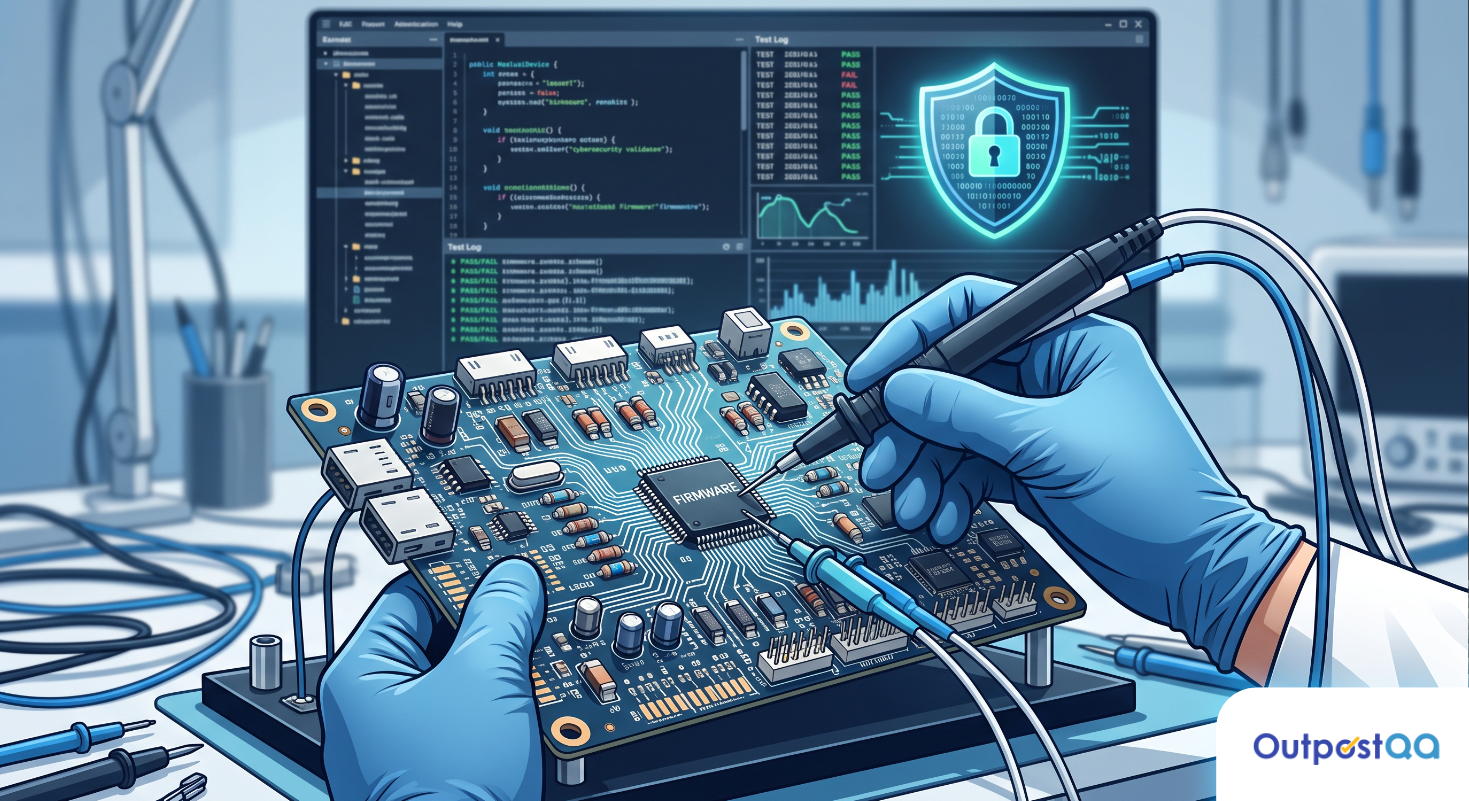
A firmware testing company tests the software layer that runs directly on embedded hardware, including microcontrollers, system-on-chip designs, and programmable logic. This is distinct from application-layer QA in both method and failure mode. The test surface includes memory management, peripheral communication, interrupt handling, and power-cycle behavior, none of which appear in a standard web or mobile test plan.
Bootloader and Initialization Validation
The bootloader is the first code executed when a device powers on. Failures here are catastrophic: the device does not start, or it starts in an undefined state that corrupts downstream behavior. A firmware testing company validates boot sequence correctness across a defined set of memory states, power-on conditions, and hardware variants. This includes testing corrupt flash scenarios, secure boot chain validation, and recovery behavior when initialization fails partway through.
OTA Update Integrity and Rollback Behavior
Over-the-air firmware updates are now standard for connected products, and they introduce a failure mode that did not exist in earlier embedded systems. A partial update, a power loss mid-flash, or a network interruption can leave a device in an unbootable state. Specialized firmware QA validates that the update mechanism handles failure conditions gracefully, that rollback to the previous firmware version executes correctly, and that update signatures are verified before any flash write begins.
Hardware-in-the-Loop Simulation vs. Emulation
Hardware-in-the-loop (HIL) simulation connects the firmware under test to real or simulated hardware signals, letting the test system inject stimulus that would otherwise require physical test environments. Emulation runs the firmware on a software model of the target processor. A firmware testing company understands when each approach is appropriate. HIL rigs are expensive and time-consuming to configure but catch timing-sensitive defects that emulation misses. Emulation scales for early-stage regression but cannot replicate peripheral bus behavior or interrupt latency accurately.
Environmental and Voltage-Edge-Case Testing
Firmware runs on hardware that operates across a range of temperatures, supply voltages, and electromagnetic conditions. A device that passes all functional tests at nominal voltage may crash at the low end of its rated supply range because a timing assumption in the firmware no longer holds. A specialized firmware testing company runs stress tests across the device’s rated environmental envelope, including voltage margining, thermal cycling, and power-supply noise injection, to surface defects that only appear at the edges of operating conditions.
Regulated Industries Raise the Stakes Even Further
Medical devices, avionics software, and industrial control systems operate under firmware validation requirements codified in law and enforced by regulatory bodies. FDA 21 CFR Part 11 governs electronic records and signatures in medical device software. DO-178C defines software levels and required evidence for avionics certification. IEC 62443 sets security requirements for industrial control system software.
A firmware testing company working in these sectors must produce evidence artifacts, not just pass/fail results. Traceability matrices, test case coverage reports, and deviation documentation are required inputs for regulatory submissions. A vendor without experience in these frameworks cannot produce the documentation that regulators expect. A late-stage audit finding that the firmware test record is insufficient carries the same consequence as a functional defect: delayed clearance or market withdrawal.
According to the World Quality Report by Capgemini, embedded and IoT systems consistently rank among the highest-complexity testing environments, with organizations reporting lower test automation coverage in embedded domains than in any other software category. For regulated industries, that means manual testing remains a larger share of the validation effort, which raises cost and extends timelines if not planned for deliberately.
Why the Firmware Testing Market Remains Fragmented
The firmware testing services market has not consolidated around a small set of dominant vendors the way web application QA has. The structural reason is that firmware QA sits at the boundary of two disciplines that have historically been separate: hardware engineering and software quality assurance. Hardware engineers understand the silicon but often lack formal testing methodology. Software QA professionals understand test design and automation but typically have no background with embedded toolchains, JTAG debuggers, or oscilloscope-based signal validation.
Building a team fluent in both domains is genuinely difficult. It requires engineers who can read a schematic, configure a logic analyzer, and also write test harnesses in C or Python against a hardware abstraction layer. That combination is rare, which explains why firms capable of providing genuine firmware testing services are fewer than market demand would suggest.
CTOs evaluating the vendor landscape should treat a firm’s willingness to describe their test infrastructure in specific terms as a qualifying signal. A vendor that answers questions about HIL rig configuration or JTAG chain management in concrete terms has the capability. A vendor that answers in marketing language probably does not.
Three Questions to Ask Before Selecting a Firmware Testing Partner
Before committing to a firmware testing company, bring three specific questions to the evaluation conversation.
1. What Hardware Architectures Have You Tested Against in Production?
Firmware testing expertise is architecture-specific. A vendor experienced with ARM Cortex-M microcontrollers may not have the toolchain familiarity needed for RISC-V or MIPS-based targets. Ask for named examples. A firm that has only worked with one chip family is a higher-risk partner for a product built on a different architecture.
2. What Is Your Approach to Test Automation for Embedded Systems?
Automation in firmware QA is real but constrained by hardware access. Ask how the vendor instruments firmware under test, whether they use on-chip debug interfaces, hardware test harnesses, or a hybrid approach. Ask what their continuous integration story looks like for embedded builds. A mature firmware testing company will have an answer that involves specific tools and a defined workflow, not a general statement about automation philosophy.
3. What Regulatory Experience Do You Have That Is Relevant to Our Product Category?
If your product requires regulatory clearance, this question is not optional. Ask the vendor to name specific standards they have supported, which regulatory bodies reviewed the documentation they produced, and whether they have experience preparing traceability matrices for submission. A firm that has never produced DO-178C evidence artifacts cannot credibly support an avionics certification program on your timeline.
If your embedded product roadmap carries regulatory, recall, or market-timing risk and you want to think through what that means for your QA strategy, connect with the team at Outpost QA to have that conversation at the strategy level.
Frequently Asked Questions
What is the difference between firmware testing and embedded software testing?
The terms are often used interchangeably, but firmware testing typically refers to validation of software that runs directly on hardware without an operating system or with a real-time operating system, while embedded software testing can encompass higher-level application layers running on embedded Linux or similar platforms. The distinction matters because the tooling, test access methods, and failure modes differ significantly between bare-metal firmware and embedded application software.
Can firmware testing be automated?
Yes, but with meaningful constraints. Automation in firmware testing requires either a hardware test harness that can flash and reset the device under test programmatically, or an emulation environment that accurately models the target hardware. Bootloader tests, OTA update flows, and communication protocol validation are good candidates for automation. Analog and environmental edge-case tests typically require physical equipment and cannot be fully automated.
How early in the development process should firmware testing begin?
Firmware testing should begin at the unit level as soon as individual modules are written, well before hardware prototypes are available. Hardware mocks and emulation allow unit tests to run in a host environment. System-level testing against real hardware should begin as soon as stable prototypes exist. Delaying all firmware testing until hardware is finalized is one of the most common sources of late-stage defect cost escalation.
What does it cost to recall a firmware-defective product?
The cost depends heavily on product category, distribution scale, and regulatory jurisdiction. Consumer electronics recalls have ranged from tens of millions to hundreds of millions of dollars when accounting for logistics, replacement, regulatory fines, and brand impact. Medical device recalls carry additional costs from FDA reporting requirements and potential legal liability. The general principle is that post-shipment firmware remediation costs are non-linear: a defect affecting one percent of deployed units can consume a disproportionate share of annual operating budget.
What should I look for in a firmware testing company’s test documentation?
Look for traceability between requirements and test cases, explicit pass and fail criteria defined before test execution, documented test environment configuration including hardware revision and firmware build hash, and a clear record of how anomalies were handled and resolved. Documentation that cannot be reconstructed by someone who was not present during testing is insufficient for regulatory purposes and signals an immature test process regardless of regulatory context.