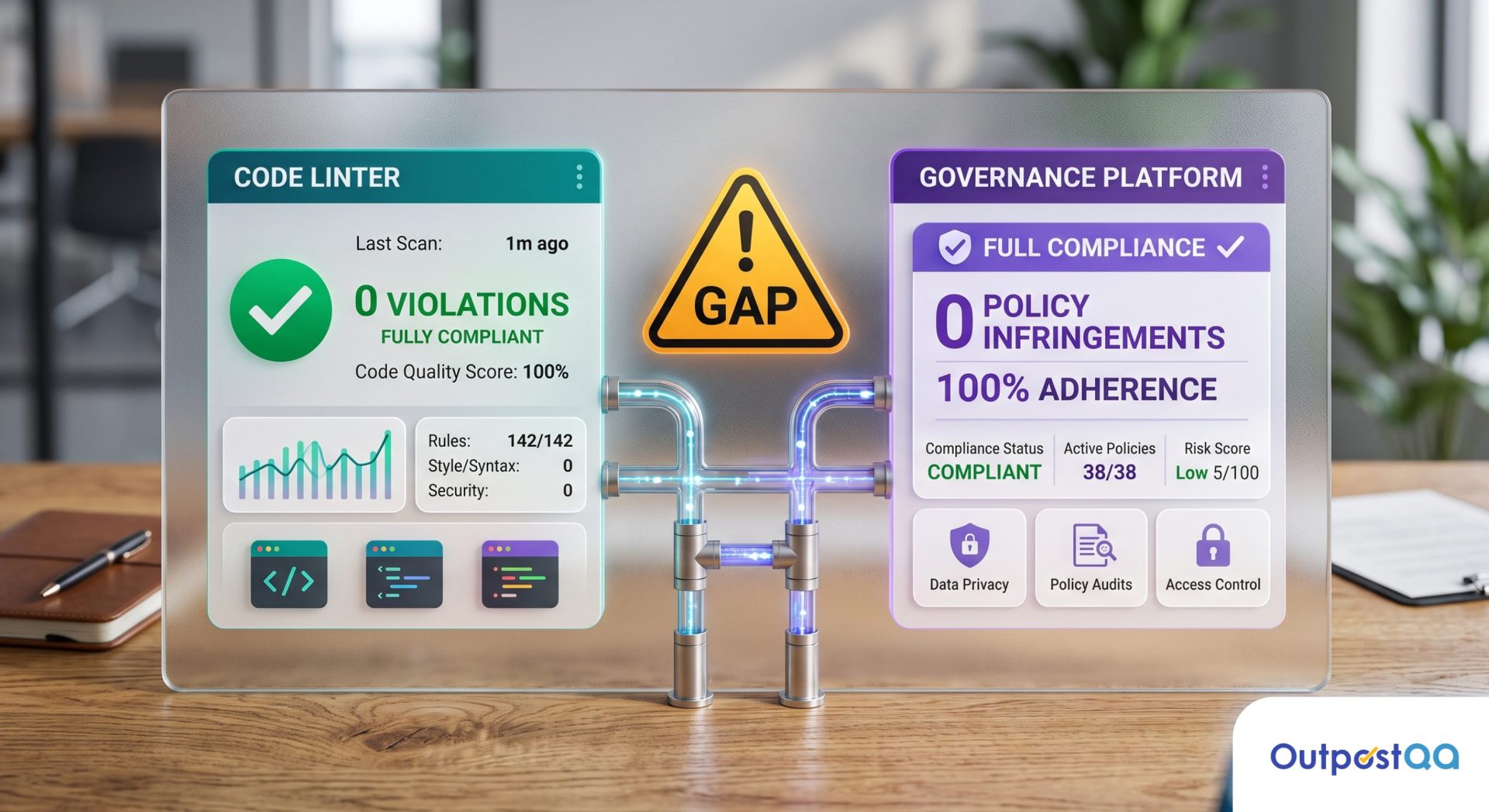
Security gates are supposed to accelerate safe delivery. In practice, many engineering teams add them to a CI/CD pipeline and watch release cycles lengthen instead. The tools are configured by developers who are not security QA specialists, false positives accumulate, manual overrides become routine, and the gates that were meant to protect the pipeline end up blocking it. The problem is not the concept of DevSecOps. The problem is ownership.
TL;DR
- A DevSecOps pipeline embeds security testing directly into CI/CD stages, not as a final checkpoint but as a continuous gate at every phase from pre-commit through production monitoring.
- Most pipeline slowdowns come from developers owning security gate configuration without dedicated QA expertise to tune thresholds, manage false positives, and maintain coverage.
- Each of the six pipeline stages requires a distinct QA activity: secrets detection, static analysis, dynamic testing, policy enforcement, environment validation, and continuous scanning.
- Dedicated QA ownership of security and quality gates removes the bottleneck without pulling developers off feature work.
- According to the DORA State of DevOps Report, elite-performing teams deploy 973 times more frequently than low performers; unclear gate ownership is a primary driver of the gap between those categories.
What a DevSecOps Pipeline Actually Is (and What It Is Not)
A DevSecOps pipeline is a CI/CD pipeline where security validation is automated and continuous, not a separate audit phase that happens before a release. Every code change triggers security checks alongside functional and regression tests. Vulnerabilities are caught at the point of introduction, not discovered weeks later during a penetration test.
What it is not: a security team reviewing pull requests manually, a quarterly compliance scan, or a checklist your developers complete before pushing to production. Those approaches treat security as a handoff. A DevSecOps pipeline treats it as a built-in property of every deployment.
The shift-left principle is central here. Fixing a vulnerability in pre-commit scanning costs a fraction of fixing it after deployment. The OWASP DevSecOps Guideline estimates that defects caught earlier in the pipeline are orders of magnitude cheaper to resolve than those found in production, a figure consistent with what security engineering teams report across the industry.
The gap most teams miss: building the pipeline requires knowing how to configure each security gate, interpret its output, tune its thresholds, and maintain it as the codebase evolves. That is QA work, not developer work.
The Six Stages of a DevSecOps Pipeline and Who Should Own Each One
Mapping each stage to a specific activity and a responsible owner is where most teams go wrong. The stages below follow the code-to-production lifecycle. Each has a distinct purpose, a distinct tooling category, and a distinct ownership question that most teams answer incorrectly.
Stage 1: Pre-Commit, Secrets Detection and Dependency Scanning
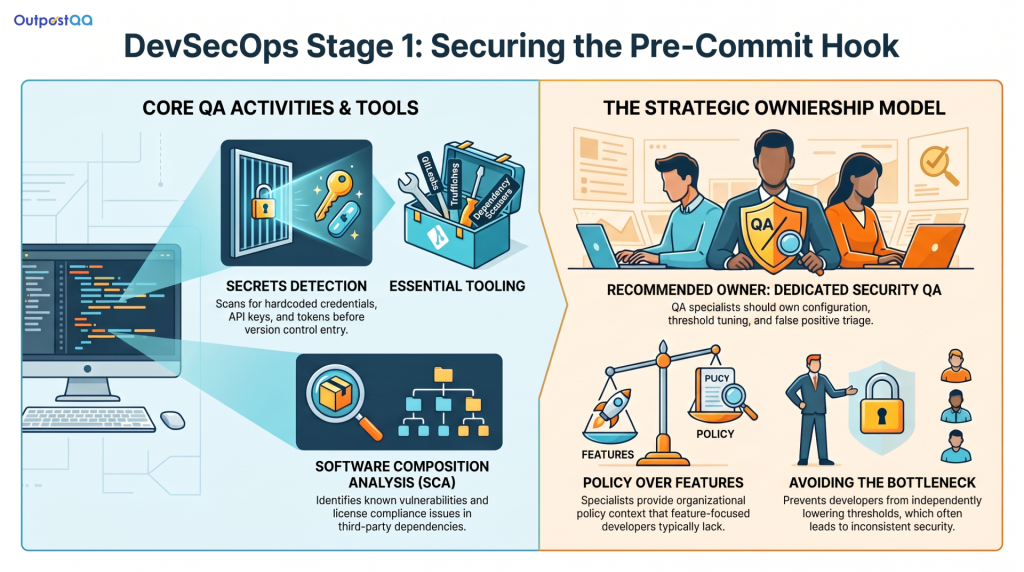
Before code reaches the repository, two checks should run automatically on the developer’s machine or as a pre-commit hook: secrets detection and software composition analysis (SCA).
Secrets detection scans for hardcoded credentials, API keys, and tokens. Tools like GitLeaks or Trufflehog catch these before they enter version control, where they become a permanent liability even after deletion. SCA identifies known vulnerabilities in third-party dependencies and flags license compliance issues.
Who should own configuration and threshold tuning: a dedicated QA or security QA function. Developers should not be deciding which secret patterns to flag or which dependency CVE severity levels to block on. Those decisions require policy context that most feature developers do not have.
Stage 2: Build, SAST and License Compliance Checks
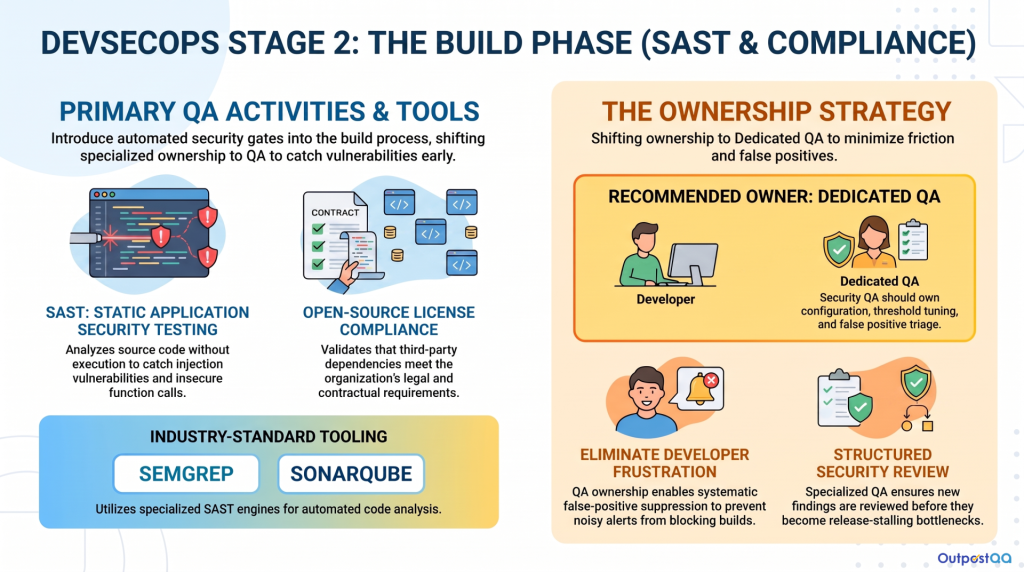
Static Application Security Testing (SAST) runs against source code during the build phase. It analyzes code without executing it, catching injection vulnerabilities, insecure function calls, and common weakness patterns before a binary is produced.
License compliance checks confirm that open-source dependencies meet the organization’s legal and contractual requirements. This matters for any team shipping to enterprise clients or operating under regulatory frameworks.
False positive rates in SAST tools are the single biggest source of developer frustration at this stage. When a SAST tool is misconfigured, developers learn to ignore its output. A QA team that owns the SAST configuration, suppresses known false positives systematically, and reviews new findings before they block a build keeps the gate useful rather than noisy.
Stage 3: Test, DAST, Functional QA, and Performance Baselines
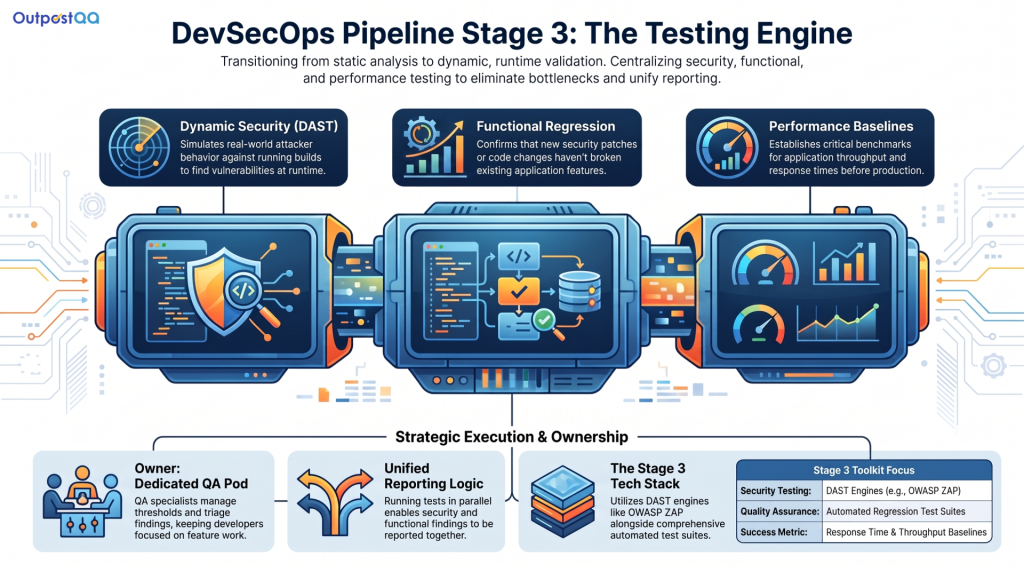
The test stage is where most QA activity concentrates. Three things should run here in parallel or in sequence depending on pipeline architecture.
Dynamic Application Security Testing (DAST) executes against a running instance of the application, simulating attacker behavior by sending malformed input, testing authentication flows, and probing for injection points. Functional QA runs the regression suite to confirm that security changes have not broken existing behavior. Performance baselines verify that the build meets response time and throughput thresholds before it advances.
This is the stage where a dedicated QA function has the clearest ownership claim. Outpost QA’s Security & DevSecOps practice covers this layer, integrating DAST execution and functional regression within the same pipeline stage so security findings and quality regressions are reported together rather than as separate workflows.
Stage 4: Release Gate, Policy Enforcement and Regression Coverage
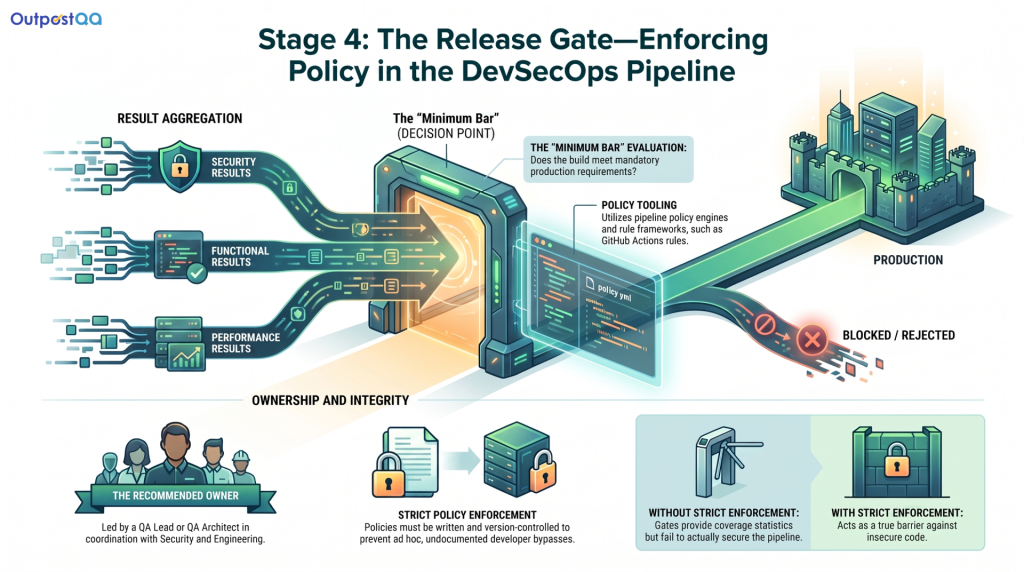
The release gate is a decision point, not a testing phase. It aggregates results from the previous stages and enforces a policy: does this build meet the minimum bar to advance toward production?
Policy enforcement typically covers: no critical or high SAST findings without a documented exception, DAST findings below a defined threshold, regression suite pass rate above a defined percentage, and performance baselines within acceptable range.
Who should own gate policy: a QA lead or QA architect in coordination with security and engineering leadership. The policy should be written down, version-controlled, and reviewed on a cadence. If developers are making ad hoc decisions about whether to override a failing gate, the gate is not functioning as a gate.
Stage 5: Deploy, Environment Validation and Configuration Audits
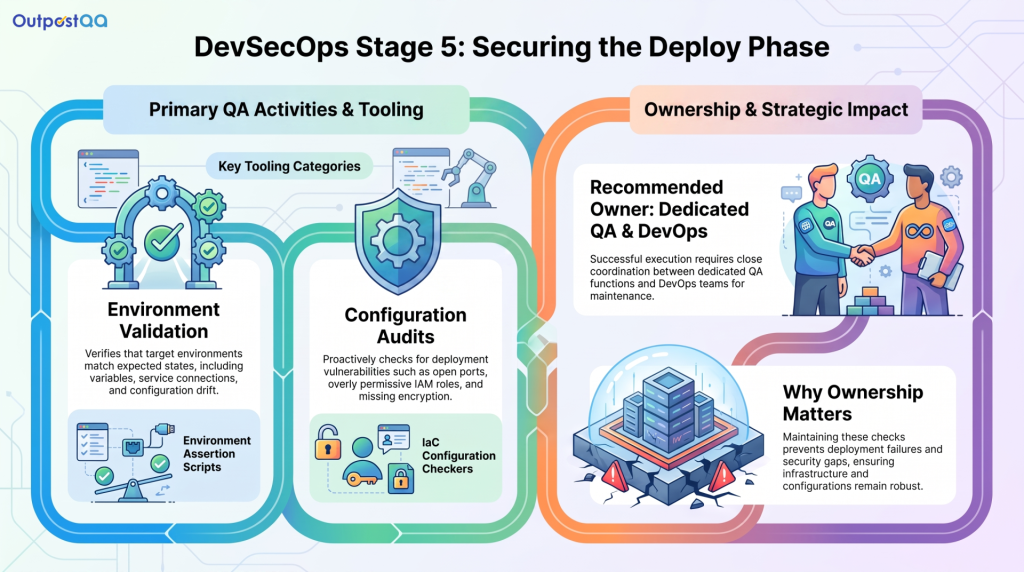
Before the build lands in a target environment, two checks should confirm the environment itself is ready and correctly configured. Environment validation verifies that infrastructure configuration matches the expected state: correct environment variables, expected service connections, no configuration drift from the last known good state. Configuration audits check for security misconfigurations in the deployment environment, such as open ports, permissive IAM roles, or missing encryption settings.
Test Automation & CI/CD Integration work covers the scripting and maintenance of these environment checks as part of the broader pipeline automation layer.
Stage 6: Monitor, Continuous Vulnerability Scanning and Incident Signals
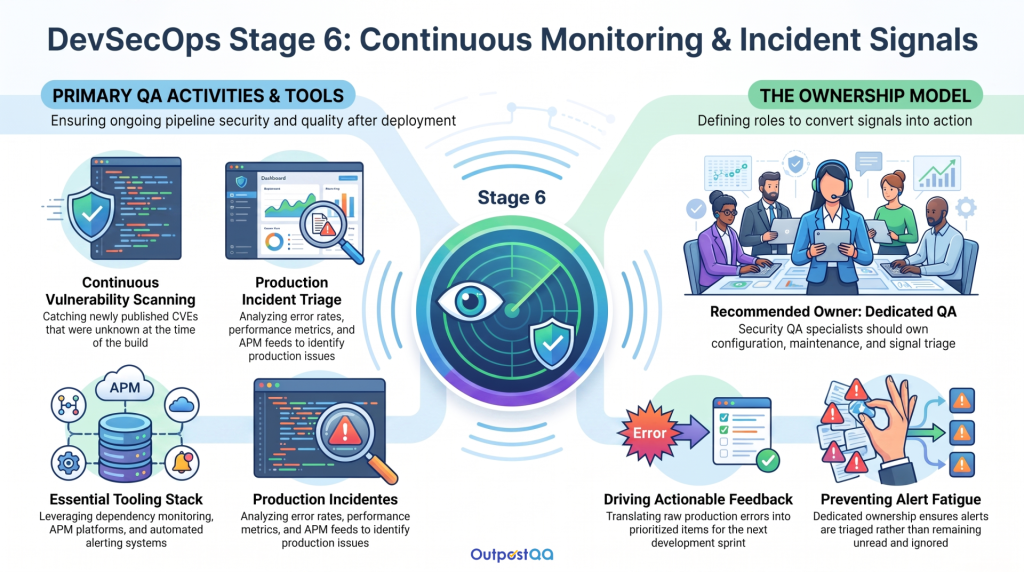
After deployment, the pipeline does not stop. Continuous vulnerability scanning runs against production dependencies on a schedule, catching newly published CVEs that were not known at build time. Incident signals, application performance monitoring, and error rate alerts feed back into the development cycle as inputs for the next sprint.
This stage is often the least mature in teams that have just adopted DevSecOps. The tooling is straightforward; acting on the signals consistently is harder. A defined escalation path and ownership model for production alerts is what separates a monitoring stage that actually functions from one that generates alerts nobody reads.
When Developers Own the Security Gates, Releases Slow Down
The DORA State of DevOps Report consistently shows that elite-performing teams deploy 973 times more frequently than low performers, with mean time to recovery measured in hours rather than days. One of the clearest differentiators between those categories is clear ownership of the delivery pipeline, including its security layers.
When developers own security gate configuration, three things tend to happen. First, gate thresholds are set too permissively to avoid blocking their own work. Second, when a gate does block a build, the default response is a manual override rather than root cause resolution. Third, maintenance of the gate configuration falls behind as the codebase evolves, and gates that were tuned for last quarter’s dependencies are no longer catching the right things.
None of this is a failure of individual developers. It is a structural problem. Developers are hired to build features. Asking them to also be security QA specialists, false positive arbiters, and pipeline gate maintainers is asking them to do two jobs simultaneously, and neither gets done well.
A dedicated QA function that owns the security and quality gates solves the structural problem. Developers stay on feature work. Gates stay tuned. Releases move through the pipeline without accumulating manual overrides.
The Pipeline Stage Table: QA Activity, Tooling, and Ownership
The table below maps each DevSecOps pipeline stage to the primary QA activity, the recommended tool category, and the team that should own it. Ownership here means configuration, maintenance, threshold decisions, and false positive triage, not just execution.
| Stage | QA Activity | Tool Category | Recommended Owner |
|---|---|---|---|
| Pre-Commit | Secrets detection, dependency scanning | SCA, secrets scanning (e.g., GitLeaks) | Dedicated QA / Security QA |
| Build | SAST, license compliance | SAST engine (e.g., Semgrep, SonarQube) | Dedicated QA / Security QA |
| Test | DAST, functional regression, performance baseline | DAST (e.g., OWASP ZAP), test automation suite | Dedicated QA Pod |
| Release Gate | Policy enforcement, coverage threshold | Pipeline policy engine (e.g., GitHub Actions rules) | QA Lead / QA Architect |
| Deploy | Environment validation, configuration audit | Environment assertion scripts, config checks | Dedicated QA / DevOps in coordination |
| Monitor | Continuous CVE scanning, incident signal triage | Dependency monitoring, APM, alerting | Dedicated QA / Security QA |
The pattern across every stage is consistent: the work requires QA expertise, not developer bandwidth. Building a pipeline where each of these stages is owned by a developer who also has sprint commitments is the most common reason DevSecOps implementations slow releases rather than protecting them.
If your team is adding security gates without a clear owner for each stage, the audit that matters most right now is not a tool selection exercise. It is a resourcing and ownership review. Book a pipeline audit with an Outpost QA architect to map your current security gate ownership and identify where bottlenecks are forming before they become a release pattern.
Frequently Asked Questions
What is the difference between a DevSecOps pipeline and a standard CI/CD pipeline?
A standard CI/CD pipeline automates build, test, and deployment steps to speed up delivery. A DevSecOps pipeline adds automated security testing gates at each of those stages, so vulnerabilities are caught continuously during development rather than in a separate security review phase. The structural difference is that security validation runs on every code change, not periodically or as a final checkpoint.
How long does it take to build a DevSecOps pipeline from scratch?
The timeline depends on the existing CI/CD maturity, codebase size, and security gate configuration complexity. Teams with a functioning CI/CD pipeline can add pre-commit secrets detection and SAST in a matter of days. A fully configured pipeline with tuned thresholds, DAST integration, release gate policies, and monitoring typically takes four to eight weeks to reach a stable state. The ongoing maintenance work, false positive triage and gate tuning, is continuous rather than a one-time effort.
What causes false positives in DevSecOps security gates and how do you reduce them?
False positives in SAST and DAST tools result from misconfigured rule sets, overly broad scanning patterns, and rules that have not been tuned to the specific codebase and technology stack. Reducing them requires systematic suppression of known false findings with documented rationale, regular review cycles to retire outdated rules, and threshold calibration based on actual vulnerability patterns in the codebase. This is configuration and maintenance work that benefits from dedicated ownership by a QA function rather than ad hoc developer review.
Which pipeline stage is most commonly misconfigured?
The release gate is the stage that fails most often in practice. Teams configure individual scanning tools correctly but then treat the gate decision as informal, allowing manual overrides without documented exceptions or escalation paths. A release gate that developers can bypass at will provides coverage statistics but does not actually enforce policy. The fix is a written gate policy, version-controlled, with defined exception processes and a QA owner responsible for enforcing it.
Does a DevSecOps pipeline replace penetration testing?
No. Automated pipeline security gates catch known vulnerability patterns and common weaknesses at the code level, but they do not replicate the adversarial creativity of a skilled penetration tester. DAST and SAST catch what tools are trained to find; penetration testing finds what creative attackers discover through exploration. A mature security program uses DevSecOps pipeline automation as a continuous baseline and scheduled penetration testing as a deeper periodic validation layer.