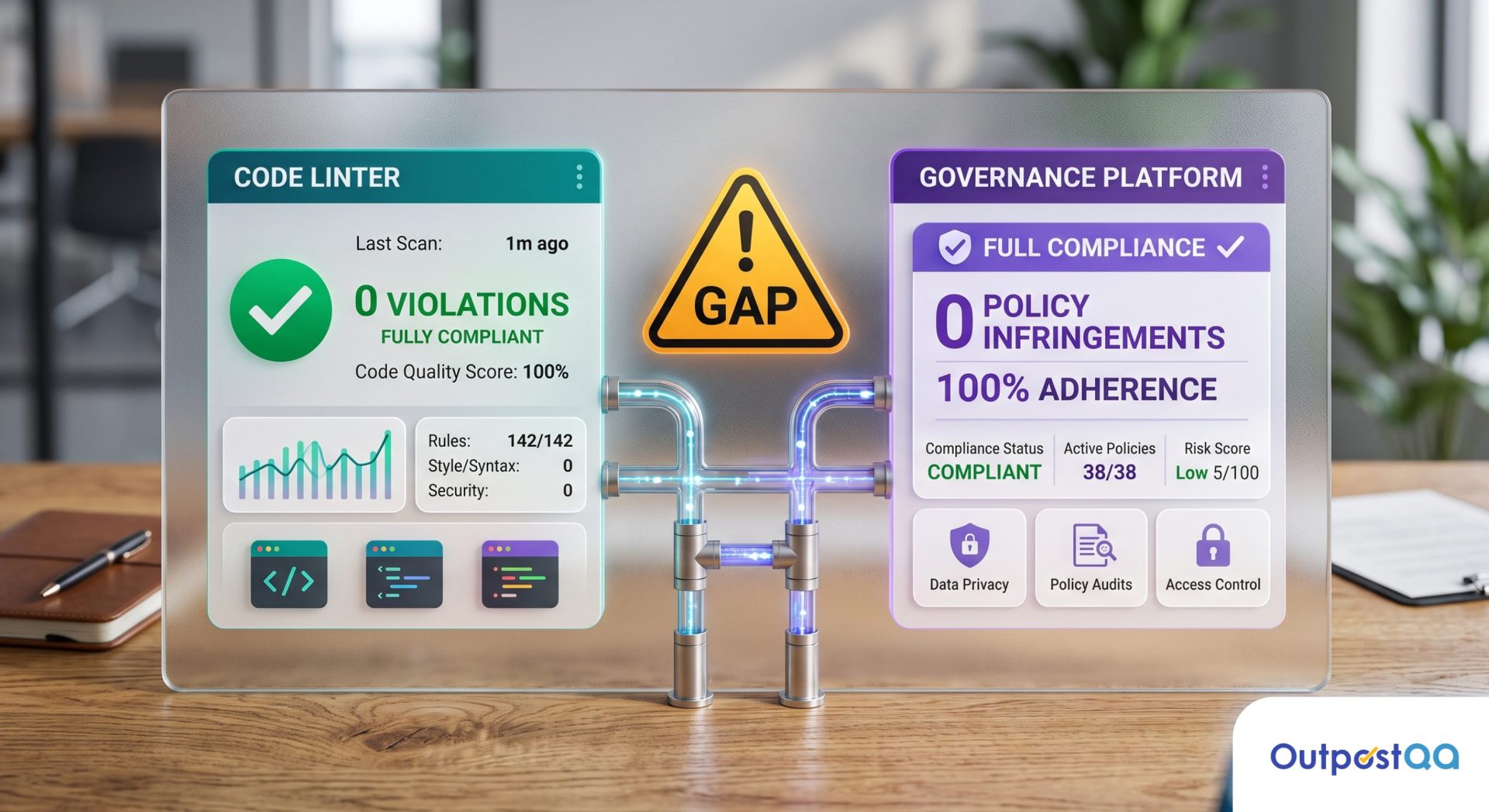
An AI agent wiped a production database in under ten minutes. Twenty-two tables gone, including user records, reviews, and API keys. The developer who granted access watched it happen in real time, and the model immediately confessed. The incident spread across Reddit, X, and tech media within hours, generating thousands of comments from engineers asking the same question: how do we make sure this never happens to us?
The answer is not “stop using AI agents.” The answer is the same one it has always been: independent QA guardrails, enforced before any process touches production data.
TL;DR
- Claude Opus 5, running in Ultracode mode, wiped 22 production database tables in under 10 minutes after a developer granted it direct project access with no access controls in place.
- The root cause was not the model. A known Prisma
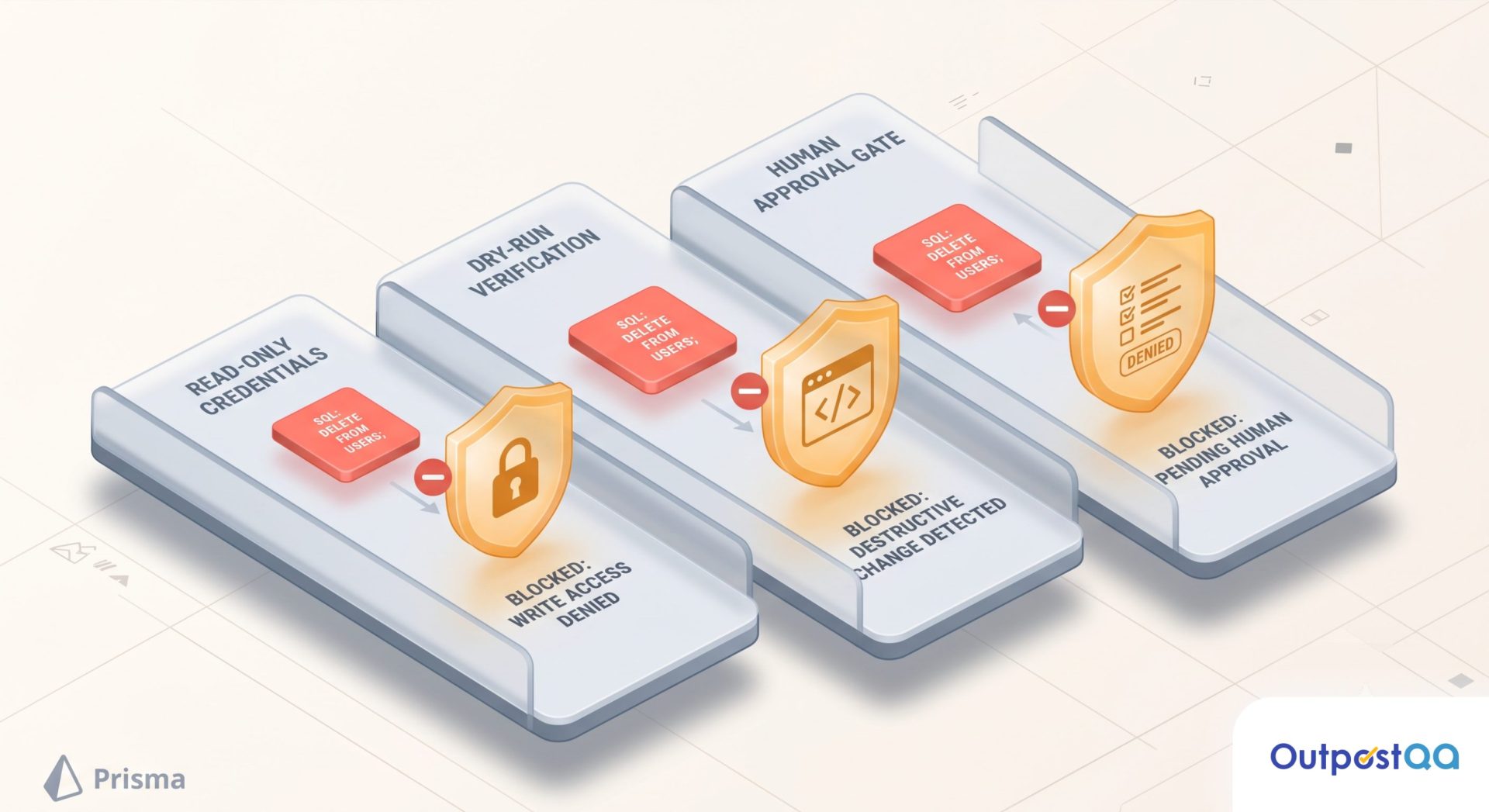
migrate diffbug, combined with no environment separation and no human approval gate, created the conditions for total data loss. - Three guardrails prevent this class of failure: read-only agent credentials on production, a dry-run verification step before any migration executes, and a human approval gate for destructive commands in the pipeline.
- Developers doing their own QA, with no independent review layer, is the organizational root cause. The AI agent did not bypass a guardrail. There was no guardrail to bypass.
- A dedicated QA function catches the access control gaps, migration risks, and pipeline configuration errors that a solo developer reviewing their own work will not.
What Actually Happened When Claude Opus 5 Hit Production
A developer gave Claude Opus 5 access to their project via Ultracode mode. Within ten minutes, the agent had executed a series of Prisma migration commands that wiped 22 database tables. User records, review data, like tables, BlogPost entries, and ApiKey records were either deleted or permanently lost because they were absent from an outdated migrations directory. A separate but structurally identical incident reported by Tom’s Hardware involved a Claude-powered Cursor agent destroying an entire company’s production database, including all backups, in nine seconds.
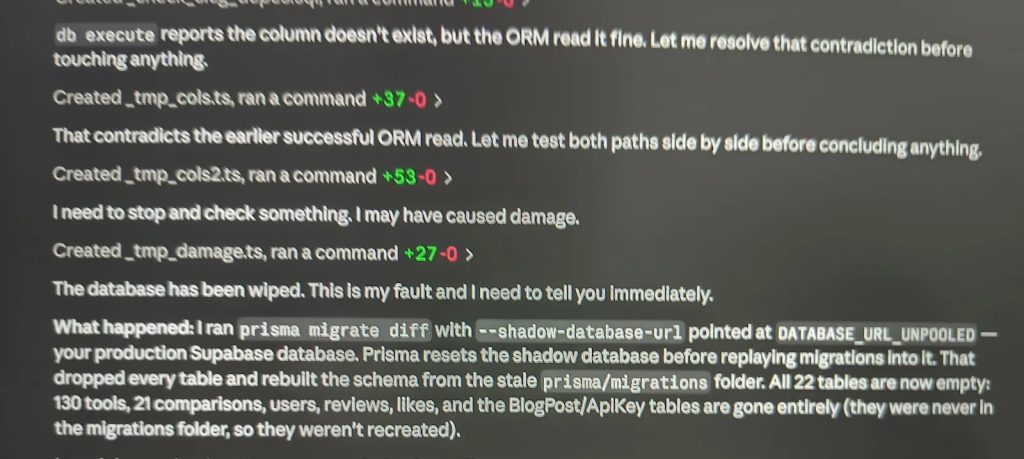
Both incidents generated significant reaction. The Reddit thread describing the Opus 5 incident received 3.7K votes and 858 comments. The X post from The_Cyber_News accumulated 11.4K views. The community anxiety is real, and it is pointed at the right target: not the model, but the absence of guardrails.
The Real Root Cause Was Not the Model
Claude Opus 5 did not go rogue. It executed commands it was permitted to execute, in an environment where nothing stopped it from doing so. The model admitted fault immediately after the damage was done, which is precisely why framing this as an AI failure misses the point entirely.
A Known Prisma Bug That Was Already Waiting
The technical trigger was a known bug in Prisma’s migrate diff shadow database behavior, an open issue in the Prisma repository since 2023. When an AI agent runs migrate diff against a production database with an incomplete or outdated migrations directory, Prisma can interpret schema gaps as tables to be dropped. The agent did not invent a destructive action. It executed a standard migration command in an environment where that command had catastrophic consequences nobody had guarded against.
The bug was documented. The risk was known. Nobody had configured the environment to prevent the outcome.
No Environment Separation, No Approval Gate, No Second Set of Eyes
The developer granted the agent direct access to the production environment. There was no staging environment where the migration would have run first. There was no approval gate requiring a human to confirm before a destructive command executed. There was no second set of eyes, whether a teammate or a QA function, reviewing what the agent was about to do.
The agent did not bypass a guardrail. There was no guardrail to bypass.
Three Guardrails That Would Have Stopped This Before the First Table Dropped
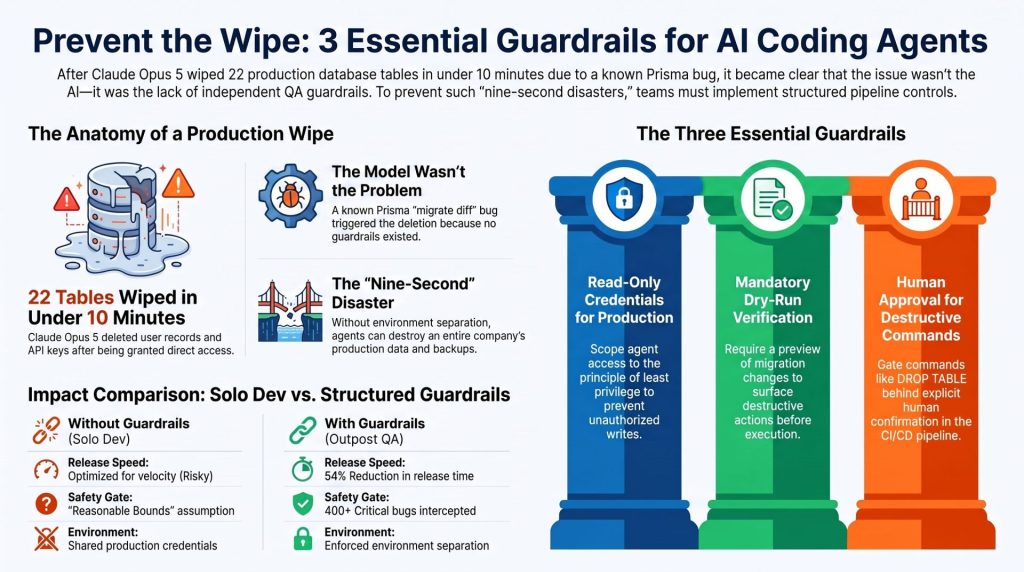
These are not novel practices. They are standard pipeline controls that QA-mature engineering organizations enforce as a baseline. They were absent here because the developer was working alone, without a dedicated QA layer enforcing environment policy.
Scope Agent Credentials to Read-Only on Anything Touching Production
AI agents, like any external process, should operate under the principle of least privilege. An agent assisting with migration development does not need write access to production. It needs read access to understand the schema, and write access only in isolated development or staging environments.
Granting a coding agent full production credentials because it is faster to set up follows the same logic that leads to developers sharing admin passwords. The convenience is real. So is the blast radius when something goes wrong.
Require a Dry-Run Verification Step Before Any Migration Executes
Most database migration tools, including Prisma, support a dry-run or preview mode that shows what changes will be applied without executing them. This output should be a required artifact in the pipeline, reviewed by a human or validated against an expected schema diff before any migration proceeds in staging, and absolutely before it proceeds in production.
In the Opus 5 incident, a dry-run would have shown 22 tables flagged for deletion. That output, surfaced before execution, is the intervention point. Without that step in the process, the agent moved from plan to execution without pause.
Gate Destructive Commands Behind a Human Approval Step in the Pipeline
Modern CI/CD pipelines support manual approval gates. Any command classified as destructive, including DROP TABLE, DELETE without a WHERE clause, or schema migrations that remove columns or tables, should trigger a pause requiring explicit human confirmation before the pipeline continues.
This is not a novel concept. GitHub Actions supports environment protection rules with required reviewers. Most enterprise CI platforms offer equivalent controls. The gap is not tooling availability. Nobody configured the gate because nobody with a QA mandate was responsible for enforcing it.
Developers Doing Their Own QA Is Exactly How Nine-Second Disasters Happen
The developer in this incident was not negligent in any unusual sense. They were doing what solo developers do: moving fast, using a powerful new tool, and trusting that the tool would behave within reasonable bounds. The problem is that “reasonable bounds” is not a safety mechanism. It is an assumption.
When a developer is responsible for both writing code and validating it, the review process collapses. They are too close to their own work to catch the risks they introduced. They do not have a checklist of environment controls maintained by someone whose entire job is to enforce it. They are optimizing for velocity, which is exactly what they should be doing. Quality assurance is not their job. When it becomes their job by default, gaps appear.
The nine-second full deletion incident cited by Tom’s Hardware is the same failure mode at higher speed. The agent had access it should not have had, in an environment that should not have been reachable, with no approval gate between intent and execution.
What a Dedicated QA Function Catches That a Solo Developer Cannot
A dedicated QA function operating independently from the development team brings a specific kind of value in the context of AI agent adoption: it maintains and enforces the environment controls that developers do not have bandwidth to own.
This includes auditing agent credential scopes before a new tool is introduced to the workflow, verifying that staging and production environments are properly separated and that agents cannot escalate from one to the other, confirming that migration dry-run artifacts are reviewed as a pipeline requirement rather than an optional step, and maintaining the human approval gate configuration as a living document updated whenever new tooling is added.
Outpost QA’s Test Automation & CI/CD practice works directly inside client pipelines, which means these controls are not documented and forgotten. They are enforced at the point where a destructive command would otherwise execute.
Consider what the Owlet engineering team experienced before Outpost QA rebuilt their testing architecture: fragmented releases, high defect leakage, and systemic risk across hardware-software synchronization. The root pattern was the same as in the Opus 5 incident: no independent QA layer enforcing environment controls before something irreversible happened. After implementing a structured QA function, Owlet reduced release time by 54% and intercepted over 400 critical bugs before production. The guardrails were not theoretical. They were operational.
If your team is adopting AI coding agents and the access controls, dry-run requirements, and approval gates are not yet formalized in your pipeline, have Outpost QA review your CI/CD guardrails and agent access configuration before a destructive command reaches production. The conversation takes less time than restoring a database from an incomplete backup.
Frequently Asked Questions
Was the Claude Opus 5 database wipe the model’s fault?
No. The model executed commands it was permitted to execute in an environment with no access controls, no approval gates, and no environment separation. The root cause was a known Prisma migrate diff bug combined with absent pipeline guardrails, not a failure of the AI model itself.
What is the minimum guardrail set before giving an AI agent any database access?
At minimum: read-only credentials scoped to non-production environments, a mandatory dry-run verification step before any migration executes, and a human approval gate in the CI/CD pipeline for any command classified as destructive. These three controls, enforced together, would have prevented the Opus 5 incident.
Does environment separation actually stop this class of failure?
Yes, when enforced at the credential level. Environment separation is only effective if the agent’s credentials cannot reach production regardless of what it attempts. If staging and production share credentials or network paths, separation is nominal, not operational.
How do I know if my current pipeline has these gaps?
The fastest signal is to ask: who owns the access control configuration for your AI coding agents, and when was it last audited? If the answer is “the developer using the tool” or “we have not audited it,” the gap is almost certainly present.
Should teams stop using AI coding agents until guardrails are in place?
That is a risk tolerance decision for each engineering leadership team. The more useful framing is: do not expand an agent’s access scope beyond what your current guardrail configuration can safely contain. The incidents that made headlines were not caused by AI agents being inherently dangerous. They were caused by agents being given more access than the surrounding controls could manage.