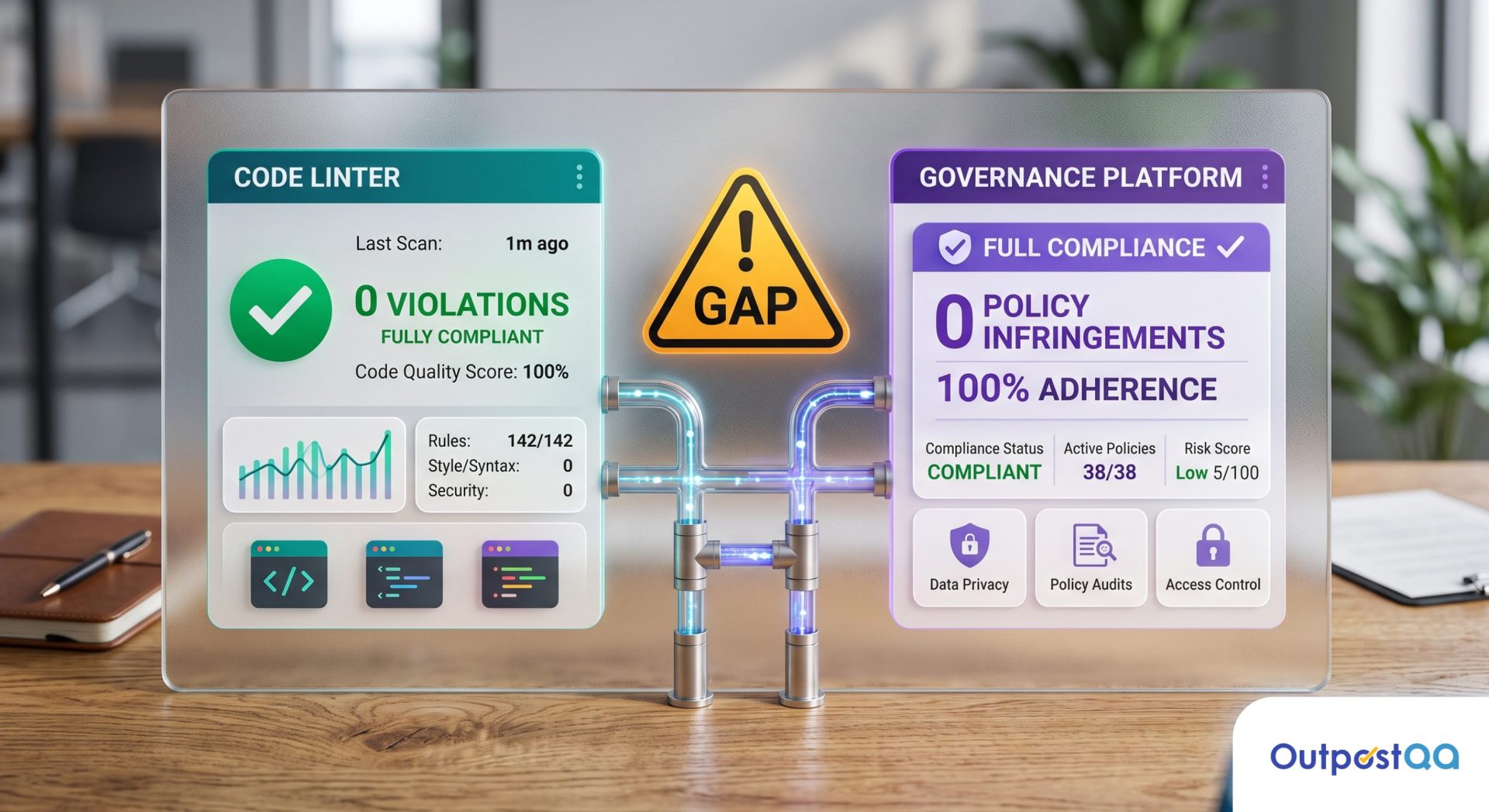
Your linters are green. Your governance policies show zero violations. And somehow, a critical bug still reached production last Tuesday. If that scenario feels familiar, the problem is not your tooling configuration. The problem is that linters and governance platforms were never designed to catch what broke.
TL;DR
- Linters cover syntax, style, and simple anti-patterns at the file level. They do not validate behavior.
- Governance platforms enforce organizational policies and AI-generated code standards. They do not test functional correctness.
- Zone 3, the gap neither tool touches, includes integration failures, UX regressions, accessibility violations, and application-layer security issues.
- Governed, linted code still ships bugs because static analysis cannot simulate how a system behaves under real conditions.
- A dedicated QA function absorbs the Zone 3 responsibility that tooling cannot, without pulling developers off their primary work.
The Coverage Triangle: Three Zones, Two Tools, One Gap
The debate over linters vs governance platforms tends to treat them as competing solutions to the same problem. They are not. They address adjacent problems in different layers of the development lifecycle. Understanding where each one stops is more useful than debating which one to prioritize.
Zone 1: What Linters Cover
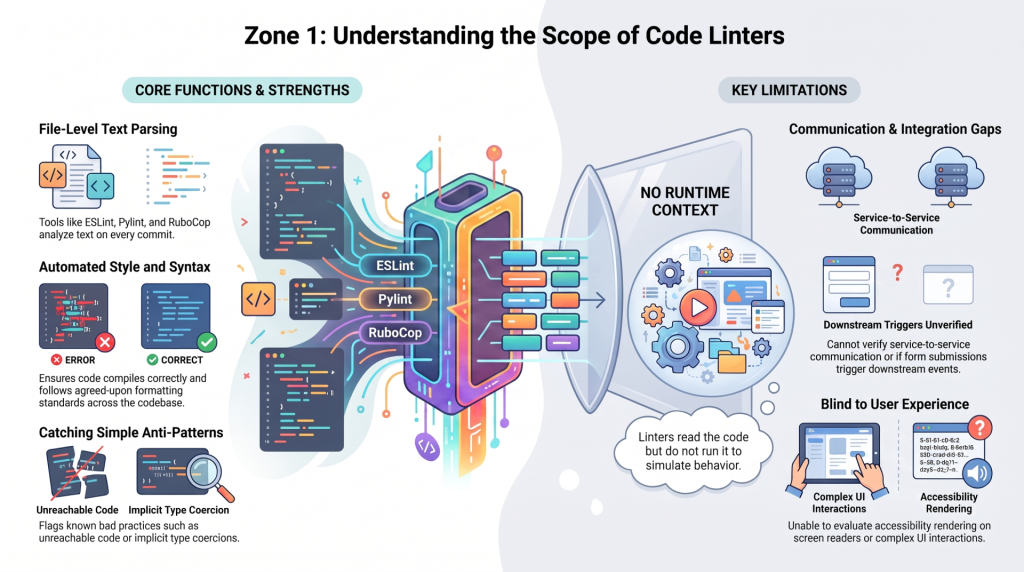
Linters operate at the file level. They parse code as text and apply rules: formatting conventions, syntax errors, known anti-patterns, unused variables, and style violations. Tools like ESLint, Pylint, and RuboCop are fast, automatable, and cheap to run on every commit.
What they cover well:
- Syntax correctness: Code that will fail to compile or parse.
- Style consistency: Enforcing agreed-upon formatting standards across a codebase.
- Simple anti-patterns: Flagging known bad practices like unreachable code or implicit type coercions.
What they cannot cover: anything that requires runtime context. A linter cannot tell you whether two services communicate correctly, whether a form submission triggers the right downstream event, or whether a page renders accessibly on a screen reader. It reads the code; it does not run it.
Zone 2: What Governance Platforms Cover
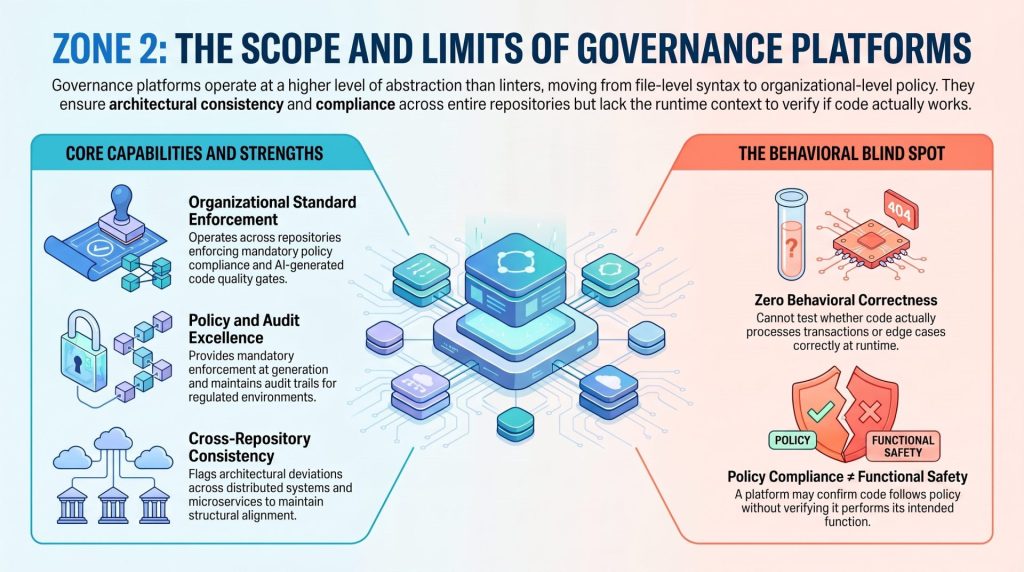
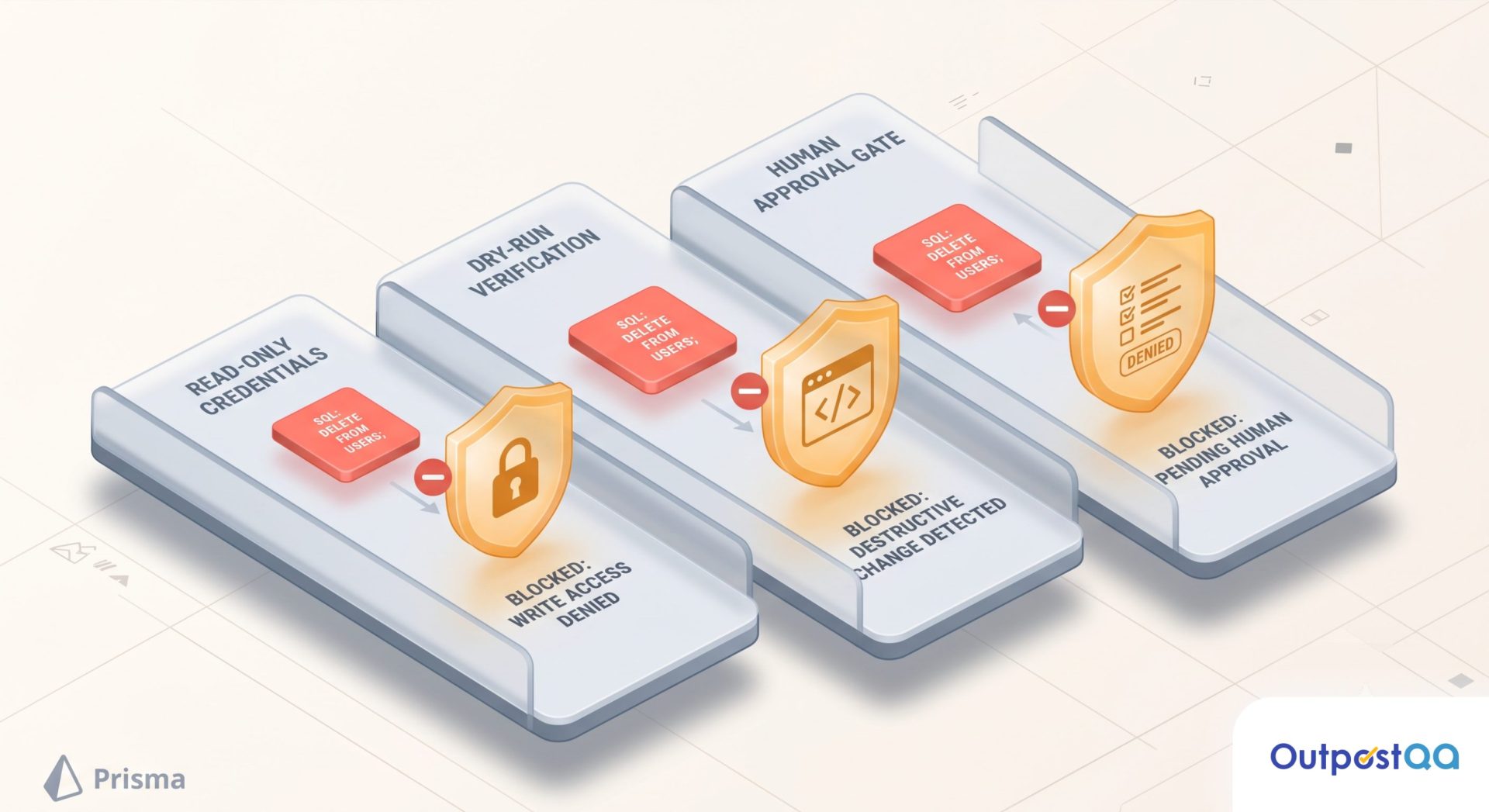
Governance platforms operate at a higher level of abstraction. Rather than checking individual files for style, they enforce organizational standards across repositories: audit trails, policy compliance, AI-generated code quality gates, and cross-repository architectural consistency.
In environments where developers are generating code with tools like GitHub Copilot or Cursor, governance platforms add the enforcement layer that advisory configuration files (.cursorrules, CLAUDE.md) cannot provide. They make policies mandatory rather than suggested.
What governance platforms cover well:
- Policy enforcement at the point of generation: Blocking non-compliant code before it enters the review queue.
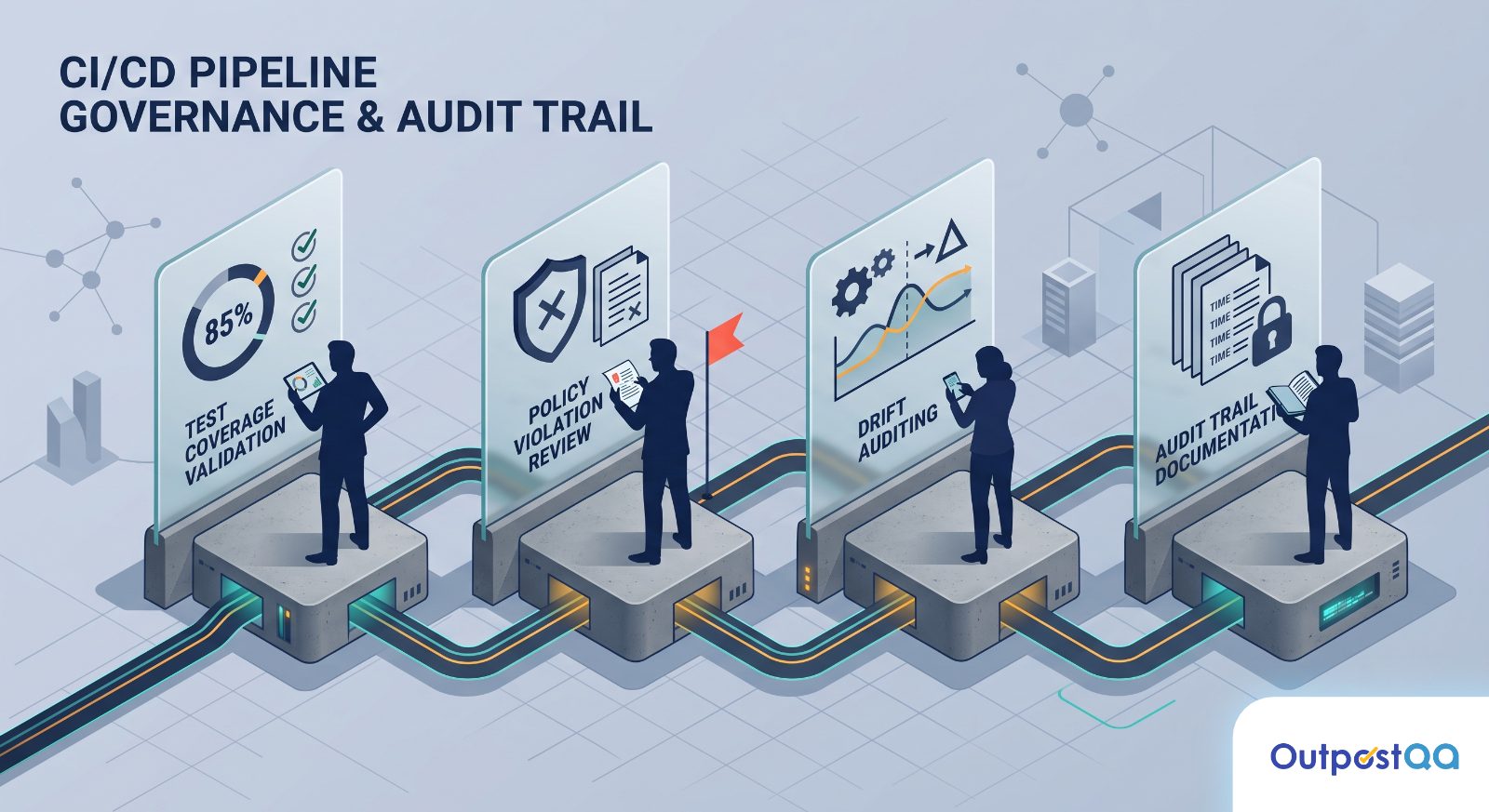
- Audit trails: Tracking what was generated, reviewed, and approved, which matters in regulated environments.
- Architectural consistency: Flagging deviations from approved patterns across distributed systems and microservices.
What they cannot cover: behavioral correctness. A governance platform can confirm that a payment handler was written according to organizational policy. It cannot confirm that the payment handler actually processes a transaction correctly under edge-case input.
Zone 3: What Neither Tool Touches
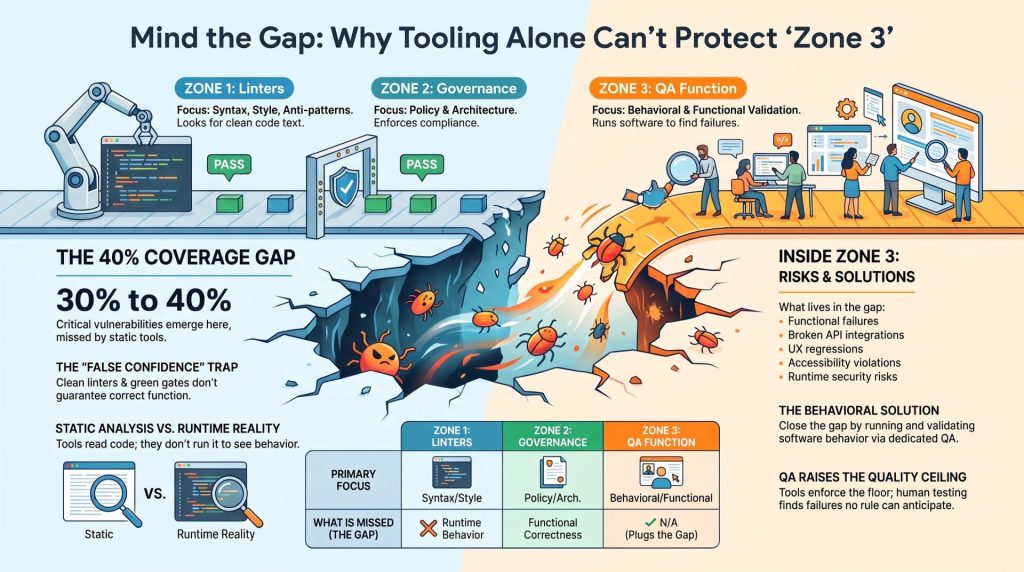
This is where production bugs live. According to analysis from Augment Code’s quality gate research, conventional static analysis detects only 60 to 70 percent of critical vulnerabilities, with the remaining 30 to 40 percent emerging after deployment. That gap is Zone 3.
Zone 3 includes:
- Functional correctness: Does the feature do what the specification requires under real conditions?
- Integration behavior: Do services, APIs, and third-party dependencies interact as expected?
- UX regressions: Has a code change broken a user flow that no linter rule monitors?
- Accessibility violations: Does the interface meet WCAG standards that static analysis tools do not evaluate?
- Application-layer security: Are there authentication bypass paths, injection vectors, or data exposure risks that emerge at runtime rather than at the syntax level?
- Performance degradation: Does the change introduce latency or memory issues that only appear under load?
No linter catches these. No governance platform prevents them. They require someone to run the software and validate what it actually does.
Governed Code Still Ships Bugs. Here Is Why.
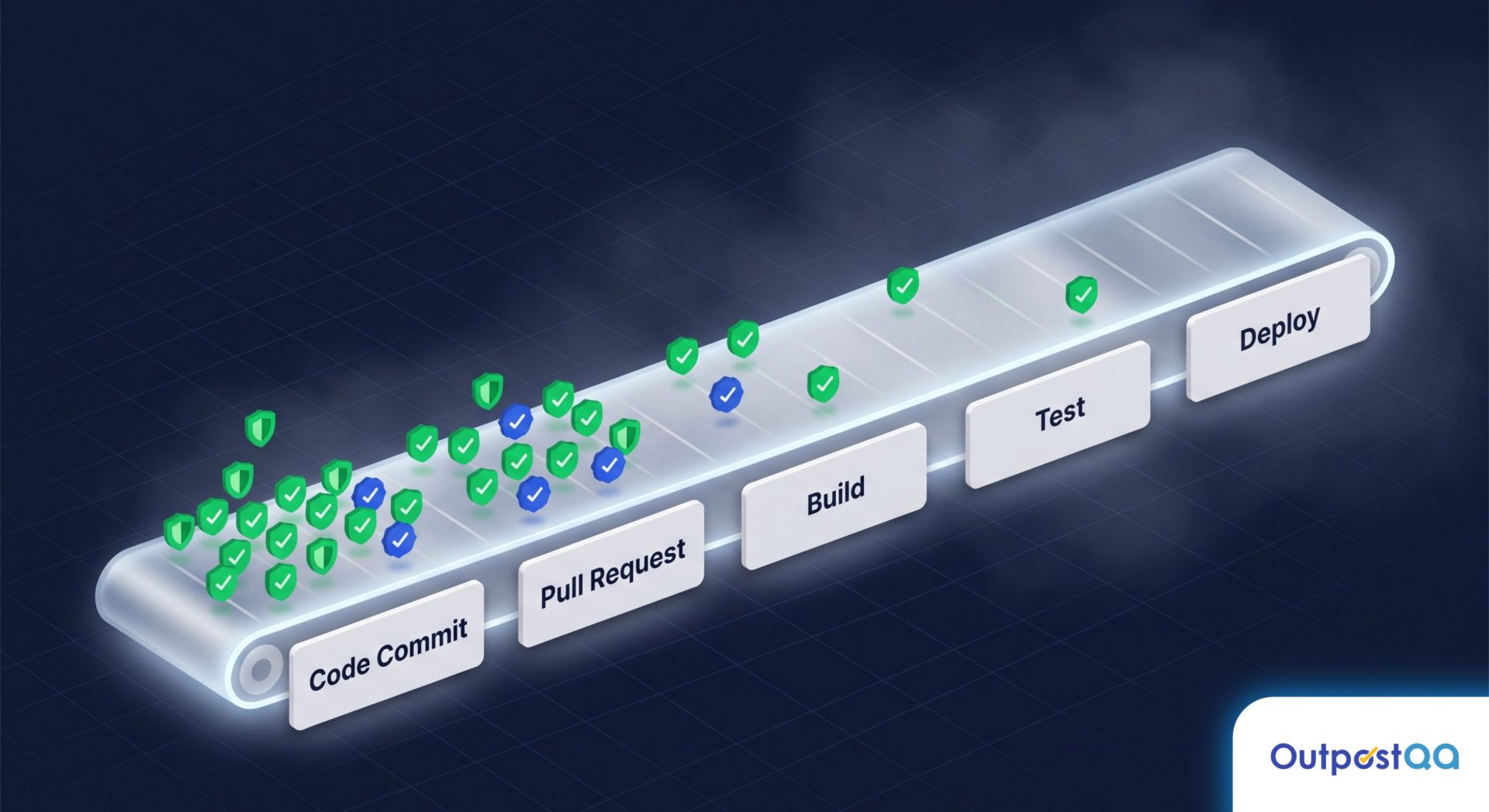
The false confidence problem is structural. When a CI pipeline shows all green across linting checks and governance gates, engineering teams naturally interpret that as a signal that the code is safe to ship. The tooling has done its job. What the tooling has actually confirmed is narrower: the code is syntactically clean, stylistically consistent, and policy-compliant.
None of those properties guarantee that the code behaves correctly in production.
Consider a team that has invested heavily in governance tooling. Every pull request passes automated policy checks. Architectural standards are enforced automatically. Developers move quickly because the friction of manual style reviews is gone. That investment is genuinely valuable. But it does not replace functional testing, integration testing, regression validation, or exploratory testing of new user flows.
Per the DORA State of DevOps Report, high-performing engineering teams do not just automate quality gates. They maintain a distinct quality function that operates alongside development rather than being absorbed into it. The tools enforce the floor. A dedicated QA function raises the ceiling.
Who Should Own Each Zone in Your Quality Stack?
Assigning ownership clearly is what prevents Zone 3 from becoming everyone’s problem and no one’s responsibility.
When Developers Triage Linter Noise, Velocity Drops
Linters generate false positives. Governance platforms flag edge cases that require human judgment. When developers are the ones triaging that noise, reviewing suppression justifications, and determining whether a flagged pattern is a real risk or a misconfigured rule, they are doing quality work instead of engineering work.
That is the dynamic behind Pain Point 1 that engineering leaders consistently encounter: developer velocity drops not because the tools are bad, but because owning the quality layer end-to-end is not what developers were hired to do. The cognitive overhead compounds across sprints.
Zone 1 ownership belongs with developers, supported by automated enforcement. Zone 2 ownership belongs with engineering leadership or a platform team setting and maintaining organizational standards. Zone 3 ownership requires a dedicated QA function.
What a Dedicated QA Function Absorbs That Tooling Cannot
A dedicated QA team does not replace linters or governance platforms. It picks up where they stop.
Concretely, that means:
- Functional test coverage: Writing and maintaining test cases that validate behavior under realistic conditions, including edge cases that no static rule can anticipate.
- Integration validation: Confirming that services, APIs, and external dependencies work together after a release, not just that each component passes its own checks.
- Regression management: Maintaining a test suite that grows with the product and catches regressions that automated linting misses by design.
- Exploratory testing: Finding the failure modes that no one thought to write a rule for, which is consistently where the highest-severity bugs hide.
When this work is owned by QA engineers rather than developers, developers ship faster. The quality layer does not disappear; it moves to people whose entire job is to own it.
How a Nearshore QA Pod Plugs Into an Existing Linting and Governance Setup
The practical question engineering leaders often skip is how a QA team integrates with tooling already in place. It is simpler than most teams assume.
A nearshore QA pod from Outpost QA consumes the artifacts that linters and governance platforms produce. Linter reports surface the files under active change, which informs where regression risk is highest. Governance violation logs flag the components that deviated from policy and may warrant closer functional scrutiny. CI pipeline status signals when a build is ready for QA handoff.
What the QA team adds to that pipeline:
- Automated functional test suites triggered after governance checks pass, not instead of them.
- Exploratory testing cycles focused on new features and recently modified components.
- Integration test runs that validate end-to-end user flows rather than individual files.
- Defect reports that close the feedback loop back into the development cycle before a release goes to production.
Because the Outpost QA team operates in the same timezone as US-based engineering teams, the async lag that undermines offshore QA setups does not apply. When a governance check flags something unexpected at 2 PM, a QA engineer can respond that same afternoon rather than the next morning.
The Flex fintech case study shows the model directly: a team with automation in place but no capacity for functional validation brought Outpost QA in to cover Zone 3. The result was 600 high-priority defects intercepted before production across 50 consecutive clean weekly releases.
If you want to know exactly where your current quality stack stops, Outpost QA offers a QA process audit that maps your existing linting and governance setup against the coverage triangle and identifies what is falling through Zone 3. Start the conversation with a QA Architect here.
Frequently Asked Questions
Do linters and governance platforms overlap at all?
They share some surface territory around code standards and policy enforcement, but they operate at different levels. Linters work file-by-file at the syntax layer. Governance platforms work across repositories at the policy and architectural layer. Neither one duplicates the other’s core function, and neither one covers runtime behavior.
If my CI pipeline passes all checks, is my code production-safe?
Passing CI checks confirms that the code meets the rules those checks enforce. It does not confirm that the code behaves correctly under real conditions. Functional correctness, integration behavior, and performance under load require testing that runs the code, not just analyzes it.
When does a team actually need a governance platform versus just a linter?
Governance platforms become necessary when a team scales past the point where linter configurations alone can enforce consistency, or when AI-generated code is entering the codebase and needs policy enforcement at the point of generation rather than after the fact. Smaller teams with stable codebases often find that well-configured linters plus a strong code review culture cover their needs.
What types of bugs does Zone 3 most commonly produce?
The highest-severity production incidents tend to come from integration failures between services, edge-case handling in business logic, accessibility regressions introduced by UI changes, and security vulnerabilities that only appear at the application layer during runtime. These are the failure modes that static analysis, by design, cannot reach.
Can a QA team work effectively without access to linter and governance reports?
A QA team can function without them, but having access improves targeting. Linter reports show which components are under active change, which helps QA engineers prioritize regression testing. Governance logs surface architectural deviations worth functional scrutiny. The tools and the QA function work better together than either does alone.