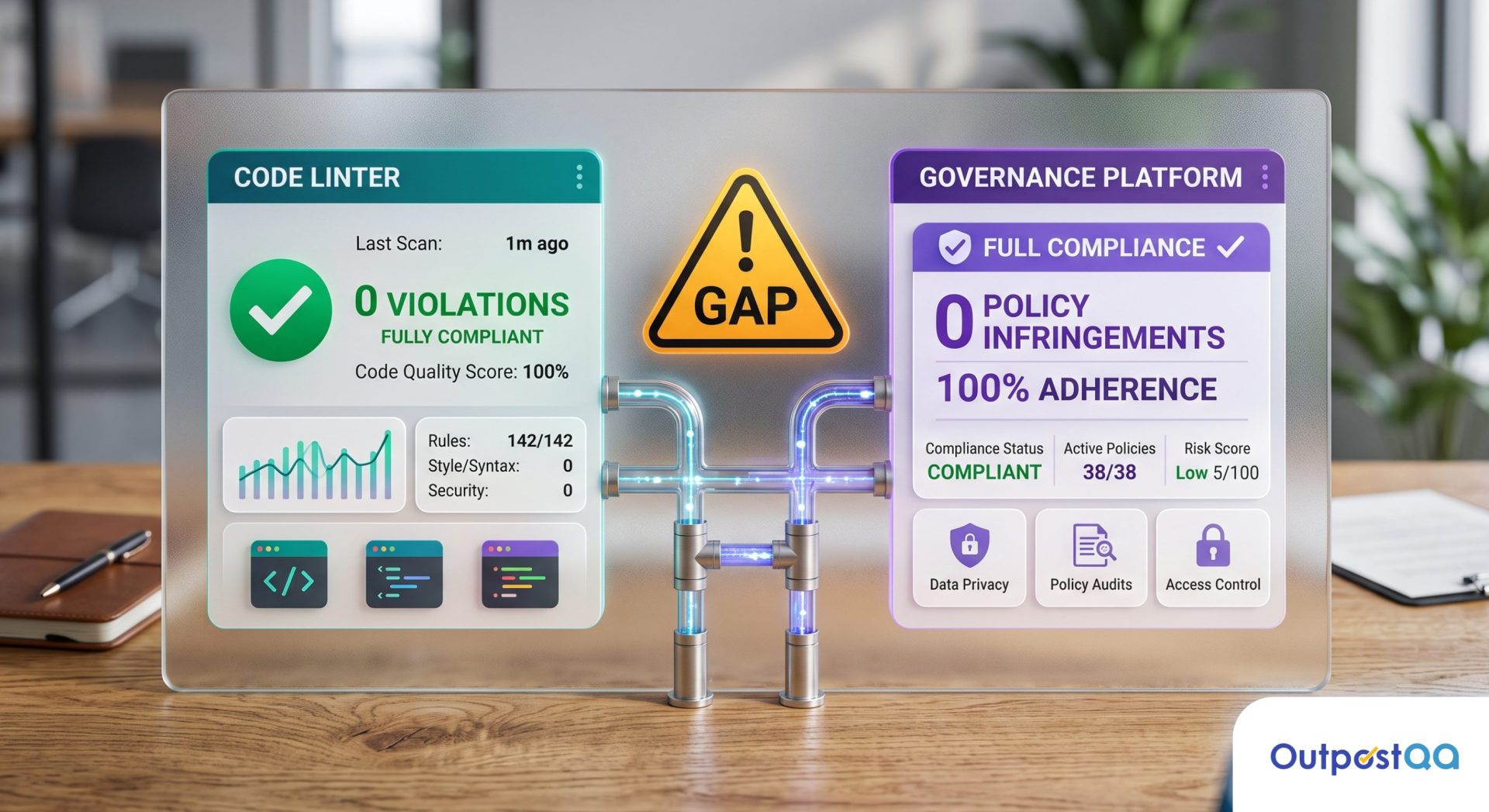
Three engineers are staring at a production incident. The service is throwing a null pointer exception in a payment processing module that shipped six weeks ago. Nobody in the room can explain why a particular conditional exists on line 847. The engineer who wrote it says, “I think the AI suggested that pattern and it looked right at the time.” That is not a debugging session. That is comprehension debt collecting interest.
TL;DR
- Comprehension debt is the gap between code that ships and code anyone on the team can reason about, and it compounds faster than technical debt.
- The symptoms are specific and observable: uninformed PR approvals, test suites that describe behavior nobody will defend, and post-mortems where nobody can account for why a line exists.
- “Move slower” and “document more” are the wrong fixes because they treat this as a process problem rather than a workflow-design problem.
- Four checkpoints that fast teams will actually use: explain-before-you-merge, architecture decision records as a forcing function, testing as a comprehension gate, and code archaeology before modifying any module older than one quarter.
- The worst-case scenario is not a bad deploy; it is a bad deploy six weeks after the person who vaguely understood the module has left.
The Incident That Nobody Could Explain
The post-mortem template asks for root cause. The honest answer, in a growing number of incidents, is: “we do not know why that code behaved that way, and we do not know why it was written that way.” Teams are shipping code faster than any individual can reason about it, and the downstream effect is not just slower debugging. It is a codebase where the question “why does this do that?” has no living answer.
That specific failure mode is what concerns me. Not that code is complex. Not that AI tools generate imperfect output. The feedback loop between writing code and understanding code has broken down at the team level, not just the individual level. Per the 2024 GitHub Octoverse Report, over 55% of developers are now using AI coding tools regularly. The speed gains are real. The comprehension accounting is not happening.
What Comprehension Debt Actually Looks Like in a Codebase
Comprehension debt is not the same as technical debt. Technical debt is code you know is suboptimal and have decided to tolerate. Comprehension debt is code nobody on the team can fully explain, defend, or predict. It is a distinct and more dangerous condition, and it has three observable signatures.
PR Reviews Where Nobody Can Say the Approval Was Informed
Watch the next ten PR approvals on your team. Count how many involve an AI-generated block that the reviewer approved because it “looked right.” The reviewer could not tell you what edge cases the implementation handles. They could not tell you what happens when the upstream service returns a 429. They approved it because it did not look obviously wrong, which is not the same as understanding it.
According to the DORA State of DevOps Report 2023, teams with high software delivery performance invest significantly in code review quality, not just review frequency. Approving code you cannot reason about is not a review. It is a rubber stamp with extra steps.
Test Suites That Describe Behavior Nobody Will Defend
A test suite written against a module nobody fully understands will describe the observed behavior of that module, not the intended behavior. Those are not the same thing. When the module has a bug, the test suite will often confirm the bug. The tests pass, the behavior is wrong, and the team has no way to tell the difference because nobody knows what “right” actually looks like for this code path.
This is the testability consequence that gets skipped in every hand-wringing article about AI-generated code. You cannot write a meaningful test for behavior you cannot specify. And you cannot specify behavior you do not understand.
The Second-Order Problem: Nobody on the Team Understands It
There is a meaningful difference between “I don’t understand this code” and “nobody on this team understands this code.” The first is a personal knowledge gap. The second is an organizational liability. When a module reaches the second condition, the team has lost the ability to modify it safely, test it meaningfully, or debug it systematically. Every change becomes a guess. Every incident becomes a mystery.
Staff and principal engineers are not immune to this. As abstractions stack, and as AI tooling substitutes reasoning steps rather than assisting them, even experienced engineers lose familiarity with platform internals at a pace that used to be reserved for legacy systems nobody wanted to touch.
Why ‘Move Slower’ and ‘Document More’ Are the Wrong Prescriptions
Both prescriptions fail for the same reason: they treat comprehension debt as a byproduct of speed rather than as a failure of workflow design.
Documentation written after the fact describes what code does, not why a particular decision was made, what alternatives were considered, or what boundary conditions the author was (or was not) reasoning about. If the author did not fully understand the code when they wrote it, the documentation will not reveal that gap. It will paper over it.
“Move slower” fails because it asks teams to absorb a velocity cost without giving them a mechanism for spending that cost on comprehension. Slower movement without a forcing function just means slower shipping. It does not guarantee deeper understanding.
Most workflows have no comprehension checkpoint at all. Speed is measured, reviewed, and rewarded. Understanding is assumed. The fix is to build moments into the workflow where comprehension is required, not just encouraged.
Four Comprehension Checkpoints Fast Teams Will Actually Use
None of these require a process overhaul. All of them create a moment where someone has to demonstrate understanding rather than just intention.
The Explain-Before-You-Merge Rule
Before a PR is approved, the author explains, in two to four sentences in the PR description, what problem this code solves, what approach it takes, and what could go wrong. Not a summary of what the code does, but a demonstration that the author understands the tradeoffs. If the author cannot write those sentences, the code is not ready to merge. This is not a documentation requirement; it is a comprehension gate.
Architecture Decision Records as a Forcing Function, Not a Formality
Architecture Decision Records (ADRs) work when they are written at the moment of decision, not reconstructed afterwards. The forcing function is writing the ADR before the implementation is complete: what are we deciding, what alternatives did we consider, what consequences are we accepting? A team that uses ADRs this way will catch AI-suggested patterns that nobody actually evaluated. The record does not need to be long. It needs to be honest.
Testing as the Comprehension Gate
Require that any new module ships with tests written by the author covering at least three non-trivial scenarios: a happy path, a failure mode, and a boundary condition. Not generated tests, not tests copied from an AI suggestion: tests the author wrote because they thought through the cases. If you cannot write those three tests, you do not understand the module well enough to ship it.
This is shift-left testing used as a comprehension tool, not just a coverage metric. Writing tests forces the specification problem: you have to decide what the correct behavior is before you can describe it in a test.
Code Archaeology Before Modifying Any Module Older Than One Quarter
Before any engineer modifies a module that has not been touched in more than three months, they spend twenty to thirty minutes in archaeology mode: read the git log, read the existing tests, read any ADRs, and write a one-paragraph summary of what this module does and why it exists. This surfaces comprehension gaps before they become production incidents. It also creates a record of what the team actually understood at the time of modification, which is invaluable in the post-mortem three weeks later.
When a Team Member Leaves Six Weeks After Shipping the Module Nobody Understood
This is the scenario teams consistently underestimate. A developer ships a module with AI assistance, moves fast, and two months later is at a different company. The module is running in production. Nobody else on the team has read it carefully. The original author understood it at maybe 70%, and that 70% is now gone.
This is comprehension debt converting into permanent knowledge loss. The module does not get refactored because nobody wants to touch something they do not understand. It gets wrapped in workarounds. The workarounds get tested. The tests describe the workarounds. Six months later, the module is load-bearing infrastructure that the team maintains by superstition.
The checkpoints above exist specifically to prevent this. If the explain-before-you-merge rule was followed, there is a written record of what the author understood. If tests were required, there is a behavioral specification that the next engineer can read. If an ADR was written, there is a decision log. None of these guarantee full comprehension. All of them raise the floor.
If your team has modules in production right now that nobody can fully explain, the question is not how to understand them retroactively. It is how to stop adding to the pile. If you want a second set of eyes on the test suite or pipeline covering those modules, the kind of review that asks “does this test suite actually constrain the behavior of this module, or does it just confirm it,” that is the conversation to start at Outpost QA.
Frequently Asked Questions
What is comprehension debt and how is it different from technical debt?
Technical debt is code you knowingly wrote in a suboptimal way and plan to revisit. Comprehension debt is code that nobody on the team can fully reason about, explain, or predict. Technical debt is a deliberate deferral. Comprehension debt is an unintentional knowledge gap, and it is more dangerous because the team may not know it exists.
How does AI-assisted coding make comprehension debt worse?
AI tools can generate syntactically correct, superficially plausible code faster than a developer can evaluate it. When engineers merge AI-suggested blocks without fully understanding the boundary conditions or failure modes, they ship behavior they cannot predict. The gap between writing speed and comprehension speed widens, and the codebase accumulates modules nobody can fully explain.
Can you write meaningful tests for code you do not understand?
You can write tests that confirm the observed behavior of code you do not understand. But confirming observed behavior is not the same as specifying correct behavior. If the code has a bug, your tests may encode the bug as the expected result. Meaningful tests require that the author knows what the code is supposed to do, which requires understanding it first.
What is the minimum viable comprehension checkpoint for a small team moving fast?
The explain-before-you-merge rule requires almost no overhead: the author writes two to four sentences in the PR description explaining what the code does, what tradeoffs it makes, and what could go wrong. If the author cannot write those sentences, the code is not ready. This one checkpoint surfaces most comprehension gaps before they reach production.
How do you handle modules already in production that nobody fully understands?
Start with code archaeology before any modification: read the git log, read the existing tests, and write a brief summary of what the module does and why. For critical modules, run a structured comprehension session with the team, using the existing tests as a starting point for what behavior has been specified. The goal is not to fully understand the module in one session but to raise the floor before the next change.